Squirrel!

Every year, we go to Portland, Oregon to visit my father and his wife.  Every year, we discover some new and fascinating part of Oregon that makes us think about living there.

For example, I thought hiking in Hawaii Volcanoes National Park was the kind of experience that nothing on the mainland could even suggest.  As it turns out, Oregon has Lava Lands National Park.  While you can’t creep out over still crackling hot lava that’s only a couple of weeks old, you certainly can experience walking through a vast stretch of nothing but cooled lava.  Who knew?

The entire area is amazing.  The Three Sisters mountains stand watching over the lava fields, a reminder of where the lava originated from.

But an interesting reality came home to me while we explored the area:  there is something about me that attracts mosquitoes and chipmunks.  To be honest, I discovered the mosquito thing many years ago when I realized that I averaged anywhere from 5 to 10 times as many mosquito bites as the people sitting around me at a campfire.  Anytime I need to feel attractive, I just take a walk in the evening while the mosquitos are buzzing.  But, it wasn’t until we were walking around lava lands that I realized chipmunks seem to follow me wherever I go–especially when I’m carrying a camera.

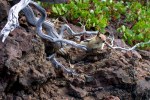
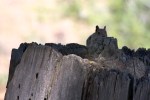
To be more accurate, these are golden-mantled ground squirrels, but they look like overgrown chipmunks to a mid-westerner.

I have nothing against chipmunks.  They are extremely cute.  I was slightly embarrassed when I tried to identify a bird I kept hearing for about two years until I finally saw a chipmunk making the mysterious chirping I could never identify.  But, I don’t hold it against the chipmunks.

I appreciate their willingness to pose for me when no other wildlife dares to appear.  I particularly enjoy the range of caution these little guys display.  Some seem to be out trying to attract attention while others appear to practice careful camouflage.

They all freeze when they see me swing my lens their way.  I wonder what they think?  I suspect what they think is something like, “I wonder if I sit real still and let that woman take pictures of me if she’ll eventually throw me something to eat?”

The lava fields make for an incredible playground for the ground squirrels.  They have an infinite number of crevices to jump into, tunnels to run through, and rocks to sun on.  If it weren’t for the predators, I imagine there would be a ground squirrel on every rock, every one of them hoping for a hand out.

As it is, they appear and disappear frequently enough to demonstrate that the static field of lava pulses with life.  The rhythm of their movements becomes the heartbeat of a place that might appear dead to the casual observer.  They remind me to stop and look closely.

Among the Clouds

In 2004, I talked my now-husband into going backpacking in Yosemite.  I carefully planned a 67-mile trek around the top of Yosemite Valley that I figured we’d be able to complete in 7 days.  Pat said no.  I re-planned, reducing our plan to 42 miles in 7 days  Pat was dubious, so I added “escape routes” so that if we decided to retreat to the valley and stay in a hotel, we could.

Pat had never backpacked before, but having been to Hawaii with me for 2 weeks a couple years earlier, he had learned what happened if he allowed me to set an itinerary without supervision.  At the end of our trip, I asked him if there was anything he wanted to do that we didn’t get to.  His answer was, “Well, it might have been nice to have one day to just hang out at the beach.”

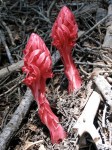
There are so many stories to tell from this trip to Yosemite, but I will stick to the ones associated with these few photos (taken with my old Powershot G3).  The red flowers are called snow plants.  Because they only grow in California and Nevada at very specific altitudes in conifer forests between May and July, I suppose it’s not a surprise I’d never seen one before.  But it was such a surprise, bursting out of the forest floor in the shadows as we made our way up to the top of El Capitan.

The rest of the photos were taken from Clouds Rest.  We had hiked all day to get to the top of Clouds Rest, the highest point visible from the valley.  Along the way, we saw many yellow-bellied marmots, a wide variety of squirrels and chipmunks, and one very curious mule deer buck who had walked up to us as if he wasn’t sure what we were.

We were also treated to increasingly amazing views of the Sierra Nevada mountains stretching endlessly beyond the horizon.  But, when at long last we made it to the top, we sat mute in a state of awe for a half an hour before we decided to hurry up and get camp setup and get ourselves ready for bed in time to sit and watch the sunset.

We found a spot to pitch the tent below the ridge, made our dinner following strict guidelines to avoid bear invasions, got our accommodations all arranged, and put on some extra warm clothes.  Then, we sat on the ridge and watched the light changing across the valley as the sun sank below the mountains and the mist rose in the valley.  We sat there for over an hour feeling like there was nothing more we needed to be satisfied in life than sitting on that ridge together watching the wonder of mountains.

While we had many inspiring moments on that trip, I think if that would have been the only place we hiked to, we still would have gone home satisfied.

Itching to Hike

Back when I was a Camp Fire Girl, I accepted a dare to roll in a patch of poison ivy. 24 hours later, I showed no reaction. Even three days later, there was nothing.
Fast forward about 15 years.

I was working in the garden at our first house, removing the crazy plants that had taken over in front of the house. I noticed about half way through that some of the vines I was attacking were poison ivy. I shrugged and thought, “Good thing I’ m not allergic.”

By the next day, I had a horrible itchy mess. A friend told me running hot water on it would help shorten the length of the reaction by stimulating the histamine response to happen faster (or something like that). I decided to try it. By the following morning, I had an enormous welt at least 5 inches in diameter and 2 inches high. It was oozing so much fluid, a stream was running down my arm.

Ever since, if I so much as see poison ivy (and perhaps more often, when I don’t) I end up breaking out. Thankfully, having learned a few things since then, not like that first time:
1) I watch out for it and avoid it as best as possible.
2) If I do come into contact, I wipe off with alcohol and wash thoroughly at the earliest possible moment.
3) I treat my clothes as hazardous and throw them into the wash in hot water immediately.
4) If I start to itch, I take an anti-histamine.
Above all, I do NOT run extremely hot water over the area!

As we picked our way along the Cumberland Trail last Sunday, all of these memories flooded into my head. The poison ivy grew so prolifically all along the trail, it was impossible to avoid contact. Even of I could have successfully cleared every leaf, vine, and stem, Tisen simply plowed right through it.

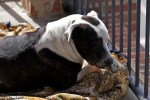
After all, Tisen doesn’t have to worry about being allergic to it. But dogs are great transferrers of poison ivy oils from plant to human. So, Tisen got treated like my toxic clothes and went straight into the tub when we got home. He was not very happy about his bath afterwards, as you can see from the last photos.

In spite of the poison ivy, the trail was beautiful. Because it was up high on a ridge, the wind blew through the trees almost constantly. The sound of wind blowing through trees always creates an inner stillness for me–even when I’m watching Tisen run through hundreds of poison ivy plants.
When a grove of older trees started creaking with an almost mechanical noise, I had to laugh–they sounded a lot like my knees.

After winding our way along the ridge listening to the woods being played by the wind like a strange instrument, we decided to head on back. After all, we had eight creaky knees reminding us not to overdo it.

Tennessee Hocking Hills

Hocking Hills is . . . An area? A collection of parks? A collection of hills? Perhaps all of the above. Whatever the name refers to, for me, it a part of growing up.

Something that my friends in Tennessee might not quite understand about growing up in Ohio is the experience of growing up where the land is flat. While Ohio has its river valleys, in Central Ohio, they tend to create long, slow slopes that are barely noticeable in a car.

The steeply angled streets of Chattanooga that climb, descend, and climb again seem as foreign to me as a river that flows North. When I was growing up, we had to drive somewhere to experience substantial hills and, more often than not, that somewhere was Hocking Hills.

Hocking Hills is about an hour or so South of Columbus. It marks the edge of a glacier that planed down the irregularities in the landscape to the North, leaving behind what was once plains and then forests and is now some of the flattest farmland around (except maybe for Kansas). But just beyond this geological boundary, the land rolls. The hills are high and cut deep by ancient rivers, leaving fascinating ravines with sandstone outcroppings and lush ferns.

It’s the kind of place that brings people from several states back over and over to experience in every season. In the spring and fall, it’s hard to find a parking place in any of the state parks if you get there after late morning. Flat landers rush to the hills in droves, seeking the experience of driving the winding roads as well as hiking the ravines.

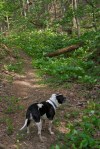
On Sunday, Pat and I took Tisen for what may have been his first hike in the woods ever. We went to a section of the Cumberland Trail and picked our way through incredibly large and voracious looking poison ivy plants.

As we entered the woods, the bright sunlight dimmed under the trees and we had to blink, waiting for our eyes to adjust.

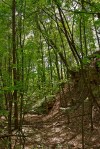
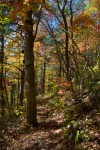
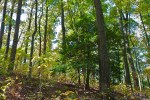
We started near the top of a large hill that would put Hocking Hills to shame and ascended several more times until we were walking along the very edge of the ridge line of the slope. As we worked our way along the ridge, the large outcroppings of stone protruding from the opposite side of the ridge immediately made me think of the kinds of formations we would see at Hocking Hills. It’s funny how you can hike to the top of a mountain and find only what you brought with you.

Tisen, having never seen Hocking Hills, cannot appreciate the similarity, but he appreciates being allowed to run ahead on the trail–something he could never be allowed to do in the crowds at Hocking Hills. Today, we are the only car parked at the trailhead and we neither see nor hear any other hikers on the trail. This solitude makes the walk that much more satisfying.

Mine Sweeping

We attempt to go for a walk this morning.  But it’s getting late by the time we leave so we are forced to do the short loop through the park.  We realize that someone new must have moved into the neighborhood because of the dog poop on the sidewalk.  There are three separate piles along the way.  Each one looks older than the last, like the piles are from three separate days.  I wonder if the new dog owner is French–they’re not allowed to pick up dog poop because it’s someone’s job.

Stopping short of doing forensics on the dog poop piles, we walk around cautiously, avoiding getting any on our shoes successfully.  Then, we are greeted by three women, each with a small dog.  We’ve met these women and their dogs before–these women pick up after their dogs.  The little dogs have fun racing around together, but they don’t stop for a pet.  Although one is willing to let you throw its ball.  Today, we let them go on by without attempting to pet them.

Convinced that there is no dog poop to step around in sight, my eyes go to the sky.  I am hoping to see the Red-Shouldered Hawks who hunt in the park, but instead, I spot a flock of much smaller birds hanging out in the tree tops where they are back lit and there is no hope of getting a good look at them.  From their size and shape, I would guess they were a group of Cedar Waxwings, but who knows.  The call of the White-Throated Sparrow catches my attention.  I point it out to Pat, but he doesn’t know what I’m talking about, having failed to notice a bird was singing.  I realize he is probably thinking about our dogs, long gone, and missing them.

I try to imagine having a dog again.  I feel certain that some day, a dog will walk into our lives and stick.  But, for now, we are dogless and content to remain so for a while.  In the meantime, we console ourselves by petting other people’s dogs.

We return home and I work.  Our walk seems to have been symbolic of what I will face during my work day–I seem to spend most of my day trying to avoid land mines.

At the end of the day, it’s getting late and we have nothing to eat in the house.  It’s been raining since mid-morning, but it’s not that cold.  We decide to walk over to the Japanese restaurant by Coolidge park.  I pull on a rain jacket with a hood and find an umbrella.  We make our way carefully, leaping over deep puddles that have formed, dodging the splash from cars, and peeking from under our hoods before crossing the street.  I can’t help but feel my entire day has been about avoiding traps and obstacles.

When we get to the Japanese place, we discover it’s not open on Mondays.

We head for the Italian place at the end of the street.  It’s the restaurant furthest from our place on this strip, which means another block of dodging puddles.  But, we are happy to learn that tonight there is a special.  Fat Tire for $2.50 a pint and 20% off all pizzas.  We decide to give their pizza a try.  At the end of our meal, we discover that we’ve just eaten the cheapest meal we’ve ever had in Chattanooga.  Since the Japanese place tends to be the most expensive, we’re happy that they were closed today.

Now that we are warm and full, it’s time to go back out into the rain.  I pull on my raincoat and steel myself mentally.  We rush through the darkness, holding the umbrella so that it partially covers both of us. When Pat tips the umbrella, the water runs off onto my shoulder and into my purse.  I straighten the umbrella in his hands several times before I finally take over holding it.

We run across the streets, black silhouettes against headlights.  I realize we should have worn something with reflective strips on it.  Instead of avoiding mines, now we are dodging bullets.  When we make it back to our building, a man with a backpack is sitting on the steps up to the entry.  The steps are sheltered.  We assume he is homeless and trying to get out of the rain.  We greet him and continue on by, entering the security code to get into the building and making sure no one follows us in.

We walk into our place dripping with rain.  I strip off my rain jacket and find a spot to set the umbrella so it can dry.  After shaking away the wet, I get myself ready for bed.  I feel as if I survived some sort of test today.  Walking in the rain, especially after dark, always feels like an adventure.  I wish the end of my work day gave me the same rush that walking in the rain does.

Sassafras Falls

It’s our third day in the Smokies for the long holiday.  We take the same approach that we took yesterday–wake up slowly, lay around until hunger kicks in, throw something on and go to breakfast.  Then, we return to our room to choose today’s hike.  It’s a little cooler today and overcast.  Visibility is supposed to be poor.  The weather calls for clouds, but no rain.  We get out the guide in our room and I ask Pat if he’s up for a 9 mile hike.  There is a trail to a waterfalls nearby that’s supposed to be a nice easy walk. Neither one of us is up for a big physical challenge this weekend, still recovering from pulled muscles on the hang gliding training hills.

Much of the drive is alongside a stream that rolls and tumbles over rocks, creating white water.  There is trout fishing in this stream, a good sign that the water is clean.  I am too busy watching the scenery to be a lot of help navigating, but I interrupt gazing out the side window long enough to check the directions when Pat gets confused about a turn.  We manage to make it back to the trailhead with only one wrong turn.

We start up the trail as a light rain blows in, misting my face gently as we walk into the wind.  The trail used to be a railroad track, but was converted to a trail long before “rails-to-trails” meant bike trails.  As we start out, the climb is gradual, the trail is wide and flat, and we have no troubles finding our way.  We take our time.  We have 6 hours of daylight and emergency flashlights in our day packs.  If we need 6 hours to go 9 miles, we can take 6 hours.

After a short distance, we enter what feels like a maze of Rhododendron.  The enormous shrubs on either side of the trail loom large, daring us to go off the path.  Pat and I both have flashbacks to our first backpacking trip together at Otter Creek Wilderness in Monongahela National Forest in West Virginia.  It was early in the spring–so early, it snowed our first night.  When it wasn’t snowing it was raining.  When we started out, the trail looked more like a stream than a trail.  Unfortunately, it rained so hard that after a while, there were hundreds of mini-streams all around us and we couldn’t tell which one was the trail.  We ended up bushwacking our way through giant Rhododendrons.  Each shrub was like a giant octopus, its twisting arms grabbing hold of our backpacks as we tried to belly crawl underneath.  I had visions of us being found weeks later, captured in the arms of giant greenery, suspended above the ground and frozen in postures of horror.  I’ve never felt quite the same about Rhododenrons ever since.

Thankfully, today they remain on the side of the trail, clearly demarcating where we are and are not supposed to be.  As a side benefit, because they keep their giant waxy leaves, they provide good hiding places when nature calls.  That doesn’t make me feel significantly better about them, however.

After about 3 miles of enjoying the view of the stream through the Rhododendrons, which has gotten steadily further below us, we arrive at a stream crossing in front of us.  We contemplate the best place to cross.  The water is high and moving fast.  These are dangerous circumstances for a water crossing; we want to find a safe route to ensure we don’t end up washed downstream.

I pick a route and make my way across.  In my hiking boots, I’m nervous about sticking to the wet rocks covered in moss.  It’s easy to lose footing and get caught in the current.  I make it OK with only one scary moment when I teeter on a rock waving my arms until I leap for the next rock and manage to land with firm footing.  Pat follows the route I took, probably figuring that if I can make it safely across, anyone can.

As we finish up our crossing, two dogs suddenly appear on the side of the creek we just left.  They are followed shortly by a family with a young daughter and teenage son.  They shout across the stream to us asking if this is the way to the falls, wanting to make sure they really needed to cross the stream before they decide whether or not to risk it.  As they contemplate, one of their dogs jumps in and is soon headed downstream in the rapids.  I run along the stream until I find a place that has an opening in the trees with an easy launch in and out of the water.  The dog hears me calling him and is able to swim over to the shore, climbing out and shaking every drop of water in his fur onto me.  My face and pants are dripping wet, but the dog is safe.  He runs back to his family who is now starting to cross.  As Pat and I walk away, we see the dog poised on the bank, about to jump back into the water and the family calling to him frantically to keep him from heading downstream a second time.  I imagine him thinking body surfing is great fun.

The next part of the trail gets steeper, narrower, rockier, and more overgrown.  We spot a faded sign after about 500 yards and make the turn to Sassafras Falls.  It’s supposed to go to the bottom of the falls, so we are surprised that it climbs even more sharply.

Now, the trail is on the edge of a drop off.  I do not have such a good track record when it comes to walking alongside cliffs.  Pat warns me that he’s not going to be able to catch me today (having grabbed me by the back of the pants in time to prevent me from falling to my death on more than one occasion).  Fortunately, this is not really a cliff and, when I look at it, if I were to fall, I would probably break a bone at worst.  Having broken quite a few bones and healed eventually, this thought is oddly reassuring.  Not worrying about falling helps me stay on the trail and I avoid any incidents.

We make it to the falls and spend some time looking at the water crashing over the rocks with surprising force for a relatively small mountain stream.  It’s a beautiful falls, although I’d like to be able to back off from it so I can take in as a whole a little better.  We are so on top of it that I almost feel like I need the glasses I wear when I’m at the computer to fully appreciate it.

After I attempt to get some shots, we find a nice grouping of rocks to sit on and eat our lunch.  The rocks are moss covered, which makes them padded if slightly damp.  We sit facing the falls, enjoying our private table as we unwrap our sandwiches provided by the lodge.

We move at a much faster pace on the way back with most of the trail being downhill.  We do lose time trying to find a different place to cross the stream than the way we came over.  Our first route looks much more difficult from this direction.  It’s hard to explain how that happens–maybe it’s just an optical illusion–or maybe it a matter of stepping up vs stepping down depending on which direction you’re going.  In any case, we revisit our buschwacking-through-rhododendrons skills as we make our way along the stream, looking for a safe crossing point.

Pat finds a fallen tree and decides we should cross there.  I follow after he makes it safely, but have trouble not worrying about the camera around my neck.  If I fall in here, it’s deep and it won’t just be my feet that get wet.  I end up sitting on the log about halfway across and scooting forward until there is a branch sticking up that I can hold onto for balance.

We make it across the stream, back to the car, and even back to the lodge safely.  When we get out of the car, I stand and wait while Pat gathers some additional gear that he needs to bring into the hotel.  As I stand there, I hear the loud call of the Pileated Woodpecker.  My camera is around my neck still, although I have only my wide-angle lens with me, having opted to leave my other choices back in our room.  I spot the bird on a tree not too far away.  I decide to try to sneak up on him in the hope of getting a decent shot.  I do manage to sneak up closer, but not close enough to get a good shot before I make him too nervous and he flies away.  The brilliant red crest on his head practically looks neon in the light of dusk.

When the woodpeck flies away, he makes a giant arch around the parking lot and then flies over a deck where another guest is sitting.  We walk over and ask if she saw where he landed.  It turned out she never saw the bird that flew right over her and directly into her line of sight.  Given the size of a Pileated woodpecker, we are both (silently) amazed that someone could miss something like that.  She, however, seems nonplussed.  It makes me wonder how many birds have flown over my head that I never saw.

The sun setting behind the mountains tells us it’s time to go inside, clean up, and go to dinner.  We head on in, although we are in no hurry.  We have all evening.

Sunny Black Friday

It’s the day after Thanksgiving.  For some people, going to the malls before dawn and waiting in lines is the best way to spend this day.  Our agenda is the extreme opposite.  We start by sleeping in.  Well, maybe not exactly sleeping.  I wake up earlier than I’d like, but I simply lay in bed and refuse to get up.  I’m not sure exactly what is so wonderful about being able to just lay in bed knowing you don’t have to go anywhere, but it is.

Of course, I eventually get hungry and start thinking about breakfast.  Pat is also awake and lounging.  We clean up enough to be presentable and then head to the dining room.  After a leisurely breakfast, we return to our room to change and pack for hiking.  We have no grand plans today.  I get out the notebook in the room provided by the lodge that has a section on nearby trails.

We overheard the innkeepers parents talking about Huckleberry Knob as a short hike with a spectacular view.  Today promises to be a clear and sunny day, so this seems like a good choice.  The hike is listed in the notebook.  Since it’s only 2 miles round trip, I select a second hike that’s 4 miles round trip that also goes to a high spot with a great view.

As we leave, we pick up our brown bag lunches from the cooler next to the lodge door.  They don’t serve lunch in their restaurant, but they pack everyone a lunch in either a brown bag or a backpack to take with them.

I decide to try my fivefingers trekking shoes on the first trail since it is short.  I want to test whether my feet will be warm enough to wear them on a longer hike or not.  If a trail isn’t very rocky, is dry, and the ground isn’t too cold, I prefer my trekking shoes.  But it is late November and my feet can get painfully cold.  I decide the first trail is a good test because it’s long enough that my feet will have time to warm up and short enough that I won’t be miserable for long if they don’t.

The trail is actually a forestry access road that’s wide and flat with ruts in it.  In many places, it’s still puddled and muddy from recent rains.  I do my best to walk around the mud, but the tiniest bit of moisture seeps into my shoes, soaking my feet.  Each time my feet get wet, they get very cold.  With movement, they warm up until I get to the next puddle.  I’m glad that I choose a short trail to try them on.

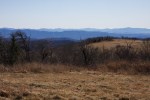
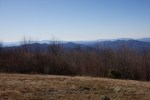
While the walk to the first “knob” is not particularly interesting, or if it is, I was so busy watching for mud that I missed it, the view from the knob is amazing.  If the mountains had snow covered peaks in the distance, I would feel like we were on the set of The Sound of Music.

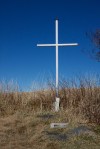
The first knob has a view of the second knob, which appears far away.  A huge cross looms up on the hill and we wonder what’s up there.  We enjoy the view a bit longer and then continue up to Huckleberry Knob.  We are upon it in no time–the distance is far less than what we thought from down below.  Oddly, the giant cross turns out to be a rather small.  So much so that we walk around the knob looking for the giant cross we saw from below.  I just recently relearned that looking up at something makes it appear larger, but this seems ridiculous.  Neither one of us can believe the 3’ cross that marks the grave of a man that died by getting drunk on the mountain and dying of exposure is the same cross we saw from below, but it has to be.

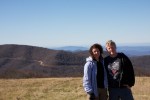
We run into a couple of women we saw at breakfast who are also enjoying the view.  We take turns taking pictures of each other.  It’s an incredibly beautiful day, but it’s noon and the lighting is not good for taking pictures.

Pat and I sit on the side of the knob for a while, looking at the sky and the mountains below.  It’s nice to just relax here for a bit.  After a while, we decide to walk back and go on to our next hiking destination, Mud Gap.

While Pat drives us to the next trail head, I slip out of my shoes and prop my feet up near the defrost vents so they can dry before I switch to my socks and boots for the next hike.  We eat our brown bag lunch while we drive and finish it in the parking lot at the trailhead.  Two other vehicles are in the parking lot.  One is a small pickup truck with Sierra Club stickers on it.  The other is a big pickup truck with an older man in an orange vest in it.  He is hunting.  It’s a little nerve wracking to realize we’re out hiking in a national forest the first official day of deer season.  It occurs to me we really should be wearing orange.  Fortunately, the trail is another well known trail that’s easily identified, so hopefully that will reduce our chances of being mistaken for deer.

We pause at the sign in the parking lot before heading up the trail.  I learn that this is actually part of the Benton-MacKaye trail.  This will be the second time I’ve hiked on part of this 275-mile trail that starts at the same point as the Appalachian trail, loops around, and then reconnects with the Appalachian trail in Smoky Mountain National Park.

As we study the sign, the hunter calls out to us.  He tells us about the hike, the view, and an alternate route that allows you to drive almost to the knob.  As we thank him and start walking, he calls out loudly, “I’m 77 years old; if I can walk up there, y’all sure can!”  We laugh and agree as we continue on our way.

As we make our way up the wet and rocky first 100 yards or so of the trail, I decide switching to my waterproof hiking boots was a good idea.  Pat interrupts my thoughts with, “How would that guy get a deer out of here if he shot one?”  We continue to contemplate that question as the trail gets steeper, rockier, and wetter.  I finally say, “Maybe he’s one of those guys that really just wants an excuse to go hiking.”

As we continue, we pause every once in a while to listen.  Sometimes we hear birds or squirrels, but more often, what we hear is the wind.  It starts like a far away swell, gathering in the distance.  Then it rolls its way up the side of the mountain, rising towards us as it gradually gets louder and louder.  Finally, it crashes over us and lifts my hair off my face.  The experience is like standing on the beach as the tide rolls in without getting wet.  I could stand and listen to the rise and fall of the wind all day, but we start moving again after the current wave starts to recede.

When we arrive at the knob, we are startled to see that it is littered with trash.  Then, two piles of trash jump up and start running towards us with wagging tails and a third assimilates itself into a man sitting up suddenly after having been caught in a nap.  As it turns out, it’s a couple with two dogs who have blankets and picnic gear with them.  We assume they are the owners of the Sierra Club pick up truck.

The dogs greet us and we pet them as the owners try to call them away.  I never know what to do in these circumstances.  The owners want the dogs to listen, but we want to pet the dogs.  Since these don’t seem like people who will abuse their dogs for being friendly, we go with petting them.

After being welcomed to the knob, we settle down on the side of it, slightly downhill from the Sierra Club couple and their dogs.  I work my way around the circumference, shooting the panoramic views even though the light isn’t any better than it was at Huckleberry knob.  I’m so happy to have finally gone somewhere with a spectacular view on a day when it’s clear.  Usually we only go to high spots on cloudy or foggy days.  I guess it pays to check the weather before you pick a hiking trail.

After shooting the view, we lay in the short, dormant grass on the knob and stare at the blue sky.  It’s so blue that I have a hard time focusing on it.  Not a single trace of cloud gives my eyes something to tell what an edge is.  I feel like the lens of my camera when I point it at a solid-colored surface.  I can’t say I’ve ever experienced that before.

As we lay there, Harry the dog suddenly appears standing over Pat’s head.  Apparently he was worried about us when he saw us lay down.  Pat pets him and he wags his tail.  Convinced we’re OK, he returns to his owners.

We get up and attempt to brush the dead grass off our shirts, but it really wants to stick to us.  We make our way back to the car, pausing to see a downy woodpecker, a grasshopper, and a squirrel.  By the time we get back down to the parking lot, my knees are starting to ache and I’m wondering if I should have worn my trekking shoes after all.  My feet are warm and dry, though, so I won’t be able to decide which was better until I know how long my knees will hurt.

We return to the van, hot inside from the sun.  We strip off some of our extra layers, extraneous in this sunshine.  We climb into the warm van and I am transported to the feeling of getting into a hot car after spending a summer day at the local swimming pool.  I love that feeling.  Any part of my skin that feels chilled suddenly feels like it’s been wrapped in a blanket.

We return to the lodge before sunset–enough time to shower, change, and sit and relax before dinner.  This has been a perfect day.  No crowds.  No traffic.  Just beautiful weather and a great view.  Sometimes I think that’s all I really need.

Hiking Little Frog

It’s Sunday morning and I am joining a group hike on the Benton MacKaye trail in Cherokee National Forest.  Pat is still out of town, so I will have to drive–this will be the 3rd time I’ve driven within the city limits of Chattanooga in the 2 1/2 months we’ve lived here.  I load minimal gear (camera with only one lens, daypack with water, money, snacks, and sunscreen) into the 1990 BMW that my husband loves so dearly and that I have eventually come to love as well.

When I get well out of Chattanooga and onto the two-lane highway that runs along the Cherokee National Forest boundary, I have a little fun going around the curves at speeds that aren’t exactly recommended.  But I am forced to slow down by a line of three slower-moving cars ahead of me.  At first, I am disappointed, but then I look right.  To my side is a river that flows into a lake.  It’s surrounded by mountains covered in brightly colored fall leaves.  Mist rises off the water, swirling around the trees and rising over the mountains.  In the distance, the sun rises over the mountain tops.  I have just missed the perfect place to pull over.  I contemplate the next pullout, but I’m nervous about being late and I am unlikely to get a good shot since I didn’t bring a tripod.   I decide to remember the scene instead of photographing it.  I look again and again as the road and traffic permits.  I feel the beauty of this scene so intensely that my eyes start to tear.  I cry like a man–a little moisture in the corner of one eye and then it’s over.

I make it to the Piggly Wiggly we’re meeting at early.  I’m not sure who thought it was hilarious to name a grocery store Piggly Wiggly enough to actually do it, but it makes me laugh every time I hear a reference to this huge chain in the South.

I am a little bummed that I’m so early–now I wish I would have stopped to shoot the mist even without the tripod.  However, it does give me time to go inside the Piggly Wiggly and use the restroom.  Unfortunately, instead of a public restroom, they just let customers use the employee restroom which is through the back room.  It’s not in particularly good shape and the lighting is so dim that I’m left to wonder if it’s clean or just dark enough I can’t tell it’s dirty.  I buy a bottle of Gatorade on the way out just because they let me use the restroom.

I return to the parking lot where the group is gathering.  As more people arrive, it appears I am the youngest.  We divide up between 2 cars and then head up a bumpy dirt road to get to the trail head.  It takes nearly 45 minutes to get there.  The trail is a 7 mile through-hike.  We will hike the full length of it and then take 2 other cars that were dropped off at the other end.  This seems like a lot of driving, but I’m not up for volunteering to walk back the 7 miles.

After we get to the trailhead and get organized, we start our walk along the ridge.  We are at a fairly high elevation, but only a small number of trees are really bright.  People keep commenting about the beautiful color in the leaves, yet they seem drab to me.  I am assured that the color change is just starting now and that it will get brighter.  I am also told trees need colder weather to get bright oranges, which have already happened at higher elevations.

It’s an incredible day.  The sky is every bit as blue as yesterday.  The sun is bright.  There’s not a cloud in the sky.  It’s a little cool, but a fleece is enough to stay warm.  As we walk along the ridge, we periodically get views of the mountains off in the distance.  Our hike leader, Dick, likes to hike up hills and then stop and catch his breath while we wait for the entire train of people to catch up.  There are only 12 people on the hike, so it doesn’t take long and we don’t have to worry about leaving anyone behind.

While we wait for the group, Dick explains that a National Forest is more about forest management as a resource (i.e., logging) unless an area is designated as a wilderness area.  Then, the area is supposed to be maintained as a pristine forest area that goes unharvested.  As we prepare to enter the Little Frog Wilderness, we learn that our group was limited to 12 because no more than that are allowed in a wilderness area.  We also learned that trails are not supposed to be blazed unless it’s absolutely necessary, and then only minimally.

As we start walking again, we periodically run into limbs that have fallen across the trail.  Dick pulls out a saw and he and another man on the hike clear fallen limbs from the trail in a mater of minutes.  The organization that Dick belongs to keeps the Benton-MacKaye trail in shape and different volunteers take ownership for different stretches of the trail.

The hike is lovely.  Just being out among the changing leaves was a treat, let alone the ridge views.  But, it comes to an end about an hour after lunchtime.  We all agree to go eat at a restaurant across the parking lot.  I decide to order pulled pork.  However, I’m not able to because the restaurant is out.  I order a Fried-Green Tomato BLT and am told they’re out of green tomatoes.  I getting pretty impatient by the time the waitress tells me they’re also out of cole slaw.  I go for a regular BLT and, finally, they have all the ingredients (although they fail to add mayo).

After filling our bellies, one of the hikers takes the two men who left cars at the trailhead back to get their cars.  I pay my check and walk the 1/4 mile back to the little BMW at the far side of the Piggly Wiggly parking lot.  I set down my camera on the daypack in the passenger seat and then turn the key in the ignition.  Nothing happens.  I try pushing a button that will prevent the car from starting.  Nothing happens still.  I am perplexed until a reach out and touch the headlight switch and realize that I left the headlights on all day.

I head back to the restaurant to wait with the wives of the guys who went to get their cars.  It will be an hour and 1/2 before they get back.  As it turns out, the time goes by quickly as we sit and chat.  When the men return, we all go to my car so they can give me a jumpstart.  However, I soon realize that I have never opened the hood of this car.  I cannot find a hood release.

The man who is an ER doctor for a living manages to find the release.  Dick, fortunately, is able to figure out how to open the hood (which is the reverse of any other hood I’ve ever opened).  Having spent several minutes trying to figure out how to open the hood, we stand there and gawk when we finally get it opened fully.  No battery.  We get out the manual to locate the battery.  As it turns out, the battery is tucked under a cover in the trunk.  I know how to open the trunk!

At last I am running again and I head on down the road.  However, there is construction and I have to stop in a long line of cars because the road is down to one lane.  About the time we’re going to start moving, I realize the car is no longer running.  I put the stick in neutral, jump out, and start pushing it with my shoulder against the door jam while steering with my right hand.  At this moment, I’m very happy that the guy behind me jumps out of his car and offers to help.  We get my car off the road and he pulls in behind me.  At least now I know exactly where the battery is and how to get to it!

He gives me my second jumpstart.  I hop out of the car to thank him and then get back in and discover I’ve stalled again.  I have to run to stop him before he gets back in his car, but he does jump the car one more time for me.  This time, I do not get out.  I keep my foot on the accelerator so it won’t stall again.  I thank him through the window and then drive off.

The need to keep the engine revving combined with the curving road causes me to drive harder than I might have otherwise.  The car has been lowered, converted to a 5-speed, given a sport suspension, performance computer chip, and performance wheels/tires.  It’s fun to drive.  Although, I confess that I refused to drive it until it also got a new paint job.  Now, humiliated by spending time on the road, it’s almost like I feel like I have to prove that this is not an old junker even though it is over 20 years old.

I apparently intimidated the man driving a Porsche Boxster in front of me.  He was driving like my grandmother and I was trying to back off, but it was a little tricky given the circumstances.  In any case, he finally decided to pull off the road and let me pass.  But then I get to a place where there is a traffic light and I have to stop.  I downshift one gear at a time, keeping the revs up and slowing the car.  But eventually, I have to use the brake.  I put the stick in neutral, brake just enough to get the car to a near stop, and then pull on the parking brake so I can put my foot back on the accelerator.  I manage to stop and keep the revs up.  Then I have to get started again.  I put the car in gear and rev higher than I would normally rev to start a car from a stop.  At the moment I’m about to engage the clutch, I release the parking brake and go.  Using this technique, I’m able to make it through the three stoplights between me and the freeway until at last I’m headed South on 75, back to Chattanooga.  I figure I’ll be good to go after nearly an hour drive on the freeway.

When at last I get off the highway, I stop at the end of the exit ramp and damn if the car doesn’t stall again!  Fortunately, there is enough charge in the battery to start it, but it doesn’t really fire up the way I expect, so I am now afraid the battery is not fully charged.  I have only one more stoplight to get through before I am home.  When I stop, I am not quite quick enough getting from the brake to the accelerator and it starts to die.  But, I manage to catch it just in time and get the engine revving enough to prevent a stall.  When the light changes, I make it through the intersection and into our parking lot with only one or two close calls.

Parked, I unload the car and pick up my gear.  I’ve lost my lens cap.  This is a major crisis.  A lens cap isn’t worth a whole lot, but what it protects is.  My camera has been sitting on my passenger seat for the past hour and a half; there is no visible damage.  I look under the seats and cannot find the cap.  I give up and carry everything inside.  I place a lens cleaning cloth over the lens and hold it in place with the sun shade for the lens.

What a day.  I wish I could reverse the morning and the afternoon–it started out so fantastically!  How is it that three annoyances can erase the glorious feeling of wonder that adventure inspires?  I met 11 new people today.  I witnessed the formation of clouds in the sunrise.  I hiked in a wilderness along the ridge of the mountain in the fall leaves.  I got to drive a little aggressively around some fun curves.  I smile to myself as I realize that the wonders will be what stay with me–the annoyances will be relegated to just another funny story.

Hiking the Black Forest

I wake up at 6AM, surprisingly on schedule for having gotten so little sleep the night before. Pat, however, sleeps until I wake him at quarter to nine in spite of the fact that he fell asleep two hours before I did the night before. He jumps out of bed and throws on some clothes–we have purchased breakfast with our room and he doesn’t want to miss it.

The breakfast is a large buffet that offers foods that range from the same kind of fare at American hotels to a very German assortment of meats and cheeses. I opt for a small plate of fruit, a croissant, smoked salmon, and a small piece of cheese. I go back to make a waffle, but someone else is using both irons, so I eat corn flakes instead. After filling up, we return to the room with me thinking we’ll get ready to go to the Black Forest immediately.

Pat, however, has other plans. He lays back down “only for a minute” and falls sound asleep. I get out my iPad and read. This has happened every time we’ve gone to Europe together. Pat can’t get started before noon and I can’t stop until I collapse around 1PM. I resign myself to trying to stay awake all afternoon and let Pat sleep, slipping out to the terrace to read since it’s more pleasant than our room and I think the sunlight will help reset my biological clock.

I return to our room around noon and wake Pat up. We are not going to spend an entire day in bed. Pat says he feels like he’s fighting something and I feel bad for waking him, but he gets up anyway. We pack a single day-hike pack, filling the water bladder and stuffing it with an extra lens for my camera, his rain jacket, two pairs of reading glasses, and an assortment of maps–our loot from the tourist center yesterday.

We walk to the street car and purchase two tickets. The ticket machine is in German and I am grateful that he is the one figuring out how to buy the tickets. When we get on the street car, we stamp our tickets in a timestamp machine, i ask Pat what happens if we don’t stamp them and he tells me that there is a big fine for not having a ticket. As we come to the next stop, a blonde woman gets on wearing a T-shirt and cropped jeans and carrying a black messenger bag. She could be a college student, but she looks closer to our ages than to a 20-something. Continuing our conversation, I suggest to Pat that if he sticks to speaking English, we might get away with not stamping the ticket, but he seems quite nervous about this suggestion–apparently, Germans follow the rules. A minute later, the blonde woman approaches us, holding out an ID that shows she is “control” and asks to see our tickets. Pat gives me the “I told you so look” as she examines our properly stamped tickets.

The street car takes us to the end of the line where we transfer to a bus on the same tickets. The bus takes us to the cable car, which will take us to the top of the mountain. I suggest that we hike up instead, but it’s over a 1200 meter rise in elevation and Pat isn’t feeling up to that kind of climb. A woman with two small daughters rides up with us. She tells us they were there the day before and have returned to retrieve a forgotten teddy bear. She was forced to pay for the cable car a second time, which hasn’t made her happy, but her ire is directed at the cable car operate, not her daughter. They talk softly and laugh often. Upon discovering that I speak only English, the girls practice their English a little on me–they start learning English and French in the first grade. One girl asks me, “What is your name?” in perfectly clear English. I reply with, “My name is Dianne” and we both giggle as if we’ve told a joke. I giggle because I think we sound like every language book I’ve ever used and not at all like a real conversation. I’m not sure why she giggles, but maybe I am the first person she’s talked to who can only communicate in English (as far as she knows) and she’s delighted that her English worked.

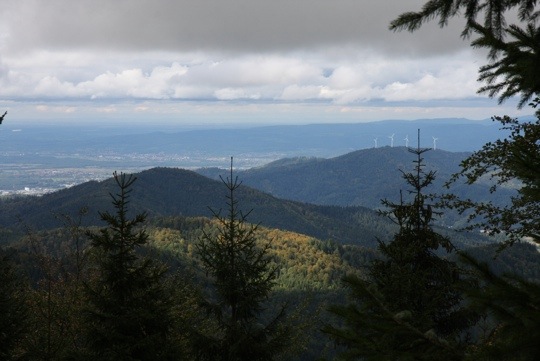
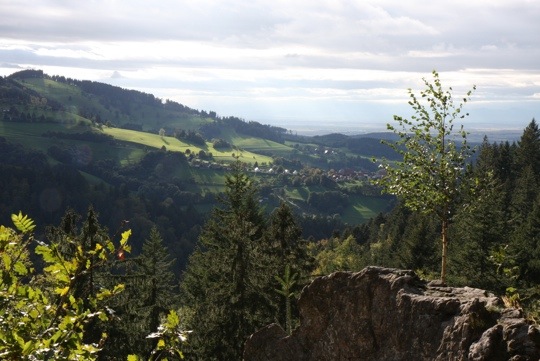
As we rise towards the top of the mountain, we go from lovely views of the valley up into a massive cloud of fog and rain. I’m not sure which gods I’ve offended, but it seems a continual theme that whenever I get to a great view point, there is fog. When Pat and I were here last, several years ago now, we spent a day hiking to the Feldsberg (the highest point in the Black Forest) after reading that the morning fog clears in the afternoon. The fog didn’t clear and we could barely see each other if we got more than a few feet apart. We also went to the Zutgsptiz, the highest point in Germany, on a cable car and had a similar experience. You’d think I would learn.

When we arrive at the top, we’re hungry. Realizing we have only a leftover bag of peanuts for a snack, we decide to get lunch at the restaurant. We gorge on lentils with a wiener and snitzel. Of course we each have a pilsner to wash it down. Pat orders a piece of cheese cake to top it off. I have a few bites, but it’s not as good as his Mother’s cheese cake–it took me a few times to get used to the less sweet version of cheese cake German’s make, but now it’s a favorite.

After filling our stomachs, we head for the trail. We have only 2 1/2 hours left until the last cable car goes back down the mountain, and Pat wants to do an out-and-back. I tend to think we might as well just walk all the way down, but I keep this to myself since Pat does better making these kinds of decisions on the fly than in advance. We set the alarm on his iPhone for about ten minutes before half our time will be up, so we can decide then.

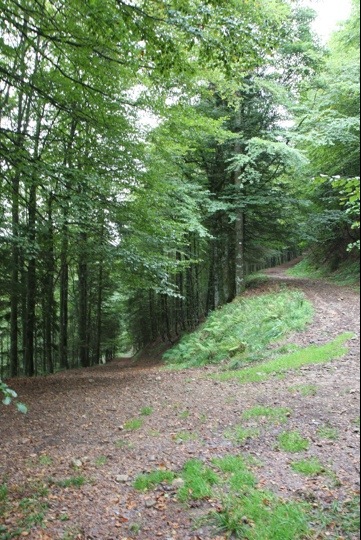
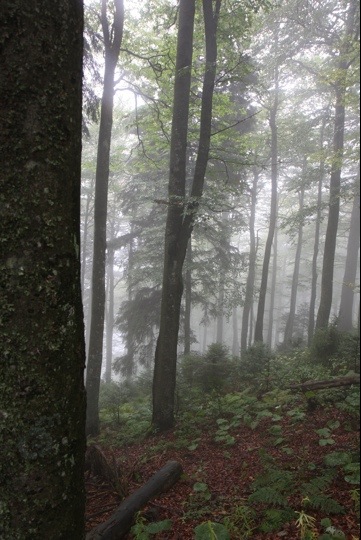
The forest is different than Pat remembers it from his many childhood trips here. There are many deciduous trees and he remembers only pines. When we get lower, there are more pines, but they are younger and less dense than he remembers. It’s beautiful none-the-less and we see few people on this Tuesday afternoon. We hike slowly down a broad path, trying to preserve our knees. The forest is quiet, and so are we. Just as Pat comments that there are no critters, a huge woodpecker appears from behind a tree. I get out my telephoto lens, but as typical, it disappears again before I can get a shot. If we were in the states, I would say it was a Pileated Woodpecker, but it looks different and I don’t know the birds here.

We walk on, the trees clear briefly and we look down into a pasture full of reddish brown creatures that I am sure are cows. Pat thinks they are deer, but the long lens on my camera proves my eyes are better than his. We wonder if there are deer here–we have seen no signs of them.

As we continue down the mountain, the path gets narrower, steeper, and rockier. My left knee reminds me that I am 44 and I’ve asked a lot of my knees over the decades. We take smaller steps, careful of the rocks, trying to step lightly on now painful knees. I don’t like hiking as much when my knees are shooting sharp pains up my legs with every step, but it still beats laying around. I think again that we would have been better off hiking up than down, but I don’t say anything.

We find ourselves at a junction that doesn’t match anything on our map and has no signs. We debate which way to go. A man on a mountain bike appears from the path above us and Pat asks him for directions. We follow his advice and walk on. A few minutes later, our alarm goes off. Pat looks up the hill we have been working our way down, the grade seems daunting, and suggests we continue down instead of going back up. I agree, since that was my plan anyway, but I’m glad he thinks it’s his idea. We walk on as the trees grow thicker and the forest darker. Pat wonders if we will make it back before dark. I realize that we didn’t take anything out of my pack and put it in his when we left mine behind–the first aid kit, the emergency blankets, the flashlight are all back in our hotel room. If we were confident that we are on the right path, we wouldn’t have these worries, but we are not.

We continue down the trail, reaching another confusing junction. The problem with tourist trail maps is that they don’t have all the trails on them. I don’t know why people think you don’t need that information–it’s hard to locate yourself on a map if you can’t recognize the drawing compared to the situation. I suppose this is life, however, you never really know exactly where you are, but you keep moving forward in the hope that it’s the right direction. Another cyclist appears as we ponder the signs at this junction. He comes up behind us, pondering as well. I say, “Do you know where you are?” to him. Pat laughs because I have spoken to the man in English without warning. But the man answers, he thinks he does. Pat consults with him and we head down one of the trails.

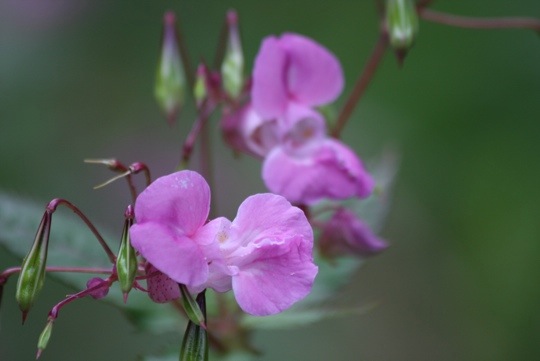
The sound of hammering reaches us from the valley below and we think we must be getting close to civilization. We reach a dirt road that runs along a stream, with banks covered in purple flowers. They are so fragrant, the air drips with their sweetness. We pause to check the time; it’s nearly 6PM. We wonder what time the last bus stops at the cable car station. The trail cuts to the left from the road and winds through a pasture surrounded by electric fences containing goats. We pass by, watching the goats, especially a baby. They are preoccupied with eating and barely notice us except one, who follows us along the fence as if he thinks we might be good for a hand out.

The trail goes back into the woods, down another steep incline, and then comes out to a paved road. It is a country highway and we cross it at a blind curve, hurrying so as to avoid surprising any drivers. Then, it returns to woods. We are going slowly again, now. In spite of feeling time pressure, our knees will not tolerate a fast pace as long as we are headed downhill. When the path looks clear, we take turns turning around and walking backwards, stretching our calves and resting our knees. Walking backwards, however, is not easy, so we give up when the trail becomes rocky again. Eventually, we can see the cable car. We wind our way through an open field and one more wooded area to the parking lot, relieved that we made it, but still not sure of the bus.

We walk to the bus stop and read the signs. There is no where to buy a ticket and the signs are somewhat confusing, besides being in German. I decide that the sign indicates a bus will come in 7 minutes. Pat has to be convinced that the numbers are times–apparently the words only make the sign more confusing. We sit and wait, the cable car station is completely shut down, looking as if it’s been boarded up for the season, although I know the wooden shutters will open again tomorrow. The bus arrives in just 2 minutes, ending our worry, but it’s going the opposite direction. The driver tells Pat we can get on now and she will turn around in a few stops. So we board and ride. I’m glad we did because the views from the mountain road of the setting sun are fantastic.

When we stop at the turn around point, the driver turns off the bus and we sit for a few minutes. I notice a ticket machine on the bus and Pat goes to purchase tickets for us. He’s unable to decipher which tickets to buy and another man, having just gotten on the bus, comes over and helps him. Germans do not understand why my husband speaks German with no accent but doesn’t know how to do things like buy bus tickets. This man is patient, however. Now that we are legal again, we sit back down and enjoy the views once more as the bus takes us back towards town. We are tired and ready for our next meal.

20110917-013031.jpg

20110917-013043.jpg

20110917-013102.jpg

20110917-013126.jpg

20110917-013136.jpg

20110917-013150.jpg

20110917-013213.jpg

20110917-013231.jpg

A Room for the Night

After spending the day on the Appalachian Trail near Clingman’s Dome in Great Smoky Mountain National Park, we head into Cherokee, NC to find a hotel.  Soaking wet from a downpour that doesn’t look like it will let up for days, I pull out my iPhone and start up the Tom Tom app to see what hotels I can find.  Our GPS can’t find us between the trees and the heavy cloud cover.  I have no signal and can’t do an internet search.  Pat keeps driving, pointing out wild turkeys along the way and I continue to struggle to find some sort of direction before he gets us lost.  Fortunately, GPS picks us up and I’m able to find a hotel before Pat hits unfamiliar territory.  We find a Comfort Inn not too far away and head in that direction.
As we drive into Cherokee, we see countless motels like the Princess Motel and the Drama Inn.  We’re wet and dirty from camping and hiking, but the motels look too seedy to be tempting.  The motels in this area resemble trailers placed on foundations and we’re just not up for that kind of adventure.  In contrast, a beautiful park sits on the opposite of the river that parallels the road.  The river is more of a creek with shallow water (even in the rain) bouncing over rocks that cover the bottom.  People stand in the water, wading with the ducks and geese who seem nonplussed by the close proximity of humans.  We saw this on the way in, but I’m now surprised at the number of people still in the creek in the pouring rain.  Next to the entrance to the park, a life-sized black bear statue guards the drive.  It’s painted in native american art.  These artful bears appear all over Cherokee, each one uniquely decorated in the artist’s own style.  I am reminded of the Stratocaster guitar statues in Cleveland and the cows (is it cows?) in Cincinnati.  Apparently this form of art has become a trend.

We drive on until about a mile before we get to the hotel I’ve located, Pat spots and Comfort Inn and Suites.  He assumes it’s what we’re looking for and pulls in.  I sit in the car while he runs in.  He returns in just a couple of minutes and declares that the rates were too high and that we should drive on.  I explain that the one I found is a regular Comfort Inn and this one is a Suites version and, relieved, he follows the GPS to the Comfort Inn I originally chose.  This time, he comes back out of the office with a room key.  I’m not sure if he’s proud of himself for saving us money or disgruntled that the rate difference was only $10, but whichever it was, the difference seems to have put the room rate under his threshold for “too expensive.”

The room is surprisingly nice.  It has a living room area with a large balcony that looks over a river.  The balcony has a roof over it and we’re able to sit out there watching the rain.  The river appears swollen and flows by rapidly with the heavy rain, but it’s far enough below that there’s no reason to worry about flooding.  We take turns taking hot showers.  While I always enjoy a shower more after camping, we haven’t been in the woods enough for it to feel quite the way a hot shower feels after at least 3 days in the backwoods.  I think a person reaches maximum stinkiness after about 3 days–after that, you pretty much stop smelling much of anything.  I love showering in any case and am grateful that the hotel has good water pressure.

After getting cleaned up, we decide it’s time to go to dinner.  We cruise back up the road the way we came into town and spot a crowded family-owned place called Paul’s Diner.  Figuring a crowd was a good indicator, we pull into the lot, but there are two women in an SUV looking like they want to pull into a spot.  We wait for them to decide what they are going to do.  When they do nothing for what seems like minutes, Pat pulls into an open space and we hop out of the car.  The woman driving the SUV apparently has troubles backing because she ends up pulling forward and doing a complete loop to finally pull into another open spot.

I am reminded of a woman in the Worthington, OH Graeter’s parking lot.  Several weeks ago, before we moved, we’d gone there to meet friends for dinner.  There were 3 cars trying to leave, but all of them were blocked by one woman in a mini-van who mis-judged the length of her vehicle by about 6 feet.  She kept pulling up and back, up and back, turning her wheels the wrong way and never backing up far enough to angle her vehicle in any direction.  One of the men waiting for her to get out of the way finally got out of his car and attempted to direct her.  Even with him standing there, showing her with his arms how much room she had, she would keep stopping every couple of inches convinced she was going to hit something that was still 4 feet away.  I admit that I laughed pretty hard at her incompetence.  Maybe they should add backing out of parking spaces to the drivers test?

When we enter the restaurant, we are greeted by a sign that informs us the restaurant is not a fast-food establishment and that we should “be expected to wait” when they are busy.  Pat comments on the popularity of signs telling us how to behave, referencing the various signs in the restaurant we had breakfast in that morning.  We are apparently expected to wait for a table as well, even though the restaurant is only half full.  We stand awkwardly while the cashier chats idly with a departing couple.  When she is finally done with them, she disappears into the kitchen and we stand there some more.  Eventually, a waitress stops and asks us if we want to sit inside or out.  We choose out just because it is slightly warmer than the air conditioned interior.  But, when we go outside, none of the empty tables are clean.  We return inside and the waitress points us to a choice of two tables against the far wall.  We pick the cleaner of the two and take a seat.  The women from the SUV are already seated in the waitress’s section on the other side of the restaurant and have drinks sitting in front of them.  A group of four comes in and takes the table that was occupied by the couple who was leaving when we came in.  We watch them get drinks and place their orders, but still no one has come by to wait on us.  When the waitress brings salads out to the women who were behind us, we get aggressive and turn our bodies in our chairs and start staring at the waitress.  As it turns out, we’re not in her section.  But, she apparently got the hint because shortly after she goes back into the kitchen, our waiter appears and apologizes for the wait.

Deciding to try something I’ve never eaten before as a tactic against disappointment, I order Fry Bread with Chili and Cheese.  I have no idea what fry bread is, but I’m hungry enough that I’m confident I’ll be able to eat it.  Dinner and drinks come out a few minutes later and I discover that fry bread is a large circular piece of dough deep-fried.  The chili and cheese are dumped directly on top of it.  It’s not bad, but I’m pretty sure it’s not on the list of super foods.  Once again, the salt content is a bit more than I’m used to.  Sipping pink lemonade between bites mingles the the over-the-top salt with over-the-top sweet and doesn’t really help.  I enjoy the hot food none-the-less–one of the advantages of being cold and hungry.

After filling our bellies once more, we return to our hotel.  It’s still early and I suppose we could have checked out the sites in the town, but there is something about this town that reminds me of the state fair.  Maybe it’s the “Genuine Indian Dancers” standing on a stage in a parking lot dressed in neon colored “native” attire or the signs for “Real Indian Artifacts” for sale in trinket shops that give me this feeling.  All of it just seems like a big show put on for foolish non-native americans who don’t know any better.  There’s nothing that makes us want to participate, so we drive on.

Returning to our hotel, the bed feels pretty darn good.  And the fact that we can’t hear our neighbors seems even better.  Maybe I’m getting soft, but I feel no remorse that we’re not out in a tent tonight.