The Next 6.3 Miles

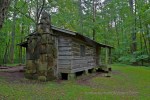
Mentally embracing the rain, we started down the trail, determined to make it the next 6.3 miles to a place called “Hobbs Cabin.”  We couldn’t help but hope the cabin (a rustic, first-come, first-serve arrangement) was available.

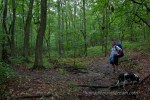
After about 10 minutes of hiking in the downpour, we realized hiking in the rain on a hot day was quite pleasant.  Instead of feeling stinky and sticky with sweat, we felt cool and refreshed and there were no bugs while it was raining.

Tisen, on the other hand, was not so enamored with the feeling of cool rain. He did his best to walk underneath the overhang of our packs to try to avoid being rained on directly.  He ended up just as wet as the rest of us, but there must have been something comforting about feeling like he had a roof over his head.

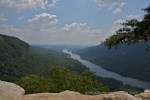
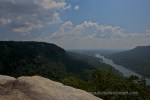
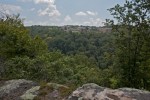
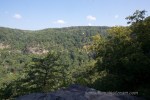
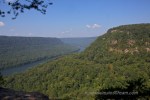
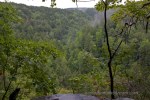
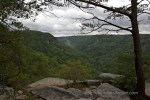
When we got to the first overlook of the “gulf”  (apparently that’s what a gulch is called in Tennessee), the rain had taken a break.  The sky was overcast and it was hard to tell it was noon.  The break in the rain was nice, as was the breeze blowing up from the valley below.  But, alas, we were trying to cover 6.3 miles before it got too late in the afternoon, so we couldn’t stop long to enjoy it.

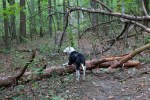
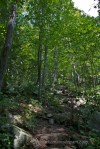
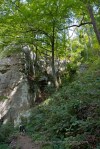
As the trail veered away from the edge of the gulch, we re-entered the woods, and perhaps a time from the past.  It was easy to imagine the first settlers finding their way through woods like these when such woods covered much of the Eastern US. Of course, they would have all be old-growth forests back then.  But, these woods, mostly free of invasive plants, made me feel like we’d been transported in time. Thankfully, our gear wasn’t transported back to historical equipment–I think we would have needed a wagon.

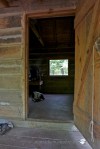
At long last, we arrived at Hobbs Cabin and were relieved to find it unoccupied.  A tiny, dark, uninviting shelter, it was equipped with 6 bunks and a table fastened to the wall.  The bunks were wood planks that would require sleeping pads and bags to make comfortable.  The small windows on the back wall let in so little light that even with our flashlights, we had trouble seeing inside the cabin.  I had a hard time imagining spending the night in there.

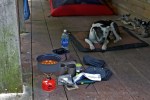
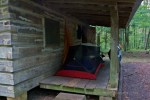
I proposed we pitch the tent on the front porch, screening out all insects, putting us where we were sure to get a breeze, and under a great big roof to keep up out of the rain.  We hung the rain fly in position just in case we started to get wet, but planned to sleep under just the screen for the night.  Tisen was more excited than a child to crawl into the tent with us, even though we decided to call it a night around 7:30PM.  It was the earliest we’ve ever gone to bed.
2 Miles

There is a fine and delicate line when it comes to backpacking between having what you need to survive and having too much weight on your back to have any fun.

Once a backpack reaches a third of your body weight, or even a quarter, when you get a few miles into the hike, you start to question the wisdom of backpacking vs day hiking.  This has been a battle played out over years for me.  The first time I went backpacking, I barely made the ascent up a 4 mile trail that climbed almost 1 mile in elevation.  I didn’t even know how much weight I was carrying at the time, but I had packed things like an 11-cup percolating coffee pot, so I’m pretty sure it was a lot of weight.

When my husband and I were in official “backpacking training,” we went on a 3-day trip to Otter Creek Wilderness in Monangahela.  This was right after I’d read a book called “The Ultra-Light Backpacker.”  I took no spare clothes except socks and underwear, no tarp, no extra anything.  If I thought I could live without it for 3 days, I left it at home.  My pack was a lot lighter, but it rained the entire time, except when it snowed, and we came pretty close to hypothermia by the time we hiked out the 3rd day with no dry clothes to change into.

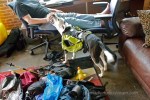
Ever since then, we’ve erred on the side of too much weight.  As we headed down the trail on the Sunday of Labor Day weekend, we not only were carrying too much stuff for us, but also too much stuff for our dog:  His new special diet frozen and packed so it would stay cool long enough to be fresh for his dinner and breakfast; his bedroll strapped to the outside of Pat’s pack; extra towels packed just for drying the dog; and, of course, Tisen’s special water bowl and his own water bottle.  Spoil our dog?  What are you talking about?

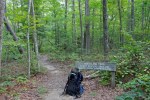
It’s not surprising that after about 2 miles, we were ready for our first snack break.  We stopped right on the trail as there was no where else to go.  We opened up our packs, broke out our snacks, and started munching.

As we stood there with our stuff strewn about, we heard a sound.  It wasn’t just the sound of the wind whistling through the trees.  It was the sound of an enormous sheet of rain blowing through.  Pat went for the tarp while I went for the rain cover for my pack.  I got my pack closed and covered while Pat built us a little shelter.

We felt a little foolish when three backpackers came through soaking wet and had to duck under our shelter to continue on the trail.  We started packing up our stuff and accepting that this rain wasn’t going to just blow over.  It was time to get wet.

Dogs and Tents

We have decided to take two days to go backpacking.  It’s been a long time since we spent the night in backcountry.  We have chosen a pretty easy place to re-introduce ourselves and expose Tisen for the first time.  At least, we think it will be easy.  What’s 7 miles with 35 pounds on your back?

We have a checklist of things to pack for our dog:

  • Medications (the only one with no insurance is the only one on medication!)
  • Vitamins
  • Special food (because he has allergies, which led to the medication in the first place)
  • Insulated and padded sleeping roll for dogs
  • Collapsible water bowl
  • Water bottle
  • Wipes to remove poison ivy from his fur (for my protection, not his)
  • Super glue (in case he cuts a paw pad)

Given the list, it seemed logical to me that Tisen would carry some of his own stuff.  At least his own food and first aid items.  So, I had him fitted for his own backpack.  Pat vetoed the backpack idea.  He thinks Tisen will be sore from walking so much and doesn’t need to carry any extra weight.  He has a point.

Of course, once we agreed no backpack for Tisen, it was like he knew he wasn’t going to be carrying anything so he started adding to the pile of gear.  First Blue Dog appeared on the pile.  When I moved Blue Dog, Lion showed up.  Most recently, it was Duck.  I haven’t broken it to him that he’s not going to be able to bring any of them on the trail with him.

We have, however, had pre-camping lessons in the living room.  We wanted to see if Tisen would fit in the tent with us.  It’s going to be a tight fit, but if he lays parallel to us, we can put his sleeping mat under our mats (which are narrow at the feet) and he can lay between our sleeping bags.  As long as no one moves, it should be super comfortable.

We also practiced entering and exiting the tent.  We wanted to make sure Tisen would get in and out quickly so we don’t end up with a swarm of mosquitos cuddling up with us.  After a couple of practices, he was coming in and out like a trooper.

Next, I practiced getting up to heed the call of nature (which happens about 8x a night when I am camping just because it’s so inconvenient, I think) and leaving Tisen in the tent.  He did pretty well lying still while I got out and back in again.

I think we’re ready.  Now we just have to figure out how to stuff it all into our backpacks.

On a photography note, what’s really amazing about the shots in the gallery is that all but the first one were shot at 25,600 ISO.  The darker images have some grain, but they look better than the Canon 40D did at 800 ISO.  That’s pretty impressive.

The Last Push

After spending some time cooling in a stream, Tisen and I make the final push home from Edward Point.  We make it to the first place we got lost on the way out.  When we get there, it’s completely obvious that a lower trail completely avoids the downed trees that caused us so much trouble on the way out.  We make it around the whole area with only one lift for Tisen in a spurt of steep rock steps.  I cannot resist looking to see if the trail was obvious from the other side.  It was not.  I have an excuse for at least one of my wrong turns.

I’m almost afraid to stop again.  Tisen is moving well and looking energetic.  I’m moving well now that we’re going uphill, my knee only complaining when we go downhill.

We make it back to the first natural overlook and I know we’re home free.  We take a break there, just to be safe.  Tisen looks at me with an expression on his face that I swear says, “Yay, Mom!  Look at us!  We’re almost back!”  Who knew a bit bull could look like a cheerleader?

A couple pauses to take a few quick shots from the overlook while we gather our energy for the last push.  The trees start rustling, the sun disappears, rain drops start to fall.  I realize I have nothing to cover my camera with and hope that it doesn’t get too wet.

I text Pat and let him know that we have survived and are on our way home.  I had updated him earlier when we were lost–one of the advantages of hiking on Signal Mountain is that you still have a signal.  🙂

When I start packing up Tisen’s water, Tisen pops up like he’s been waiting on me all along.  I smile.  I don’t know if he remembers what the last part of the trail is like, but it involves a lot of jumping up onto high steps and rocks to get back to the manmade overlook at the parking lot.  It’s a lot to ask of a tired dog.  I prepare myself for the possibility of having to lift Tisen many times in the last quarter mile.

Tisen springs up every rock and step like a young pup.  He is clearly excited to be getting closer to home.  He charges ahead when I pause.  When he’s behind me, I have to be careful not to kick him as I step, he’s so close on my heels.

We make it to the park.  We make it up the final hill to the car.  Tisen catapults himself into the back seat and lies there panting.  I rush to change my shoes so I can get us moving.  The breeze is still blowing, cool and slightly damp, although the rain has stopped.  I smile to myself as I put the car in drive:  we finally made it to Edward Point.
Blazing Trails

After allowing Tisen a 20 minute nap at Edward Point, I decide we’d better start working our way down.  With our side-trips on the way up, we’re an hour behind schedule and we’ll be two if it takes as long to get back.

Unfortunately, the sun is now higher, the temperature hotter, and the bugs swarming more energetically.  I’m not sure if it’s the heat or the bugs that get to Tisen, but not more than a 1/4 mile from Edward Point, he finds a shrub, runs into the shade underneath, and starts digging himself a nest in the dirt.  It takes quite a bit of coaxing to get Tisen back out into the sun.

Fortunately, we are back in the shade a little further down the trail.  And the turkey vultures who greeted us on the way up have given up on us dying, disappearing down the river valley.  I took that as a positive sign.

Because I had opted to break in my new hiking boots in anticipation of a back-packing trip the following weekend, my knees were suffering.  My left knee was the first to start screaming.  This has something to do with inflammation.  As my knee starts to swell, it no longer wants to bend.  When I bend it and step downhill, a sharp stabbing pain shoots through the joint.  It makes going downhill excruciating.  I make a mental note to make sure I figure out how I can carry my camera and still use my trekking poles before we set out backpacking next weekend–I imagine my knees won’t hold up to a backpack without trekking poles.  I wish I could wear my fivefinger shoes, but the rocky terrain and the extra weight of a backpack is a bit much for almost-bare feet.
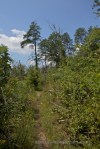
We manage to stay on the right trail on the way back.  I am watching for blazes with the intensity of a pit bull.  Or maybe that’s Tisen?  When we get to the juncture where I went the wrong way on the way up, I look back to see how I got confused.  I realize there is no excuse for missing the main trail.  The blazes are obvious and well-placed.  I don’t know what I was thinking.

We keep on stepping, slower than I’d like, but we’re making more progress than if either my knee or Tisen gives out completely.  I have to lift Tisen over some big rocks in the part of the trail we missed on the way up.  While I’m glad I’m able to lift him, I am simultaneously worried about how much poison ivy he’s run through and how much of it each lift is getting on me.

We make it back to water.  Tisen plows in and lays down.  I watch and wait for him to look cooled and refreshed so we can continue on our way.

Edward Point

As Tisen and I walked what we thought was the last 15 minutes to Edward Point, shadows raced across the forest floor like silent, dark ghosts.  I looked up to discover a half a dozen turkey vultures circling overhead.  Close overhead.  Too close.

Given we were hot, tired, and bleeding from numerous wounds from brambles, it was a little ominous to feel like they were so interested in us.

Fortunately, they soared further away as we approached, giving us a more breathing room.

As we looked around (well, I looked around, I don’t know what Tisen was doing exactly), I realized that the area must have had a fire in recent years.  The trees were charred in place.  The growth was thick and dense, but it was all wild flowers and sun-loving brush.  The bugs loved it.  I couldn’t seem to keep them off of me.  I saw bugs on me that I’d never seen before.  I stopped shooing and started swatting, leaving red hand-prints on my arms.  They went well with the bleeding scratches from the earlier brambles.

There is something disconcerting about hiking from relatively deep forest into bright meadows when a mountain is well below timberline.  You expect to come out into open spaces when hiking in Colorado, but here, it just seems wrong.  I found myself wondering when the forest had burned and whether that was normal here in the Eastern  US.

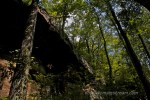
About 15 minutes after we’d found our way back to the Cumberland Trail, we encountered an overlook that faced the cliff on the other side of the gulch.  Directly across from us was a huge building that absolutely looked wrong.  There is nothing I resent more than when I spend hours making my way to a overlook in the “wilderness” only to discover I’m within a football field (or two) of a major development.  I found myself hoping this was not, in fact, Edward Point.

I googled Edward Point to see if I could tell.  Thankfully, I was able to determine that we were not there yet.  Now, I had a decision to face.  A 72-pound dog who is tired and hot and 45-year-old knees that are equally tired give one pause at moments like these.  Had it been me and only me, there would have been no hesitation–I was going to make it to Edward Point this time no matter what.  However, I’d lifted Tisen enough times on the way up to know I couldn’t carry him back.  I had to consider whether he could make it or not.

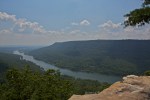
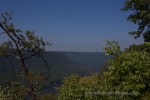
I decided to give it another 10 minutes.  I could see where we were along the gulf and it seemed like Edward Point, which overlooks the main river valley, had to be close.  I was so glad we’d stuck it out when we arrived at the overlook.  While Tisen took a nap in the shade, I took as many photos of the view as I could.

Lost Again

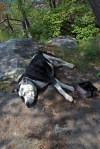
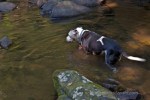
Tisen has a very specific way of cooling off in streams. He walks in, feels around with his feet until he finds the perfect spot, then he lays down.  I suspect it has something to do with his Holstein genes.

Having cooled off for several minutes and drunk his fill of water, Tisen recovered enough to tackle the uphill climb.

As we made our way of the far side of the gulch, the climb got steeper.  We were distracted by the amazing rock formations.  Perhaps this is why, when we got to the next junction in the trail, I decided we needed to head downhill rather than up.  This turned out to be a bad mistake.

We ended up on a trail that kept getting narrower and more overgrown.  Soon, we were walking through brambles that hooked themselves into bare skin, tearing flesh as I forced my way through.  Tisen was somewhat protected by his fur, but both of us looked like we’d taken a beating by the time we got to a clearer part of the trail.

The trail now tucked up against another rock bluff, looking more like a deer trail than a parks and recreation trail.  I should have turned around about a 1/4 mile in.  Have I mentioned I have issues with going backwards?

On the plus side, since nature was calling pretty loudly at this point, it was good that we were in an isolated area with plenty of underbrush so I could heed the call without fear of someone walking up on me.  On the minus side, there were so many enormous spider webs in the rocky bluff I was almost afraid to turn my back on them.

When we got around the bluff, we started bush-whacking uphill, hearing voices above us and thinking that must be the main trail.

This was tough going.

Not only were there more brambles and spider webs, but now there were more and more rocks to climb as well.  I was worried about Tisen getting a little more exercise than he could handle.

As we walked along the face of yet another rock bluff, we caught up with a couple with a child and two dogs.  I have no idea how they all got there, but there they were.  I asked them where we were and they assured me that we were just below the Cumberland Trail.  All we had to do was go straight up the rock face.

I found an entry point that I could climb, lifted all 72 pounds of Tisen up onto the rock at shoulder height and managed to convince him to stay up there while I used a tree to assist my own ascent.

Bush-whacking through another patch of brambles rewarded us with being back on the main trail.  The couple had said Edward Point was about 15 minutes away; had it been much further, I probably would have started heading home.

Beyond the Overlook

Continuing our hike from Signal Point to Edward Point, Tisen and I made our way along the steep slope of the gully.

I guess it’s a gully.  I’m not really clear on when a gully becomes a canyon or if there’s some other name for a horse-shoe-shaped space in the side of a mountain, but essentially, we were going to hike in nearly an ellipse, but we were going to end up on a point on the opposite cliff from where we started.

The trail starts high, goes mostly downhill to the midpoint and then climbs again to Edward Point overlook on the far side.  It requires stepping over, on, or around many rocks in the process.  We clambered our way up the trail, keeping a pretty good pace going.  I eyed the poison ivy growing along the trail with disdain–I knew it meant Tisen and I were going to be taking very thorough baths that night.

When we got about another 1/2 mile down the trail, we ran into an impasse.  This happens quite frequently on trails.  A tree has fallen across the trail that can’t be gone over, so you have to go around.  Usually, this might mean walking a 1/10 of a mile out of the way to skirt the fallen tree.  In this case, there were dozens of trees that had fallen.  It was a terrible scene of destruction that made me sad.  On the other hand, with as many bad storms as have rolled through this area in recent years, it’s pretty amazing that that’s all the damage that’s been done.

But there were piles of fallen trees.  And we we tried to go around, we ran into only more fallen trees.  We went around and went around some more, trying to find a route through all the crap that fell with the trees.  Eventually, we did make it.

Of course, in the process, I lost the trail.  We ended up bush-whacking our way back to the trail, arriving slightly scratched and a little more tired than we would have otherwise.

When we finally found the main trail again, we hadn’t gone more than 10 feet hen we saw a junction with a trail that came from the same direction we had just come from.  It was clearly blazed as the main trail and it looked like it would have missed all of the fallen trees.  I kicked myself and wondered how I had missed that option when we took the high trail to hell.

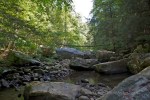
But, back to relatively clear sailing, we continued on our way, making it to the point where we’d turned around the first time we tried to hike this trail and pushing beyond.  Less than a 1/4 mile past our previous turn-around point, we ran into a stream.  Tisen made quick work of laying down in the water to cool off.  I thought about joining him, but there wasn’t a puddle big enough.

Re-Hike

Sunday has become unofficial hiking day.  Of late, I seem to have fallen into a new routine.  Saturday, I recover from the previous 5 days of hiking, biking, rowing, and yoga.  I do this mostly by laying on the couch with the occasional interruption of taking Tisen for walks.

But Sunday, Sunday I hike.  And this past Sunday, Pat needed to work, so it was the perfect opportunity to make my second attempt at Edward Point.  This time, Tisen and I would start at 10:30 in the morning instead of 4:30 in the evening.  We were mentally prepared for a rather challenging 6 mile hike, up and down Signal Mountain, scrambling over rocks.

This was our fourth trip to the Signal Point overlook.  It’s an easy walk down a paved trail from the parking lot.  We spent 20 minutes covering the 100 yards from the parking lot to the overlook–there were lots of places to sniff.

But the overlook is it for the suburban park setting.  After stopping for a couple of quick shots, we headed to the Cumberland Trail.  Even with its manmade steps, it’s not an easy trail.  Many people make it the first half mile to a “natural” overlook point over the gully that our trail would wind its way around.  But it involves clamoring down steep and big steps, jumping onto rocks, and stepping carefully.  Tisen did an amazing job navigating all the obstacles.

Every time we go on a hike that starts out with an accessible view, I notice the drop off in population as you get further from the parking lot.  We were still on the most traveled part of the trail, but already we were down to only 2 other people who we didn’t see until we made it to the overlook point.

Before we’d rounded the first blind turn, a Pileated Woodpecker called from so close to where we were standing that I was sure I would look up and see it clinging to a tree.  As I searched for the shape of this giant woodpecker, it called again, sounding slightly further away.  I searched frantically, watching for shadows against the dark forest floor.  When it called a third time, the Doppler effect kicked in–I could hear it moving away from us as it called.  I was bummed.  I haven’t seen a Pileated Woodpecker in quite a while–I would have loved to have gotten a shot of it.

We continued our hike possibly in greater safety now that the woodpecker was gone–I have a tendency to forget I’m walking on the edge of a cliff when I’m searching for a bird.

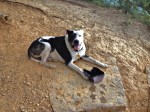
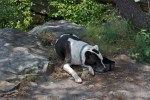
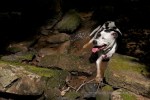
When we stopped at the first natural overlook, Tisen was already panting hard.  I got out his portable water bowl and tried to coax him into drinking water.  Tisen stuck his elbow in the collapsible water bowl and stared at me, pink tongue lolling from his black-and-white mouth.

Bluff Trail

Having made it to Sunset Rock, instead of going back the way we came, we looked for the more popular trail back to Craven’s House, Bluff Trail.  However, the map was a bit confusing as to whether we had to go back down the trail we’d come up to get to Bluff Trail or if it was at the same elevation as Sunset Rock.

There was a trail leading in the correct direction from Sunset Rock, so we decided it must be the trail we were looking for and headed on a treacherous route along the cliff.  It ended about 100 yards beyond Sunset Rock and we were forced to double back.  When we returned to Sunset Rock, a man with a young daughter was there.  There were two choices:  go up or go down.  I decided to ask the man which direction they’d come from.  They’d come down the trail we were eye-balling.  Turns out, we could have gotten to Sunset Rock by driving o the top of the staircase and walking about 1500 feet.  We walked over 2 miles to get to the same place that the man and his daughter had walked about 500 yards to.  It’s almost depressing, but we really enjoyed the walk.

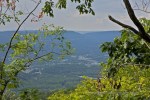
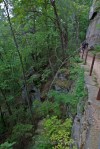
In any case, we deduced that back down was our only option.  We climbed the “stairs” back down to another junction and then headed parallel to the bluff.  We were treated to occasional glimpse between the trees of a view of the valley.

Tisen liked this trail a lot.  He came into his own trotting along, right next to a cliff.  I was more worried than he was. Any time I started to freak out that he might fall over the edge, I’d call him and he’d look up at me with an expression that clearly said, “you’re not good at math.”  Maybe he’s right–he never did slip over the edge.

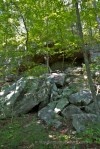
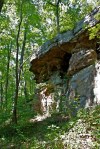
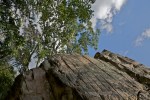
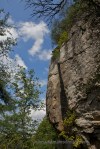
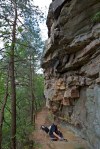
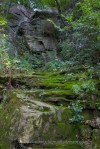
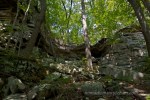
The rock formations on Lookout Mountain are pretty amazing.  Giant Rocks have fallen into unexpected places, decorating the landscape in places where it seems they must have been air-lifted in by helicopter.

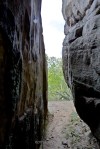
The rock formations are a  beautiful.  They are sandstone, with intense layers that create interesting caves or have splits and vines and/or moss, all depending on where you see these giant reminders of a time long gone.

I don’t know what exactly is so attractive about these giant boulders.  Perhaps it’s because where each one appears, it’s as if time has stood still for centuries.

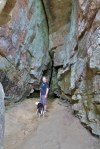
Tisen was less impressed with formations and more concerned about ensuring he had a way out.

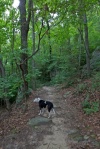
Perhaps this is why Tisen had a magical ability to always end up in my frame?  His obsession with being in front led him to pass me whenever I stopped to shoot.  I’m not sure what was driving him to always be in front, but he ended up walking into my frame almost every time I stopped to get a shot.