
What’s the Point?

This evening, I realized I didn’t do anything “bloggable” on Sunday, so I was out of topics to write about.  I pondered writing about my work laptop crashing and having to get a replacement sent to my home office, but that’s pretty much the whole story in one sentence.  I could have writen about having maintenance people in the apartment installing an air duct while trying to work, or Tisen’s return to day care, or perhaps even my workout this morning.  But, let’s face it, I’m obsessed with photography and no other subject will do.

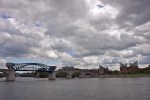
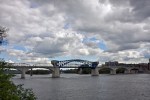
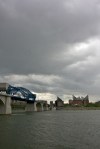
Therefore, the only solution was to go out and shoot.  However, I’m tired of going across the street to the riverfront and taking pictures of the Market Street Bridge and the Tennessee Aquarium.

One of the places near Chattanooga Pat and I have wanted to explore is Point Park.  Point Park is one of the battlefield monuments to the Civil War in the area.  It’s also known for spectacular views.

It’s located on Lookout Mountain, which would be better described as a ridge.  The point is literally just that–it’s the end of the ridge, affording views in three directions.  This was the destination I picked for tonight.  We loaded up my gear, Tisen, water, and rain gear and headed out.

When we arrived at the park entrance, a police officer pulled up in front of the gate and was pulled out a backpack.  We wondered if he was there to check to make sure that everyone in the park had purchased a pass and made sure we stopped to get ours before going in.

We wandered along the paved trail around the landscaped park area enjoying the views.  I set up my tripod and took some shots towards downtown Chattanooga, finding our building off in the distance.  The meander in the river that goes through the downtown area was fascinating.  I always knew the river bent back upon itself, but I never realized just how narrow the land in the middle gets just West of us.  Looking at it from up on the point made me realize why it’s called moccasin bend–the land mass resembles a snake’s head.

As we worked our way along slowly, several police cars squeezed by on the paved trail.  Then, an ambulance went by.  We watched them setting up a gurney and wondered if someone was injured.

As we headed down the path towards the museum on the point, we passed a large rock formation that seemed to be begging people to climb it to see the view.  I might even have been tempted myself except that the base of the rock was surrounded by a variety of medical equipment that the paramedics hadn’t yet returned to pick up.  It was fairly obvious why the ambulance was there.  We stuck to the path.

Even Tisen only went off trail once when he accidentally ducked under the rail without realizing it.

To be continued . . .

Winging It

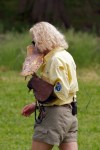
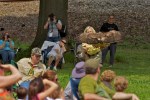
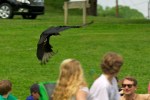
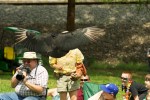
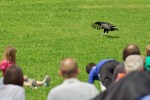
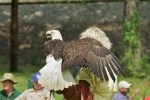
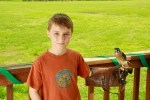
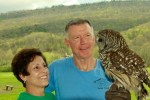
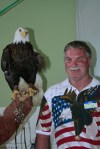
On Saturday afternoon, I went to a Chattanooga Audubon Society fund raising event as a volunteer for S.O.A.R.  S.O.A.R. was there to do their 45 minute long educational program on birds of prey in support of the Audubon.

The challenge for John and Dale was that the program was in a large field outdoors, potentially tempting free flying birds to head for the trees.

The challenge for me was to see if I could get any good shots of the birds.  I am planning to make a screensaver to give away in exchange for donations at an upcoming event.  Unfortunately, I’ve never seen the program before, so I am completely winging it (yes, a pun).

I chose my new 70-200mm lens thinking because it’s faster, it will help me freeze more movement.  Given that it was a bright sunny day, I probably would have done better with my 100-400mm since I didn’t really need the speed.

I put my camera on a tripod and set it at its maximum height thinking I’d have a better angle catching the birds flaring before they land.  Unfortunately, I didn’t consider the need to separate the birds from the audience.  I would have been better off getting really low–well, not sure my knees would have been better off, but my pictures would have been.

I also needed to be as unobtrusive as possible so the birds didn’t get confused and fly to me.  No one wants a bird of prey to land on their unprotected flesh.  As a result, I tried to stay in one spot and not move around much.

In addition to being in a fixed position, up high, with too short a lens, all my subjects were in motion.  John and Dale are constantly moving.  When I am looking through my lens, I can only track one of them, but I need to know where the other one is to predict what direction the bird will fly.  Looking away to locate the destination person caused me to miss more than one good shot.

My lack of experience using the continuous focusing mode also did not help.  I had issues with losing focus. I’m not sure what I did wrong, but I’m going to have to do some more practice with continuous focusing mode.  It was depressing to see perfectly framed and timed shots that were totally out of focus.

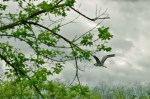
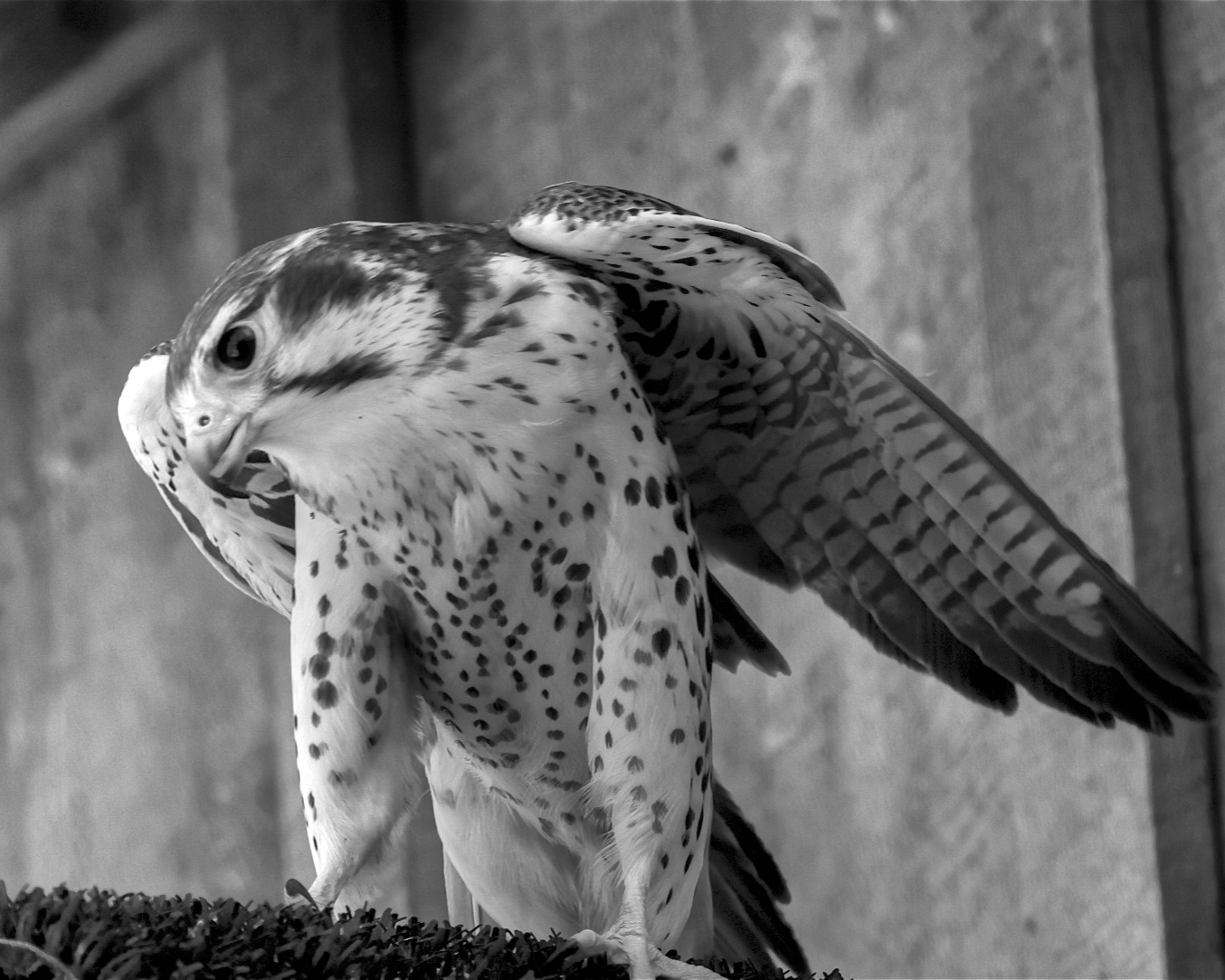
In the end, I have some fun snap shots, but nothing to put in the screensaver.  I spent an insane amount of time trying to salvage one of the photos by blurring away the distracting background.  Unfortunately, the photo doesn’t look right now–see if you can tell which one I majorly doctored.

At least I learned a lot for the next time.  And, none of the birds flew away.

As for Tisen, he couldn’t come to the event with me–birds and dogs don’t mix well.  But, I included another shot from his nap with Red Dog.

Treat Me Right (Even When I’m 86)

I have never seen B.B. King perform before.  When we saw he was coming to a small venue in Chattanooga, we had to go.  I am so glad we did.

B.B. King is 86 years old and still so full of life that you just want to stand where his light can shine on you.  He is so adorable that he could have just sat on the stage smiling and the audience would have been grateful.

I could not stop thinking to myself, this guy is the same age my aunt was when she died.  I cannot help but compare the sad shell of a woman my aunt was at the same age vs the belting-out-the-songs (albeit in short spurts) B.B. King.  What an inspiration.

I looked at Pat and said, “I wonder what it would be like to have a job you still want to be doing when you’re 86?”

What was really cool was the reverence the audience had for this octogenarian.  I think everyone there felt honored to be listening to B.B. King talk and play and sing.  I compare this to going to my aunt’s bell choir performance at her assisted living facility.  The attitude of the audience was one of amused patience; we were doing a favor for the performers by being there.

The B.B. King audience was there for the opposite reason–to have the honor of being in B.B. King’s presence.  That audience felt gratitude for B.B. King doing us the great favor of getting up on that stage.

I sometimes think about aging and what it means if, at the end of your life, who you are is taken from you in the form of dementia (something that happened to all four of my grandparents and half of my aunts).  I had a recent conversation with a friend about the Okinawa study.  There, the elderly are revered and good health reigns, even amongst centenarians.  And they have more centenarians than any where in the world.

My friend said the families there fight over who will get to take care of their aging parents.  It’s considered an honor and a privilege to take on this responsibility.

B.B. King made me feel honored and privileged; I have to wonder how much this ability contributes to the difference between a man who still lives life and a woman who sits idly in front of the TV while her memories slip away.

On a photographic note, the one disappointment of the evening was that I called ahead to make sure I could bring my camera, but when I got there, they told me I couldn’t take it in.  I should have tried a different security person because I met man with a very large point-and-shoot who said he was told just not to use flash.  I had to make do with my iPhone.  When I saw how horrible my pictures were, I understood why the promoters didn’t take away phones.

Oops, I did it again

I’m not sure how it happened, although it’s possible 2-for-1 margarita night at Taco Mamacitos is related.  Somehow, the Canon EF 70-200mm f/2.8L IS II USM lens ended up at my door.  Having lusted after this lens since its release, the combination of that second margarita and the best price I’ve seen caused me to click a button I shouldn’t have clicked.

Having taken an online workshop by Zack Arias in which he repeatedly admonishes budding photographers not to spend money on equipment until getting to know the equipment we already have intimately, you would think I would have more self control.  Zack recommends shooting with a new lens for 6 months and only that lens until you can see the world through that lens and know exactly what you’re going to get (and not get).  He has a valid point that until you know every bit of capability you can eek out of a lens, you really don’t need to buy another one.  In my defense, it’s been more then 6 months since I added a lens to my bag.

Having spent the money, I decide I should apply the second half of Zack’s advice and get to know my new lens intimately.  Since it overlaps with my 100-400mm lens, I figure doing some comparison is a good idea.

Walking over to my favorite park, I head down to the ridge between the wetland and a creek.  Since I want to see how the extra light helps out, I shoot with a wide open aperture with both lenses.  The 100-400mm lens is a f/4.5-5.6, which is annoying since the maximum aperture changes as you zoom.  But, the extra 200-400mm is sure nice.

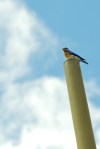
A bird I thought was an Eastern Phoebe poses for me for a bit–I am unsure of what kind of bird it actually is.  I snap a few shots with the new lens.  I switch lenses and take some comparison shots.  I switch back and get some shots of a Song Sparrow in the creek.  I switch lenses and try with the 100-400mm.  I switch back and shoot some more.  I catch a cardinal posed in the sun.  Then, on the way out of the park, I manage to spot an Eastern Bluebird who won’t quite step into the sun for me, but lets me get many shots with the new lens.

I shoot both lenses wide open and hand held.  I find that most of my shots with the 100-400mm missed the focus.  I’m not sure if I was waving around the lens too much when focusing or whata, but it’s hard to see direct comparisons because so many shots were so completely off.  The 70-200mm focused much faster in all cases, which might explain why I had an easier time focusing on my subject.

All in all, when I look at the images from the new lens, there is something about them I just like better.  Maybe it’s because I’m still trying to justify the purchase?

Double Sunset

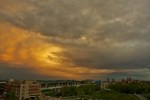
Between working on a self-portrait, working my way through another online photography workshop, and taking a break from from both by shooting outside, I’ve managed to spend nearly all of my weekend on photography.  I pick up my camera and start to tuck it back into my bag when I look out the window.  The sun is doing something amazing.  It’s setting in the East.

I am reminded of a conversation I once had with a directionally challenged friend.  It went roughly like this:

I said, “Look at the sunset!”

She said, “Oh wow!  It’s really beautiful.  I always thought that was the East.”

I replied, “What?”

She repeated, “I always though that was the East.”

Confused, I said, “The sun always sets in the West, so that has to be the West.”

She replied, “Oh, I know the sun always sets in the West, but that’s the East.”

At this point I gave up.

However, I am not confused.  The sun, of course, is setting in the West, but the light is bouncing around in inexplicable ways that make it look like it is also setting in the East.  I cannot explain why the clouds reflect the sun so brilliantly in the Eastern sky tonight, but it’s beautiful.

Frozen with my camera still in my hands, mid-way to being put away, I look at the camera and immediately head to the balcony, grabbing my tripod on the way.  The obstacles from the balcony quickly frustrate me.  I return inside, tripod over my shoulder, and head on up to the roof.

The double sunset motivates me to try to shoot a set of photos that I can stitch together into a panoramic image.  I start in the East and work my way around to the real sunset.  I end up with 12 overlapping photos.  I consider reshooting on the vertical, but the light is starting to change and do other interesting things.

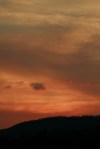
A small wisp of clouds forms just over the ridge in the distance, turning brilliant red.  I decide not to risk missing the last of the light by reshooting the panoramic and shoot the changing light instead.

When I return inside and try to figure out how to stitch the photos, I learn that my Canon software is so outdated it won’t run on any of my computers anymore.  I do some googling to figure out I can use Photoshop Elements to stitch a panoramic and go to work.

Something has gone awry in my 12-photo series and one photo seems to be out of place.  It’s as if I changed focal length in one shot.  I don’t remember doing that, but maybe I bumped the lens and magically bumped it back.  In any case, I don’t much like the panoramic with 12 pictures.  I create one of the East and one of the West instead and am much happier with the results.

I still want that full frame camera, though.

Break Time

Taking a break from my first attempt at a self portrait, I pack up my gear and head to the park across the street.  My collection of gear seems to be growing.  I have to leave a lens behind to make space for my loupe with a 3x magnifying viewer (which, by the way, kicks the but of any pair of reading glasses–not only can I actually tell if I’m in focus or not, but I can even use it to read the impossibly small icons on the control panel on the top of the camera).  I tuck in a garbage bag in case I want to lay in any mud (you never know when the urge will strike), and I stuff in my new 5-in-one 22” reflector in the event I decide to do some macro photography while I’m over there.

I go to the park prepared  to shoot macro, wildlife, and/or landscape.  I’m nothing if not flexible.  I am also prepared for rain.  Besides my trash bag, I carry my rain jacket just in case.

I swing my camera bag and my tripod bag over my shoulder with my camera hanging around my neck.  As I pass the gym across the street, I see my reflection in the windows.  I look down at my feet, clad in five finger shoes.  I find myself thinking it’s a good thing I don’t have children–they would never go anywhere with me in public.

As I enter the park, I see an eastern blue bird.  It looks like it may have a nest on the light–it’s carrying a bug and acting like it’s feeding something.  I cannot see any baby beaks from where I’m standing, however.

Next, a great blue heron lands in the wetland.  I creep behind the cattails, hoping to get a shot.  As I get close, I see him standing with a frog hanging out of his beak.  But he flies off and I am left wondering why I didn’t change to my longest lens before sneaking up on him.

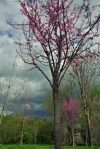
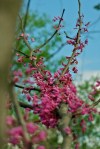
I head back towards the paved path, looking for a spot to shoot clouds, and then blooming trees.  I switch back and forth between shooting macro and landscape, wishing I had that second camera.

I make good use of the trash bag getting a new angle on blooming trees.  My reflector comes in handy when I need some shade on the red bud blooms.  However, the wind is picking up and macro shooting at 3 feet above the ground does not go well.

I shift back to shooting landscape.  As I stand overlooking the Tennessee River, it starts to rain.  My garbage bag transforms into a rain cover for my camera.  My rain jacket goes on, the hood goes up, and I head back home.

Tisen is frantic when I return home.  He jumps at my legs as if demanding an apology for being gone for so long.  Maybe someday he’ll be OK.

My Cloudy Clouds

I have been studying clouds quite a bit lately.  Not only am I obsessed with getting a landscape shot with sharply focused clouds from front to back, but I am also learning how clouds help predict changes in weather, which is helpful in hang gliding.  Apparently hang gliding pilots are the best weather (wo)men–at least the ones who survive.

Plus, I just like clouds.  Who doesn’t really?  There’s something fascinating about the way they swirl and swoosh and dissolve in front of our eyes.

When it comes to my photographic goals with clouds, I’ve come to several conclusions.

  1. A fast shutter speed freezes the movement caused by wind.
  2. A small aperture is essential for expansive clouds that range from front to back in the frame.
  3. Lower ISO settings prevent graininess that can make clouds look less sharp.
  4. All of the above makes it very difficult to get sharp looking clouds in low light.
  5. Finding a focus point about 1/3 of the depth keeps things sharp front to back.
  6. Even if you do everything perfectly, the clouds may not be sharp in real life.

Number 6 is my latest discovery in my endeavor to capture sharply focused clouds.  Given that “cloudy” is used to mean “1. lacking definite form or limits” and blurred is considered a synonym for “cloudy,” this might have occurred to me sooner.

I find myself relieved to realize that my images are, in some cases, every bit as sharp as the clouds themselves were.  I have been walking Tisen through the park gazing upwards, smiling at the blurry looking clouds.  I try to pretend I’m bird watching so bystanders don’t think I’m crazy.  I’m not sure it helps.

For today’s experiment, I tested this theory.  I went up on the roof and got some shots of the sunset.  I found an angle that had parts of a roof top in the very near foreground that angles away from the camera towards a ridge line in the mid-depth of the photo and then a second ridge further back.  I figured this gives me landmarks so I can tell if I have depth of field even if the clouds appear blurry.

I also looked carefully at the clouds and determined that they hurt my eyes when I try to bring them into focus just with my eyes–especially the dark, large, foreground mist.

In post processing, I lifted the shadows beyond my personal preference in the first shot just to be able to see the sharpness of the focus better:

I look at the landmarks at each distance through the loupe in Aperture at 200%.  They are acceptably sharp.  Perhaps they could be sharper if I were shooting more towards the middle of the aperture range for my lens, but there is no discernible difference in the level of sharpness between the foreground and the background.  This makes me happy.

I can now stop calling myself names for having cloudy looking clouds.

Portrait Anyone?

The S.O.A.R. event on St. Patrick’s Day went wonderfully.  Over 200 people came and I think the event exceeded their expectations.  Watching children hold birds was especially a treat–how many people get to hold a bird of prey on their arm before they’re even a ‘tween?

As far as my venture in trying to get people to donate in exchange for photos, well, it turned out to be quite the challenge.

I did a few things right:

  • I practiced with my new lighting as much as possible beforehand.
  • I worked out a workflow ahead of time.
  • I setup my camera to shoot in JPEGs since there would be no time for post processing.
  • I took all my equipment out to the site the night before and did lots of testing to pick a good location to set up.
  • I tested my 100mm f/2.8 lens in the space I had to work in and prepared to shoot with my 17-55mm f/2.8 lens based on the results.
  • I did a lot of test shooting with my strobes at home with the 17-55mm lens.
  • I brought Pat along so he could help solve some of my more difficult problems.

I also did a few things wrong:

  • I should not have tried to use recently purchased lighting equipment at an event given my lack of experience with artificial lighting in general–it created extra stress
  • I didn’t set a custom white balance, which I really needed because of no post processing.
  • I forgot my CF card reader, which blew away my workflow until Pat went to Wal-Mart.
  • My extension cord crossed a major traffic area; Pat and a roll of duct tape to the rescue!
  • I didn’t test the process for burning CDs beforehand.  Having not burned a CD in about 10 years, this wasn’t wise.  My workflow resulted in drive failures, ruining several CDs.  I found a work around, but it wasn’t easy.
  • Finally, and most humiliatingly, a weird shadow suddenly appeared in my photos and I couldn’t figure out why.  After rearranging lighting about 1000 times, Pat came along and asked, “Are you sure it’s not the thing on your lens?”  Apparently, I bumped my lens hood and the wide part was in the wrong position, causing the shadow in the frame.  I can only explain the failure to recognize the problem immediately as a brain malfunction given this is something I’ve seen in the distant past.  Unfortunately, it’s one of those things that screams, “SHE DOESN’T KNOW WHAT SHE’S DOING!” to your potential customers.  <sigh>

While these mishaps didn’t negatively affect my fund raising in the end, they did negatively affect my confidence.

As you can see from the gallery, I did not exactly produce stellar images.  While the circumstances were challenging, I have to face the fact that I didn’t have the skills for the challenge–yet.  So many things to work on!

On the up side, my black and white Prairie Falcon portrait sold in the silent auction.

Fledgling Part II

Recovering from a long day on the mountain.

Continued from Fledgling:

After breaking a down-tube on my first mountain launch, I have to figure out how to pick up my glider and carry it off the field.  I make it across the field and a couple of instructors run over to help.

All-in-all, I am not sure I’m ready to launch again.  But, back up to the top of the mountain we go.  I spend the ride back to the top hoping the wind has shifted.

But, no.  The wind is still good and there are plenty more gliders for me to break.

I set up the next glider with my hands shaking.

When it’s my turn, I am feeling nauseous.  I contemplate backing out.  But, I step up onto the launch ramp for the second time.  I get set, the instructor tells me the wind is perfect, I call clear and start the approach without hesitation.

This time, the launch is good.  However, when I look at the airspeed indicator, it tells me I’m flying too slow.  I pull in for speed, but the glider starts oscillating like I’m flying too fast.  I go back and forth trying to decide if the airspeed indicator is wrong or not.  Then I hit a small bump in the air.  My glider rises suddenly and then drops back down like a giant puppeteer has just jerked an invisible string.  I experience a moment of panic.  I start talking to myself out loud, trying to keep my wits about me.  I keep it together through a few more small bumps and find myself safely over the landing zone.

I have a repeat problem with suddenly being out of altitude.  As I start to make the final turn for the landing approach, I realize I’m too low and I square up the glider and roll it in instead.  No broken down tube this landing.

However, I do end up far from the breakdown area.  Gliders are really not meant to be taken for a walk.

The instructor who helped me after my first landing comes over and congratulates me.  He compliments me for my decision making.  It’s like a consolation prize–in spite of all my mistakes, I didn’t make a final, critical mistake.  I appreciate the compliment none-the-less.  Focusing on small achievements is, after all, how I ended up here one minuscule step at a time.

On the way back to the top, I experience a sense of disappointment.  I remind myself that my learning process has often been one step forward and two steps back.  I remind myself that I just launched from about 1500 feet higher than I ever imagined I would.  I remind myself that I stepped off that launch ramp, focused on the horizon, knowing that I could.  And I did.  I did something I didn’t think was possible until two weeks ago.  I launched, I flew, I landed, I survived.  Twice.  Maybe I’ll suggest a new T-shirt for the pro shop.

Fledgling

Today, we drive up to Lookout Mountain.  It’s my 4th attempt at my 1st mountain launch and the wind looks promising.

When the glider is assembled, I do the pre-flight check of my life.  I check every nut, bolt, wire, and thread as if my life depends on it.  Oh, that’s right, it does.

Shortly after 8AM, I am standing on the launch, ready to go.  I am having progressively more difficulty breathing.  I take a few deep breaths.

Alas, so does the wind, and in the wrong direction.  I sit on the ramp and we wait, hoping the wind will settle.  It doesn’t.  I back up off the ramp and set my glider down.

Three of us wait for our virgin flights.  We’ve been there 2 hours when at last, it happens.  The wind dies and starts to come in as a slight headwind.

I watch my 15-year-old fellow student launch like a pro and then step up for my turn.  I remind myself to breathe.  The instructor reminds me to breathe.  I stand ready.  I call clear and start my approach.  My eyes are on the horizon; I don’t see the ramp at all.  I have no sense of falling, but I’ve made a major mistake–I’ve let the nose of the glider pop up during the approach, which means I am, in fact, falling off the launch for a split second.

Thankfully, due to the design of the glider, I’m not in serious danger as the glider will recover on its own.  Even better, I realize the nose is high and pull in quickly, making the recovery almost instantaneous.

Surprisingly, I am not scared by this mishap.  I go through the checklist:  1) Fly away from the mountain.  As I look around and try to decide what the definition of “away” is, I am overwhelmed with giddiness–I am actually flying.  I cackle with glee.

Then, I move on in my checklist:  2)  Check your speed.  I look at the speed indicator and I am flying nearly 25 MPH.  I ease out a bit, take a deep breath, and remind myself to relax.  That’s about as far as I get before it’s time to start the box pattern around the landing zone.

I can only judge my altitude when I am level with a landmark; I completely lose track as I begin the final landing pattern.  I cut the approach pattern short when I realize how low I am.  I pull in for speed, begin the round out, and then suddenly go into brain freeze when my feet drag the ground.

Proximity to the ground does not determine when you flare and I know this.  I flare anyway.  I balloon up and then, even worse, I let the nose drop.  I try to flare again, but this never works.  I land hard on the wheels. I am unharmed but the left down tube breaks.  I get up, unhook and feel grateful for modern engineering.

To Be Continued . . .