








The Fungus Among Us

I’m a big fan of mushrooms.  I like to eat them (when someone else has tested them first) and I like the way they look.

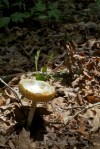
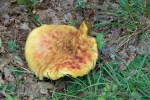
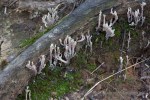
When we started off down the Savage Gulf Day Loop trail, it seemed like there was a new mushroom we’d never seen before every 10 feet or less.

In fact, sometimes there were whole families of mushrooms and, in some cases, it looked like the children were adopted.

I was blown away by the colors and sizes and varieties of mushrooms that added color to the trail in a way previously left to flowers.

Unfortunately, after toting the tripod around for 2.5 miles at Laurel Falls and Stone Door, I’d decided I didn’t want to tote it around for potentially 5 miles on the loop trail.  I opted for my camera with the 24-70mm lens and a 100-400mm lens in my bag in the hope of having less weight on my shoulders.  I also made a mental note to myself to, in the near future, look for a backpack with a hip belt that I can use to carry photography equipment–I have got to get the weight off my shoulders.

I’m fairly certain that the decision to leave my 100mm macro lens and tripod behind actually caused a massive mushroom bloom from the time we left the car to the time we started down the trail.  I would bet a lot of money that had I carried my tripod and macro lens, we wouldn’t have seen a single thing interesting enough to shoot up close.

As it was, I was left to try to simulate shooting macro in a dark environment with a hand held camera.  I was thankful that my Canon 5D Mark III has such awesome higher ISO performance (well, compared to my 40D, which I also left behind).  Were it not for that, I wouldn’t have captured a single mushroom.

On the way out, I shot mushrooms at 70mm, getting as close as possible, which isn’t that close since it’s not a macro lens.  The images are all cropped as a result.

On the way back, I shot mushrooms at up to 400mm, standing back further and desperately trying to hold the lens still.  I’m impressed that I got any decent shots at all.  I think this speaks to the amazing technology of image stabilization built into the lens.

Granted, some of the shots are a bit blurred from too much movement with too long of a shutter speed.  The second image is an example of this.  It’s one I should probably just delete.  But, when I looked at it in post processing, I was so pleasantly surprised to discover what I assumed was leaf debris was actually a tiny snail sitting on the mushroom cap, I couldn’t think of deleting the image.

It’s funny how sometimes the most pleasure comes not from executing a shot well but by discovering something in a shot completely by accident.
Stone Door

Continuing our weekend adventure, having made it from the asphalt to the “unimproved” part of the trail (does anyone actually think asphalt is an improvement?), we continued on our journey to the Stone Door.

I don’t know exactly what image “Stone Door” conjures in your mind, but in my mind, when I read the description that said:

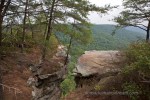
Stone Door, a 10 ft. wide by 100 ft. deep crack, forming from the top of the escarpment into the gorge below. It looks like a giant door left ajar and was once used by Indians as a passageway.

What I envisioned was a giant slab of rock standing straight up in the middle of two cliffs and standing ajar so that one can walk between the “door” part and the cliff part.  I guess I skipped over the “deep crack” part.

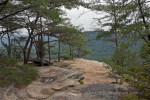
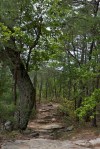
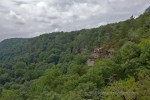
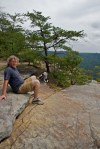
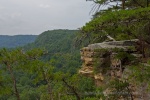
When we arrived at Stone Door, the view of the valley was fantastic.  Plus, the top of the cliffs provides some really interesting scenery in and of itself.  The only part I didn’t like was being anywhere near the edge.  The drop off was terrifying.

Pat and Tisen sat patiently while I worked my way around the top of the cliff, shooting everything I dared to shoot.  I really wanted to get a great shot looking down on the crack in the cliff, but it was tough to get a good angle without rock climbing gear.  I always knew I should have become a rock climber.

I have to pause here for a moment to do a mental double take on whether those words actually came out of my fingers.  Me . . . a rock climber?  Well, maybe not.

In any case, I couldn’t get the shot I wanted mainly out of pure fear.  Or perhaps fear in this case was good sense?  I was pretty determined not to fall into the crevasse never to be found again.

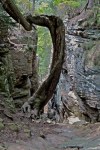
We worked our way back down with me stopping to shoot straight on to the crack.  There was a large tree in the opening that created a key hole sort of image for me.  I played with that for a while and contemplated walking down the steps a bit to see what kind of interesting views I could get, but Pat was concerned about time and we needed to drive to the other side of the park to see the next part of our adventure:  Savage Gulf Day Loop.

So, I packed it in without getting a great shot of the crack.  As we walked away, Pat said to me, “I wonder where the Stone door is?”  I wasn’t the only one who didn’t picture a big crack!

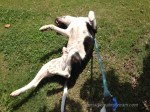
Tisen seemed nonplussed by the whole stone door thing.  I imagine there are certain advantages to being a dog.  One of them is probably no expectations.  Don’t get me wrong, Stone Door is really cool and definitely worth the effort to get there.  Just don’t expect something that looks like a door.

In Lieu of Backpacking

We are trying to get a hike in at least once a weekend.  Since it’s a big reason we chose to move to Chattanooga, we figured we ought to take advantage.  However, the hot and humid August weather has made hiking slightly less enticing.

I did a little research to pick a place to hike that wasn’t too far away.  I learned about South Cumberland State Park and the Savage Gulf State Natural Area, located inside the park.

There was a 17 mile hike that sounded intriguing, but 17 miles for us means spending the night.  Since I had a lot going on this past week, we didn’t have time to prepare for backpacking.  Plus, we weren’t quite sure where Tisen would sleep given that our 2 person tent is really only big enough for a person and a half.

So, we opted to do two short day hikes instead.

We headed out Saturday morning loaded down like we were spending the night after all (the joys of too much photography equipment).

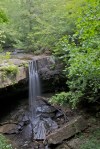
When we arrived at the Stone Door ranger station, we saw a sign that said Laurel Falls was only 250ish yards from the parking lot.  So, of course, we had to walk there first.  What they didn’t mention was that it was 250 yards down a bunch of stairs and 250 yards back up those stairs.  But, still, who wouldn’t go 250 yards to see a waterfall?

I’m not sure how excited Tisen was about the waterfall after the stairs, but he made it and I was happy I had my tripod so I could shoot with long exposures, creating smooth water.

We headed back up the steps and on towards Stone Door from there.

The walk to Stone Door started on a paved path.  Paved as in asphalt.  We noticed blazes on the trees marking the trail and Pat commented that he was glad they’d marked the trail because otherwise we might have gotten lost.  It did seem a bit odd to hang metal trail blazes on the trees along a trail that was paved, but I guess they haven’t lost anyone yet.

The first overlook was the end of the asphalt, thankfully.  Although, we passed a woman coming back the other way with only one leg.  I don’t know if she was able to walk on the unpaved portion of the trail or not, but it did make me appreciate the asphalt.

From the overlook, we not only got a nice panoramic view of the mountains, but we spotted a rocky outcropping in the general direction we were headed.  We suspected it was our destination.

Tisen was not any more excited by me setting up my tripod at the overlook than when I pulled it out at Laurel Falls, but he waited fairly patiently once Pat took him off the asphalt and into the shade.

If there was one thing that would have made the day nicer, it would have been cooler temperatures and less humidity.

The Trouble with Relationships

For those of you who have not been visiting my blog for long, we have a dog we adopted at the end of January who likes to carry squeaky toys with him wherever he goes.  Because he was previously mistreated, he has issues with food.  So, getting a new squeaky toy every once in a while has been a more effective reward than traditional doggy treats.  This has resulted in some unexpected growth to the family.

Many weeks ago, we had an “incident” where Lamb disappeared.  She went missing for two weeks.  About the second week, ‘Possum also went missing.  We were suspicious.  About a week after posting the story of our Lost Lamb, Lamb turned up again.  She was hiding under the bed.  ‘Possum turned up about a day later, mysteriously reappearing without any explanation.

Interestingly, since that incident, Lamb and ‘Possum were rarely seen together.

In the meantime, new members of the family seemed to be getting out of control.  I decided I needed to do some new portraits since it’s been a while since I last shot the entire collection of Tisen’s collection.

Unfortunately, quite a few members of the family were out in the car, but I did manage get a group portrait of Red Dog, Minnie, Eddie, Baby Beaver, ‘Possum, Lion, Big Dog, Duck, Goat, Lamb, and Blue Dog.  In the car were Squirrel, Mr. Beaver, Puppy Luv, Tiger, Jack, and Hog.  I’m thinking you can probably figure out which ones are which.

What I didn’t expect when shooting was the revelation of some really strange relationships.  As it turns out, apparently Lamb and Duck have something going on, but ‘Possum is not over Lamb.  This was revealed to me in the middle of the shoot when Duck and Lamb unexpectedly started to run for one another and ‘Possum got in the middle of it.  In fact, ‘Possum grabbed Duck by the throat and, had I not intervened, Duck would have been a goner.

By taking a photo of the event in action every few seconds, I managed to get 18 shots that I’ve strung together into a video.  It’s a bit  . . . uh . . . rough, but you’ll get the idea.

It was a lot of fun to be shooting and have two of your models suddenly expose previously undetected emotion.  Even better, a third participant decided to be extremely jealous.

At least I know where to look if Lamb disappears again!

Something New

Tonight I did something I’ve never done before.  I went to a photo critique.  I had no idea what to expect.  My fear was that the photos I brought were hopeless.  I didn’t bring perfect pictures.  I don’t have any of those.  But, I picked a few that I really felt I hadn’t done justice to.  A few where the subject was stunning–the kind of stunning that made my mouth drop open for a few seconds before I grabbed my camera.  Sadly for each image, when I loaded them onto my computer, I was disappointed with the results.  I felt like I’d missed something, but I couldn’t put my finger on what it was.

We were only able to bring 3-4 images.  And of the 4 I brought, only 2 actually got critiqued.  But, I got enough pointers from watching and listening that I’m pretty happy with my newly adjusted versions of not only the two that were critiqued, but also the first one in the gallery.  The two that were critiqued show before and after versions.

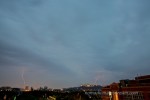
Interestingly, the critique part was not really a critique.  It was more of a group PhotoShop effort.  The image was up on a big screen and people would suggest different adjustments to improve the image.  Sometimes it really made a difference and sometimes it didn’t.  When they got to my first image (the last one in the gallery), they all seemed at a loss.  Maybe they just aren’t as awestruck by sunbeams coming through clouds as I am.  I was disappointed that no one had any really good ideas on how to make the image pop.  Everyone assumed removing the contrails would be too difficult to attempt.

When I got home, I wasn’t willing to give up on that image.  I have to give Aperture a bit of a plug here.  It took me less than 2 minutes to remove the contrails using the “retouch” brush and letting Aperture auto-select what to use to replace the contrails with.  I was impressed with how easy that was.  What was harder was doing a burn on the clouds.  I spent some time trying to increase the difference between the clouds and the sky.  The image still doesn’t do the scene justice, but I feel like it’s getting closer.

The group really liked the other critiqued image.  I played with it based on their suggestions.  Seems like it’s quite grainy to me.  I tried noise reduction, but it still looks grainy.  I’m almost afraid to do any more adjustments to it in the fear that I’ll end up with a bowl of mush.  My fellow club members encouraged me to submit it for the quarterly photo competition.  I might just do that.  Another thing I’ve never done before.

Tisen was upset with me for about 2 minutes when I got home.  Then he returned to dozing on the sofa.  He seems to be getting used to me coming and going these days.

A Different Kind of Flash

As many of you may know by now, I am fascinated by the sky.  The one subject in the sky I’ve had absolutely zero success with is lightning.  This comes with some irony as my brother has been an engineer on a project that monitors and predicts lighting for over 25 years now.

I’ve never managed to capture an actual lightning bolt.  In truth, this is probably because I haven’t put a lot of effort into it.  I have, for example, never asked my brother to let me know when they are expecting lightning storms in my area so that I might plan to shoot lightning.

On the infrequent occasions when I had my gear, I have rarely been in a place where I could get a good view of the lightning to shoot it.

At long last, I live in a place where I have a great view of the sky and I often see lightning while I am at home doing nothing more important than shooting lightning.  That doesn’t necessarily mean I actually attempt to shoot it.  Why?  What causes a person who really wants to capture a great image of lightning to sit on one’s duff and watch the light show unfold without so much as pulling one’s camera out of its bag?

Frustration.

That is the crux of it.  The times I have gone to the trouble of setting up, adjusting the settings (usually involving a few googles along the way), and then shot and shot and shot some more only to come up empty have made me bitter when it comes to lightning.

Oddly, when I see a bolt of lightning flash across the sky, it doesn’t necessarily look that fast.  Perhaps it’s because it’s burned an image of itself onto my retina?

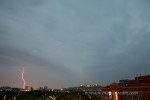
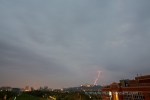
For this morning’s shoot, I started out setting a fairly open aperture for a sky (f/8) based on some advice from the web along with 100 ISO and a long shutter speed.  I quickly realized that the guy who wrote this advice assumed the sky would be dark.  With lightning at sunrise, I really wanted more depth of field.  I also wanted a fast shutter speed to freeze the clouds, which were blowing fast across my field of view.  However, I sacrificed on the fast shutter speed in favor of capturing a lightning bolt.

The lightning kept flashing within the clouds, refusing to show itself.  Then, suddenly, it flared straight at the ground.  Lucky for me, the shutter was still open.  My first lightning bolt!  Then I caught another a few minutes later.

I combined the two into one image using Photomatix (which is not what it’s designed for), but it turned my lightning bolts pink.

I shot for a long time, but there were no more bolts.  I returned indoors to comfort the dogs (Twiggy is visiting again).  As soon as I sat down, a web of lightning bolts flashed across the sky.  Shoot!  I mean, Darn–I didn’t shoot!

Portraits without Flash

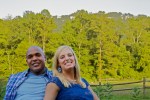
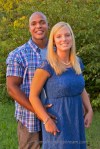
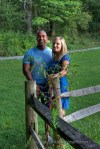
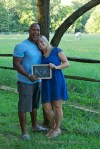
Having spent several hours on post-processing more images from my latest attempt at portraiture, I thought I would do a second post from this shoot.

I mentioned some of the challenges I was unprepared for in my previous post on this topic, but what I didn’t talk about was the flash.  Several month ago, I had the realization that I needed portable lighting while shooting the same couple.

At the time, I had recently invested in some studio lights.  When, however, the couple who volunteered to model for me wanted to shoot outdoors, I was stuck with nothing but the built-in flash on my Canon 40D.  In other words, no lighting at all.

So, I invested in an off-brand, all manual flash and started learning how to use it on a flash stand.  But, when I subsequently upgraded my camera, I got distracted relearning the things I thought I already knew how to do and the flash sat in a corner, unused.

I had started taking an online course on flash photography and learned that maybe my off-brand manual flash wasn’t the best equipment to start with.  That led to me delaying purchasing radio controllers for the flash, thinking I might end up buying the latest, built-in radio flash unit if I figured out what I was doing and decided it made sense.

All of this led to me continuing to use a long cord from the flash stand to the camera when I wanted to us my flash.  And, in case you thought I was never going to get to the point, led to an accident involving knocking over my light stand with the cord when I was attempting to light a mimosa tree a couple months ago.  What I didn’t know was that the adapter broke when the stand fell over.

Having put off scheduling this follow up shoot for so long, I hadn’t had my flash unit out for many weeks.  And, of course, we had a last minute invitation to have dinner with friends before they left to go out of town.  So, in a nutshell, I was rushing to get ready for the shoot before racing off for an early dinner with our friends and then racing back to meet my models for the shoot.

Which means, I didn’t discover the broken adapter until I got to the location and was trying to figure out how to make it work.  After fiddling around with it enough to get it to mount sideways with the flash twisted back to the front, I realized I wasn’t going to have enough power to light both of my subjects from far enough away to shoot wide enough to capture the setting, which my models wanted in their images.  So, after waiting months to shoot them outdoors with a flash, I was stuck with natural light after all.

This is a really long way of saying being prepared might be a good idea.  🙂

Crap Shoot

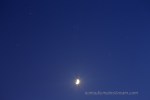
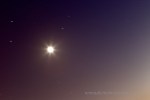
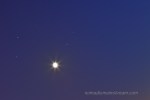
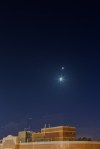
When Pat called to tell me that Mars, Saturn, and Spica were all going to be in the vicinity of the moon the other night, I, of course, had to get out my camera.  It’s a funny thing about astronomical events.  I get all excited because I get a chance to get a picture of white dots in the sky.  I could probably put white dots in a shot of twilight a lot more easily and I wouldn’t have to wait for the actual event to occur.

But, as it turns out, I’m somewhat old fashioned when it comes to photography.  This is rather strange given that I’m a relative new comer to the art.  For whatever reason, I prefer to attempt to capture the real white dots in the sky as opposed to creating my own.

That said, what does one do when one walks away from shooting and, the next day, looks at the images and smacks oneself in the forehead and rolls one’s eyes while wondering what in the heck one was thinking during the previous evening’s shoot?

I had a vague notion that maybe I could take a bunch of exposures and then combine them using Photomatix to create star trails, I guess.  I think I would have needed to shoot for about 3 more hours to create decent star trails.

But there were other problems with my shooting.  First, I couldn’t see Saturn, Spica, or Mars when I looked through the view finder.  As a result, I didn’t shoot as tight as I should have and I ended up with the moon lower in my frame than I would have liked because I guessed wrong as to where they were.

I have to pause here for a moment.  Why is it you can look at the sky and see something plain as day and then look through your viewfinder and have it disappear?  It was even worse trying to use live view mode.  I had to give up on that entirely.  Perhaps if I would have waited longer after twilight the planets and star would have shown up better in the sky.  As it was, I was trying to catch the deep blue of twilight–was there ever a better color of blue?

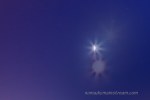
Having come up with mostly crap, I decided to play with HDR processing a bit more than usual.  I tried combining photos that were not actually shot in a sequence for combining.  I turned off the features that align images and remove ghosts.  I created a scene where we have two moons in one image.  In another, I just ended up with what looked like sun spots reflected in the lens.  It was fun to play with it even though I didn’t really get anything I like out of it.

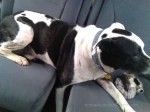
As an aside, Tisen’s girlfriend, Twiggy, is staying with us again this week.  I caught them napping on the couch together.  They swore they were just napping.  I believe them.

Shoot

I haven’t used the flash in many weeks.

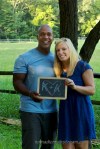
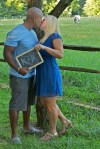
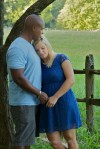
I actually bought the flash because I needed it when trying to shoot a couple for their “Save the Date” announcements.  The plan was to do a follow up shoot to get something they can use for a decorative idea the bride had for their wedding reception.  However, it took weeks for me to get the flash unit and figure out how to use it.  Then, I had the new camera I was trying to learn to use and they were busy.  Finally, we scheduled a date but then it rained.  I would love to shoot in the rain, but I don’t think that’s what they’re looking for.

At long last, this Sunday I pulled out my flash stand and flash again and we went off to the Nature Center and Arboretum.  Assignment:  Get a shot of the happy couple in a natural setting that reflects how much they enjoy the outdoors.

Fortunately, they are members of the Nature Center so we were able to shoot up until dusk.  This was very helpful.


When we arrived, the first problem was the weather.  It was so incredibly hot and humid.  It hurt to breathe.  I felt a little sorry for myself lugging around so much equipment in the heat, but the bride-to-be was wearing what looked to be the most uncomfortable dress, so I stopped feeling sorry for myself and was grateful I didn’t have to wear anything hot.

The second problem was the insects.  I know my precious birds wouldn’t survive long if there weren’t a gazillion insects for them to eat, but I really resent that insects find me so tasty.  I guess better me than the bride.

The third problem was the sun.  It was far too bright when we arrived, leading to many squinty pictures.  We moved into a shady area to shoot until the sun started to drop, but this led to the fourth problem:  the place was completely surrounded by trees.  The sun went from too high and bright to too dark in a matter of minutes.

But the final, and most difficult problem to solve was me.  I find myself having no interest in thinking of interesting poses (or looking for poses on the internet).  I’m so focused on the subjects faces that I have to force myself to notice anything else.  I’m looking for a moment of expression when the muscles relax and just do what they really do.  Sometimes it’s very subtle.  I don’t really care if the hair is perfect or if the clothes are smooth or anything else because all I want to see is that split second when the muscles of the face sink into an unforced expression.

I find I do care about the out-of-place clothes and hair after the fact, unfortunately.  They make a difference when they distract, I find.  I just wish they would distract me a bit before I shot the photo.

Feeder Watch

Apparently there were more exciting things going on in Chattanooga last Saturday than sitting around watching bird feeders because I was the only one at the visitor’s center diligently watching the feeders.  However, this gave me the opportunity to get some shots of the birds that I wouldn’t have been able to get had a crowd of people showed up, so it worked out just as well.

The House Finches were the most plentiful by far.  There seemed to be a couple of males who had collected large harems.  Or, perhaps they were couples who had many almost-adult daughters but no sons?

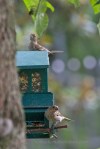
The cardinals and titmice were close seconds in number.  One of the feeders at the visitor’s center has a mechanism that closes off access to the seed if something heavy lands sits on the perch.  This keeps squirrels off of the feeder.  However, it also means only one bird can perch and feed at a time.  This creates a great study of bird learning.

Some arrive, see another bird on the feeder eating and attempt to join it.  If the bird eating is an experienced and assertive bird, it will flap and squawk at the newcomer, attempting to deter it from landing.  If successful, the newcomer will go perch nearby and wait until the first bird leaves or it gets impatient.

If it gets impatient, it may land on the perch far enough away from the second bird so that it leaves it alone.  However, the extra weight causes the perch to lower and the doors to the seed close.  Then both birds fly away and, usually, a third bird swoops in to take advantage of the opening before the other two birds can regroup.

Some birds simply give up and join the squirrels on the ground hoping for someone to knock out a bunch of seed while eating.  They are joined by the birds that prefer to eat off the ground regardless.

For me, I got a rare close look at both a male and female Eastern Towhee.  I say rare because I rarely saw them in Columbus and so far, in Chattanooga, they have mostly been perched high in the tree tops when I’ve seen them.  Apparently all I needed was a feeder.  Chipping Sparrows seemed to keep them company.

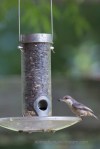
Even though the brown-headed nuthatch is a common bird here, having never seen one before, I was pretty stoked to get to see three of them gathering at the feeder.  They don’t make it up North, so I’ve only seen white-breasted and red-breasted nuthatches in the past.

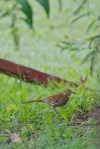
Not at the feeders, but nearby, a Carolina Wren called from the gate.  Then, a Brown Thrasher showed up under a feeder-less tree.  If that wasn’t enough, a wild tom turkey went strutting by the parking lot fence and crossed the railroad tracks in plain view.  We’d seen a whole family the last time I was there, but Tom was fun to watch, too.
Not a bad birding day.