Parade Shooting

If there’s one thing I’m learning about photography, each shoot is different and presents unique challenges from the one before.  In some ways, it reminds me of when I went through what I’ll call “my triathlon phase.”

I thought I would be able to do a triathlon and look at my times and compare them to the previous triathlon to see if I’d improved.  In reality, there were so many variables from one event to the next that there was never a good comparison.

Unlike triathlons, I don’t spend hours every day training only to be left exhausted, run down, and incredibly sore.  Perhaps this is why I don’t feel so discouraged when I come away from a shoot and feel like I’ve backtracked instead of making progress?

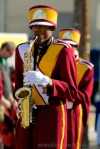
Shooting the Mainx24 Parade presented several challenges.  First, the parade started at 11AM on a wonderfully sunny day just when the light was getting really hard and bright.  Adding to the challenge, the parade participants marched with the light mostly behind them.

In addition, a parade is somewhere between a portrait shoot and an action shoot–the people are moving at such an incredibly slow speed that you think you have plenty of time.  Yet, with each step forward, the light changes, the people rearrange and get closer–just when you think you’ve figured it out, they have their backs to you.

To further complicate things, I’d decided to try shooting with two cameras for the first time.  I had my 70-200mm on my trusty old 40D and my 24-70mm on my 5D Mark III.  I haven’t shot with my 40D in so long that I had to get out my glasses to find the on button!

I took a tripod to simplify dealing with two cameras.  I set up my 5D on the tripod–I would likely have knocked myself unconscious in front of an oncoming horse if I were juggling two cameras.

I found the tripod had an additional advantage.  It allowed me to create a space to shoot in that most people respected–they tried to stay out of my shots for the most part.  Of course, when candy was being thrown to the children, all bets were off.

However, it was also restrictive and unnecessary give the shutter speeds I was shooting at.  On the flip side, I did pop the camera off the tripod from time to time, so it wasn’t like I had to use it.  I’m on the fence as to whether its advantages outweighed the difficulties.

The images in today’s gallery were all shot with the 40D.  I probably should have put it on the tripod and panned with people.  MIght have made for some better images.

In the end, this was not a banner day.  But, it was fun and I met a couple of other photographers in the process.
No Rain on This Parade

Who doesn’t love a parade?  With the possible exception of the screaming fire engine sirens (which we hear more than enough of at our place and don’t need to go out to hear), it’s pretty tough to have a bad parade.  All you need are some animals, a band or two, and smiling kids and you’re set.

Today, the first festival of the Christmas season in Chattanooga took place.  It’s called Mainx24 because it’s focused on trying to make Chattanooga a 24-hour city.

I don’t really see that happening this decade, but it’s nice that it happens once a year.  Plus, it’s a celebration of the city’s South side, which is a neighborhood in transition.

Having witnessed the transition of some of the neighborhoods in Columbus that were perceived as the “worst” into hot spots of historical preservation, celebration of the arts, and community gathering, I have a special fondness for transition.

A few decades ago, my mother ran a preschool in one such neighborhood before its transition began.  On days when I didn’t have school but she did, I would go with her and “help.”

The neighborhood seemed slightly terrifying to me at that time.  It was full of old, victorian homes with boarded up windows that threatened to throw pieces of themselves at me if I ventured too close.  Not that I wandered far–there were always people wandering the streets that, in my innocence, seemed threatening.  In retrospect, I would guess they were harmless homeless people, but I had never actually seen homeless people before then.  Sometimes they stumbled around, obviously drunk.  I had also never seen drunk people, so I had no idea why they behaved oddly.

Decrepit historical houses were purchased by the city and sold for $1 to buyers who could demonstrate their ability to restore them.  It was an amazingly successful project.  That same neighborhood is now known as Victorian Village and is one of the more expensive parts of Columbus to live in.

The restoration of this area became contagious.  Soon, the near-by neighborhood now known as the Short North started changing.  The buildings facing High St were gradually restored and turned into trendy art galleries, restaurants, music venues, and shops.  New buildings in historical styles started to appear with high-end apartments and condos.

The two areas met in the middle, although there is still a mix of the unrestored (and affordable) with the beautifully appointed, fully restored historical mansions.

Chattanooga’s South Side doesn’t seem to have too many mansions.  It was mostly an industrial area before its transition began.  But from the size of the crowd drawn to today’s festival, it’s definitely a place people want to be.

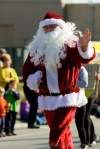
I think adopting New Orleans-parade tradition in tossing candy (and even the occasional beads) to children was a brilliant way to guarantee all the kids will be clamoring to come back again next year.

Chasing the Sun

I have had many romantic notions about the sun in my time.  What sounds more romantic than hanging out on a beach watching the sunset?  Or watching the sunset from the top of Mauna Kea on the Big Island of Hawaii?  Or staying up all night and watching the sunrise together?

The truth is, watching sunset on the beach caused one of the worst allergic reactions I’ve ever had–never did figure out what I sat on.  Standing on Mauna Kea to watch the sunset caused light headedness and near hypothermia.  And as for staying up all night to watch the sunrise, well, I haven’t actually managed to stay up all night since I was in my 20’s.  Even then, by the time the sun was rising, I was nodding off.

Don’t get me wrong, I have no regrets.  The beach sunset in San Diego was the first time I’d watched the sunset from the West coast.  We sat on a collection of rocks for a half an hour while the sun made its descent, slowly melting into the ocean at the end of its journey.  In the foreground, a collection of sea lions barked a chorus to accompany the show.

As for Mauna Kea, the clouds sank below where we were standing.  We were like the gods of Mt Olympus watching the sun follow the clouds until it disappeared beneath them.  And, the tour that took us there provided parkas, so we weren’t really at risk of freezing to death even in the blistering winds that blew up the mountain at impressive speeds.

And the last time I watched the sunrise after staying up all night, I was at Daytona Beach on the East coast, watching the sun rise out of the water like a brilliant breeching whale.

These days, I’m shooting sunrise and sunset only when I happen to notice something interesting and I happen to have my camera handy.  This is mainly because when I actually plan to shoot sunrise or sunset, I come home with about 1000 images that all look virtually the same.  Then I spend hours comparing and deleting.  It’s a time drain.

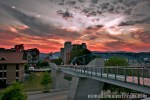
But maybe that doesn’t make them less romantic?  After all, I took the shot of the sunset over the glass bridge when Pat and I were strolling around downtown Chattanooga holding hands, exploring our new city shortly after moving here.  The image of sunrise over Market St was taken during a similar early morning walk along the riverfront.

Perhaps I’ve started taking the sun for granted.  There was a time not so long ago when seeing the sun was a real treat, regardless where it was in the sky.  In my home town, there are only 5 sunny days a year.  I think that’s the average per week in Chattanooga.

Maybe that’s why I’ve once again ended up with so many photos of the sun?

Bright Star

Bright star, would I were stedfast as thou art–
Not in lone splendour hung aloft the night
And watching, with eternal lids apart,
Like nature’s patient, sleepless Eremite,
The moving waters at their priestlike task
Of pure ablution round earth’s human shores,
Or gazing on the new soft-fallen mask
Of snow upon the mountains and the moors–
No–yet still stedfast, still unchangeable,
Pillow’d upon my fair love’s ripening breast,
To feel for ever its soft fall and swell,
Awake for ever in a sweet unrest,
Still, still to hear her tender-taken breath,
And so live ever–or else swoon to death.

-John Keats

Last night, Tisen started sticking his head under my mouse-hand, making it impossible to work.  I eventually took the hint and got his leash.

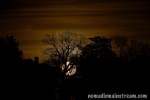
As we entered the park, I looked East and saw a bright glow coming from the ridge.  “Crap!” I said aloud, and then looked to see if anyone heard me.  Saved from embarrassment by solitude, I moved Tisen into a trot thinking we could make it around our 2/3 mile loop in time for the moonrise.

I told myself I was being foolish–the moonrise lasts only a few minutes.  As we made our way down the path, I looked over my shoulder to see if we were missing it.  The light glowed strongly through the trees in the park.  Once again, I said, “Crap!” but this time, there was a man walking behind us.  I might have blushed a little.

I tried to rush Tisen, but this resulted only in him pausing mid-sniff to give me a perplexed look.  When we made it around the next corner, I realized the glowing light I saw through the trees was a well-lit building.  There was hope!

When at last we got back to where I could see the ridge, the glow I had spotted on the way out remained unchanged.  I squinted and saw it was actually a billboard on the side of the hill.

I pulled out my phone and checked the time.  It was only 6:32.  The moon rose at 5:44PM officially the night before . . . the last time I shot the moon rising behind the ridge, it didn’t appear until 15-20 minutes after the official moonrise time . . . the moon usually rises about 40 minutes later each night than the night before . . . there was hope!

I had not missed the moonrise at all.  Perhaps Keats understood the moon better than Juliet–steadfast in its predictability.

Arriving on our rooftop, a glow started to appear behind the ridge.  I positioned the top of the ridge low in the frame to cut out a brightly lit window in a house below the ridge.  Not liking the composition, I reframed including the window and shot again.  As I check the image through my loupe, I realize it was not a window I was seeing at all–it was the moon!  I nearly swooned to death.

Huh.

After a long first day back from a week’s vacation, I look up from my work and see it’s pitch dark both inside and out.  I look at the clock.  It’s 7PM.  Rain streaks the glass on the windows.  I pause long enough to wonder how long it’s been dark and raining without me noticing.

I realize I haven’t thawed Tisen’s dinner yet.  I dump some frozen nuggets into his bowl and set them out to thaw.  Twiggy, visiting for a few days, dances at my feet, her butt wiggling back and forth with the force of her wag.  Tisen jumps at me.  Both are impatient to go out.

I put Tisen’s rain jacket on (he hates to walk in the rain) but he won’t hold still while I zip it.  After the 3rd attempt, Tisen is zipped in and I grab the leashes, checking the poop bag holder to make sure there are at least 2 bags.  I grab an extra roll just in case.  Then, I head out into the dark leaning back against the leashes like a water skier.

As we walk around the park, I think of what I want to shoot tonight.  I decide I should take advantage of the rain and see if I can capture rain drops.  This is something I have failed at so many times that I have no problem failing once more.

But this time, I am armed with a flash.

Back home, full of optimism, I walk out onto the balcony, attach the flash, position a reflective wrap to bounce the flash, find something to focus on, and take a test shot.  Nothing.

I decide it’s not raining hard enough and sit down to wait.  My glass of wine makes the time pass.  The rain picks up and I try again.  I try focusing close and far.  Repositioning the reflective wrap and shooting without it.  I get a few shots that have some white dots in them.  Nothing very exciting.

I try another round, this time, including out-of-focus street lights to add a background.  I manage to get a few more dots and I kind of like the blurred balls of colored light.  Not exactly what I was going for, though.

The rain slows and I look for something else interesting to try.  I decide to try panning with passing cars to see what I get.  This is just good fun.  Don’t ask me why I have so much fun creating completely bizarre images that really don’t work well, but I do.  I particularly like the one shot of the car crossing the Market Street bridge off in the distance.  Maybe it’s the blurred Christmas lights in the foreground that I like so much?

I am reminded of a photography workshop where the instructor talked about how at least one thing must be in focus for a shot to work.  He’s probably right.

Bubble Wrap

I mentioned in yesterday’s post that we will be home for Christmas this year.  I didn’t mention why.  We’re moving.  It’s not the kind of move that makes my Nomadic heart sing, but it’s a move none-the-less.  We are moving to a quieter place not far away from where we are now.

I have moved many times in my adult life.  My moving truisms:  1)  move often, 2) take little, and 3) start packing early.  1 and 2 are intricately related.

Toward this end, I start cleaning out excess stuff and packing what we want to keep even though we are several weeks away from our move.  It’s a busy time of year at work and at home, so the earlier I get started, the less stressed I’ll be.

This means pulling out the empty boxes from our last move along with the bubble wrap and paper packing material, and packing away the decorative things that make us feel at home.  I start with the photos displayed on our walls, mostly by photographers far more talented that I.

It takes yards of bubble wrap to safely package the photos framed under glass.  I wrap each one lovingly, remembering the photographers whose works I display on my walls.

I am tempted to pop the bubbles in some of the wrap.  It’s hard to resist the popping noise bubble wrap makes when you jump on it.  But, it doesn’t make for good protection once it’s been popped.
When I’ve packed the photos and most of the non-essentials in the bedroom, there is still a stack of bubble wrap left on the floor, perfectly sized for wrapping glasses.  It’s too soon to pack glassware, something we most definitely use every day.

I hold a piece of bubble wrap up in the early afternoon light streaming through the windows and get an idea.  What if I were to shoot the view through the bubble wrap?

I imagine reflections of the city skyline in the bubbles like those commonly seen in water droplets.   Then, I imagine a distortion that makes the city look like it’s inside a snow globe.  I can’t wait to give it a try.

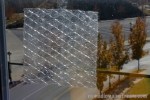
I tape a single square of bubble wrap to the window then press my lens close to the glass next to the bubble wrap and focus on the skyline in the distance.  I move my lens so I’m shooting through the bubble wrap and search for an image that might look like something.

Alas, there is so much distortion, most of the focus is lost.  There are no reflections in the air inside the bubbles like there would be in a water droplet.  The plastic creates flare, like when shooting into the sun, but it doesn’t really create a globe effect.

While I’m not fond of the resulting images (I like the macro shots of the bubble wrap better), at least I found a way to play with bubble wrap without destroying it.

A Month Before Christmas

Here we are, a month before Christmas, and I am realizing we are going to be home in Chattanooga for Christmas this year.  Having just returned from visiting family for Thanksgiving, I find myself feeling a bit nostalgic for the old days when family from both sides was within a 3 hour drive.

Combine that with the sudden nip in the air and I find myself wistfully wishing I had a few things to look forward to.

For one, gifts piled under a Christmas tree.  There was a time when I would put up a tree and wrap all the gifts early just because I liked the way they looked. I was known for taking ridiculous care in wrapping packages, always folding every crease, never leaving a cut edge exposed, and often hand making bows from interesting ribbons.

These days, I think more about using up leftover wrapping paper, recycling old paper or gift bags, or having things gift wrapped at the store.

As my nephews have gotten older, the things they want have gotten smaller and more expensive resulting in paltry stack that barely occupies the corner of a table, let alone fills the living room.  It’s a good thing they have also outgrown playing with boxes.

I gave up on having Christmas decorations, including a tree, many years ago.  I found not decorating for Christmas a relief.  The amount of work in exchange for a very small amount of time to enjoy the decorations (since we always went out of town) just didn’t seem worth the trade off.  Especially not in January when we kept procrastinating taking down the outdoor lights in the hope of warmer weather.

Now, I watch the cars driving in and out of the tree lot across the street and find myself tempted to get a tree.  But where would that lead?  Next there would be ornaments, garlands, lights, and icicles.  And it doesn’t stop there.  It’s like a gateway drug to hard-core decorating.  Before you know it, you’re putting snowflakes in the windows, lights on the windowsills, and looking for inflatable, lighted Christmas scenes for the balcony.

Instead of buying a tree, I peruse my old photos in search of Christmases past.  I am reminded of cookies, snow, and our wonderful dogs, past and present.

This will be our first Christmas at home in 21 years.  It will be only our second Christmas without my nephews in those 21 years.  The first time, we were camping in the Everglades.  This year, we will be home with no tree, no lights, no gifts, no family.

Sounds like it’s time to think of a new tradition for Christmas.  Maybe I’ll look into renting a snow making machine–a white Christmas in Chattanooga would truly be a Christmas miracle.

Going Classic

On our moonlight walk last night, I also spent some time shooting what could be called “classic” scenes from the Chattanooga waterfront.  I call them this because you can find similar shots hanging in just about any restaurant, office, gallery, or photographer’s booth at a holiday market.  It seems we are all attracted to the waterfront, particularly at night.

I discover several problems with shooting in the dark:

  1. I can’t see what’s in the frame and what’s out until after I shoot and review the shot.
  2. With a very dark foreground, it’s impossible to get autofocus to work in the part of the shot I want to focus in to get the greatest depth of field.
  3. I cannot see well enough in dim light to focus manually.
  4. Focusing on spots of light reflected in moving water is next to impossible.
  5. The magnifying loop is a life saver.

That said, in the spirit of Thanksgiving, I am grateful, too:

  1. I have this fabulous view within a 5 minutes walk
  2. It’s warm enough to be out shooting in November without having to wear a parka
  3. I have a supportive and patient husband who’s willing to walk the park with me while I shoot at 9:00PM at night
  4. I am able to make time for my hobby
  5. I have made life choices that freed up money for photography and other things I enoy
  6. The aquarium lights are on.

Perhaps I will have a more philosophical list tomorrow.  For now, It’s late, I’m tired, and what I’m most grateful for at the moment is having a comfortable bed waiting for me.

Happy Thanksgiving!

Walkin’ in the Moonlight

At the end of the day, I find myself with no new photos, nothing to write about, and a dog that needs to go for a walk.

I decide it’s been too long since I shot down at the riverfront at night.  I have shot the riverfront from the roof and balcony many times, but I can’t remember the last time I actually carried my camera down to the river after dark.

Having gone small yesterday, it seemed reasonable that today I would go wide, so I put my 16-35mm lens on my camera, grabbed my loupe and tripod, and talked my husband into coming with me and bringing the dog.

Walking Renaissance Park at night is always an interesting experience.  The meadow voles who live on the hillside at the park entrance seem to be mostly daytime critters–no rustles are heard in the leaves as we walk by, unlike earlier in the day when something scurried away every few steps.  Ironically, if they would hold still, we would never know they were there.

But as we head down the walkway past the wetland, leaves crunch loudly in the woods to our right.  A little too loudly.  We glance at each other and then peer into the darkness of the woods wondering what might be lurking there big enough to make that much noise.  I remind myself how loud even a mouse can be in fall leaves and we keep moving without any boogie men jumping out at us.

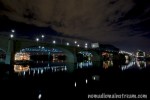
I pause to shoot the reflected trees in the wetland water.  It’s not the most stunning reflection, but I like the bright trees at the top of the hill and the dark sky streaked with clouds.

Tisen drops Snake (one of his newest family members), leaving the red and green toy (doesn’t every family have a Christmas snake?) laying in the shadows along the sidewalk while he investigates a smell.  Whoever was here before him left behind an interesting story–I finish shooting long before he’s done sniffing.

The night is cool, but I am warm enough with a sweater and light jacket.  The frogs and cicadas have disappeared and the only noises we hear besides the occasional rustle of leaves is the voices of other couples walking in the moonlight.

I think how romantic this walk might be if I weren’t carrying a tripod and stopping to shoot for long intervals.  My husband patiently keeps Tisen entertained while I shoot.  Maybe that’s it’s own kind of romance?

As we work our way around the same path we have walked hundreds of times in the past 15 months, I look at the scene anew.  Shooting causes an interesting shift in perspective–I look at the moon, the clouds, the lights, the converging lines, and the sculptures from different angles and look for new ways to combine them in my frame.

I realize the same old scene is actually never the same twice.

King of the Hood

I needed to get outside, I needed exercise, I wanted to shoot, and the dog needed to go for a walk.  The perfectly logical course of action was to take the camera, the dog, and go for a long walk on a beautiful fall day.

The dog has his own agenda.  He’s determined to claim the neighborhood between our neighborhood and Stringer’s ridge.  It’s a neighborhood full of dilapidated chain-link fences and scary looking dogs who bark at us endlessly.  Tisen ignores these dogs.  He takes a cat-like approach to tormenting these fenced-in dogs.

He takes his time sniffing every blade of grass, marking each clump taller than 6 inches–he does this so slowly I expected him to sit down and start grooming himself.  The poor neighborhood watch dog goes ballistic throughout the whole show and I try to get Tisen to move on quickly.

Having two hands free might have come in handy, but letting go of my camera and bending down to reach Tisen was not an option–at least not without risking knocking Tisen in the head with my swinging camera.

At the ridge, I sit on a tree log placed at the overlook to shoot the view.  Tisen pulls on the lead and I knock the lens hood off my camera and watch it roll halfway down the hill.  I manage to leave Tisen at the top leashed to a branch in full view as I slide my way down to retrieve my lens hood.  Being a klutz and a multi-tasking photographer are probably a bad combination, but I make it safely back to the top where I am treated to exuberant adoration from my dog who apparently had little faith I would return at all, let alone safely.

As we return home, we pause once again in front of the barking dogs.  I look around and realize that if you value having a really affordable place to live with beautiful surroundings, this is a great neighborhood.  There are nothing but colorful trees on the three hillsides that nearly form a bowl around this little valley.

But then, we pass a house with a porch covered in glass objects.  They were scattered around, fallen over, abandoned like the porch was a miniature dump.  This might not have been so disturbing by itself, but the glass was mingled with a child’s toys that looked like they had been left in the middle of play.  It made me shudder.

A motion in a tree above the porch caught my eye and I spotted a Eurasian Collared Dove sitting there, looking at me as if it wondered how long it would take me to notice him.  It’s a somewhat rare sighting here at the edge of their range, and rarer to me having grown up in a part of the world where they don’t roam.  I smile and wonder what this bird thinks of the neighborhood.