Jumping the Moat

Continued from Lost and Found.

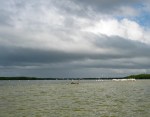
Christmas morning we woke up early and laid there in the dark, realizing we could no longer hear the Gulf slapping the banks of our tiny island.  Even when we held our breath, we couldn’t hear the waves.

When at last dawn lightened the sky, we decided to get up and get an early start in our canoe.  We had about 8 miles of paddling in store for us and we were already sore from paddling yesterday.

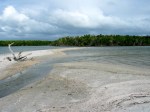
When we stepped out of the tent, we discovered our tiny island had become a giant island at low tide.  Actually, it was still a tiny island, but now it was surrounded by a giant moat.  The Gulf was suddenly so far away, it was almost unbelievable last night we were worried our canoe would get washed away by high tide.

We ate breakfast slowly.  We walked around the island and watched the sunrise.  We packed up our campsite.  We loaded up the canoe.  All the while, the water was slowly rising, coming closer, but it still looked hopelessly far away.

Having nothing left to do, we sat and waited.  But then, the wind died and we were sitting ducks for biting insects.  We were suddenly motivated to find a way across the moat, dragon or not.

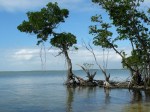
We slid our canoe along the murky shore while we walked as far as we could on dry land.  We found that the opposite end of the island was closer to deep water than our end, so we edged our way through thick mangroves until we finally stepped into the muck and pushed our canoe and gear through the shallows until there was enough water that we could get in and paddle away.  We were itchy with drying muck as we paddled off into the sun.

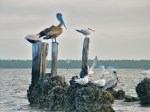
We hadn’t been out too long when we saw a strange line of evenly spaced white dots stretched across the horizon.  As the dots got larger, we realized it was a large group of American White Pelicans flying in precise formation, sweeping the surface in search of prey.  They flew to a shoal where a huge conglomeration of pelicans gathered.  That might have been the best Christmas present ever.

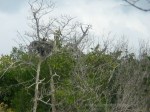
When we stopped for lunch somewhere between Rabbit Key and Tiger Key, we discovered a family of Osprey.  The young were nearly the size of their parents and angrily demanded to be fed while their parents seemed to argue that it was time for them to leave their nest.

We arrived at Tiger Key without any navigational hiccups.  But the wind soon died and we discovered “no-see-ums.”  I tried a trick someone told us–smearing baby oil on my exposed skin.  I ended up looking like human fly paper and they still bit me–my skin looked like a basketball.

Thankfully, we managed to keep the bugs out of the tent and fell asleep with smiles on our faces, dreaming of Osprey and Pelicans.

Lost and Found

The first day of our canoeing adventure along the Gulf Coast in the Everglades, I discovered a key difference between canoeing in the Everglades and canoeing down a river.  There’s only one way to get lost when you canoe downstream on a small river:  failure to stop at the pick up point.

Canoeing in the Everglades was a completely different story.  We had a permit to camp on a particular Key each night of our trip.  Our first day, we were supposed to paddle about 7 miles to Rabbit Key.  Unfortunately, we started out heading down the wrong channel through the mangroves.  As we paddled around trying to identify openings between tiny mangrove islands that matched shapes on our map, I realized how little a map drawn from an aerial perspective reflects what land looks like from the water.

As the navigator, I eventually gave up on the map all together, picked a channel that pointed generally Southwest, and took us through the maze of mangroves until we hit the Gulf.  Assuming we were West of our destination, we paddled East.

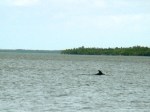
Paddling along the Gulf Coast through swells of salt water in a canoe identical to the canoes we’d paddled as children was a completely surreal experience in and of itself.  Then, we spotted a dolphin about 50 yards from our canoe.  It was a joyful sort of strange.

After having paddled long and hard in the Gulf (which is not at all like paddling down a river) we decided to break for food and try to locate ourselves on the map.  We figured we might just stay where we were.  We were rapidly running out of daylight and we really wanted to have our campsite setup before dark.

We took a walk around the island we’d stopped on, trying to get a sense of what it might look like on our map.  Fortunately, we stumbled across a sign that identified the Key we had landed on.  It was Rabbit Key, the key we were supposed to spend the night on.  While this was mostly pure luck, Pat was still impressed by my sense of direction (too bad it doesn’t seem to work in the Chattanooga area).

Taking some advice someone had given us, we found a suitable spot to pitch our tent where there was plenty of wind.  Then, we pulled our canoe well up out of the water so it wouldn’t float away at high tide.  We ate quickly and went to bed, exhausted.

In the middle of the night, I woke up and went out to heed the call of nature.  When I looked up at the night sky, I’d never felt so close to the stars.  I’ve been to the top of Maunakea, which is supposed to be one of the best places in the world to see the stars, but here at sea level on a tiny key in the Everglades, it seemed like the stars were within arms reach.  It was astonishing.

See Ya Later

Nearly a week into our 2008 Christmas road trip, we made it to Everglades City, Florida.  We were looking forward to 3 days of canoeing and camping along the Gulf Coast.  But, the day we arrived, we decided just to enjoy the surroundings and spend the night comfortably in a local bed and breakfast (who also happened to rent canoes).

Before we could really enjoy ourselves, we decided to head to the local grocery store and stock up on supplies for our camping trip.  This did not take long because the local grocery store was about the size of a large convenience store at a gas station.  There was very little selection and only one brand of anything they carried.  This had the advantage of making decisions very easy.  Do you want bottled water?  1 liter or 2 gallons?  Do you want beef jerky?  Oh, they’re buy 3 get one free.  Do you want granola bars?  1 box or 2?  I love easy decisions!

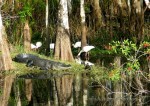
On the way back to the hotel, we discovered a roadside park with a lovely swamp occupied by so much wildlife, at first I thought it was a zoo.  I couldn’t get over the birds.  If all birds were that big, birding would be so much easier!

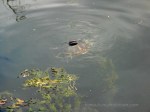
The Cormorants stood around drying their wings.  The Little Blue Heron posed while stalking fish.  And the Anhinga, well, they were the most amazing of all.  I saw a stick poking up through the surface of the water and suddenly realized it wasn’t a stick at all!  It was the beak of an Anhinga who was walking along the bottom of the pond with its beak sticking up through the surface like a breathing tube.  I don’t know if it was really breathing, but I was blown away by the scuba diving bird!

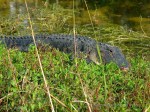
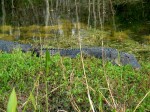
If the birds weren’t enough, the alligators added a whole new level of excitement.  While you can’t tell from the photos, there was a fence between the closest alligators and us.  Although, it was a fence they could have run around to get to us.  I’ve heard alligators are pretty fast, but Pat kept an eye on the gators to make sure none were sneaking up behind me when I was looking at his brother.  You have to respect any animal that has been around for as many millennium as the alligator.  They reek of ancientness.

Amazed, loaded with images, and stocked with food for our trip, we decided to try a local restaurant that was recommended to us by the bed and breakfast.  It was one of those hyper casual places that served on picnic tables with paper plates.  But I had the best salad I’ve ever had in my life there–the greens, herbs, and flowers (yes flowers) were all grown in the restaurant’s own garden.  Just writing about it makes me want to return just to have another one of those salads.

It was a great way to prepare for our canoeing adventure.

The Trail Less Traveled

The last installment (for now) from our backpacking trip to Yosemite . . .

Waking up that morning, we were the kind of tired you get from hiking a 1500 foot rise in elevation twice carrying close to 40 pounds on your back combined with not sleeping well.  One of my bad decisions to reduce the weight of my pack was to use an ultra-thin thermal sleeping pad that was 3/4 long.  That was a decision I would regret every night of our trip.  If there’s one thing a body needs when you’re pushing it hard is good rest and an ultralight, 3/4 length sleeping pad is not the way to get it.

So, there we were, still with no appetite although the nausea had subsided some, super tired, and in the middle of a mosquito festival.  We moved extraordinarily quickly getting out of camp that morning.  That’s one thing about through hiking–if you hate where you camp the first night, it’s only one night.

We were headed up the final ascent to El Capitan.  Although our tired bodies could feel the climb, it was a relatively gradual ascent.  Given we were already suffering from some altitude sickness, going up was not the best direction, but it wasn’t like we were climbing Everest and potentially going to die from altitude sickness.  We did not, however, move very quickly as we made our way up those last couple of miles to the top of El Capitan.

Fortunately for us, we weren’t far from the top.  We made it before lunch even at our snail’s pace.  Even more fortunately, our appetites started to return and we managed to snack and feel a little more energized before we got there.

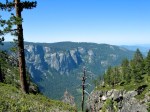
As we walked out onto the top of El Capitan, any aches or pains were forgotten.  It was the first time we stood together looking at the panoramic view of Yosemite valley.  It was Pat’s first time in Yosemite, and I was relieved that he felt the same amazement I felt when I saw a similar view from the top of Half Dome a couple years earlier.

After the nausea, fatigue, poor night’s sleep, and mosquitos, I felt giddy with relief that Pat thought it was worth it to stand there with me.

We spent an hour there.  We had our lunch on top of El Capitan, enjoying the view and the sense of achievement.  While we didn’t climb up the face like the rock climbers who come every year, we had pushed ourselves enough to still feel that rush of “I really did something.”

Although we were there during peak tourist season, we didn’t see anyone until after we got past El Capitan.  Up until that point, we’d had the trail completely to ourselves.  Of the tens of thousands of people in the park at the same time we were there, not one of them crossed paths with us for that day and a half. We truly felt like wilderness explorers.

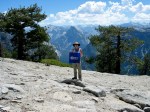
P.S.  In case you’re wondering, the photo with the “Outdoor Source” bandanna is because they offered a discount if you brought them a picture with their logo on the trail.

Fearless and Foolish

When I returned to Yosemite with my husband in 2004, after spending a night up on Clouds Rest, we hiked over to Sunrise Lakes and spent a night there.

Sunrise Lakes consists of three lakes that are at different elevations on the mountain.  We hiked our way up to the top lake, eventually coming to an area that was a popular place to camp.  As we passed a group’s campsite, a young woman stepped out of a tent.  She told us her friends went on a day hike and she decided to stay behind and read.  After chatting for a bit, we continued on, hiking over a ridge and finding a spot to set up our own, much smaller camp.

After getting our site setup, we were about to take a dip in the lake when the girl from next door appeared.

“Uh. . . can I hang out with you guys for a little bit?” she asked.

As it turned out, there was a black bear in her campsite.  I insisted we go back and chase it away or it would never leave them alone.

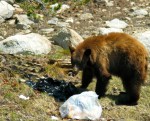
So, we returned to her site to discover a relatively small black bear (who was actually brown) had found a bag of trash that had been left in an open bear canister.

I have to take a moment to get on a soap box here.  We had never backpacked in a park where you had to use bear canisters before.  But, when we got our permit, the ranger explained to us why we needed them and how to use them.  We followed the instructions carefully.  They were simple:

  1. Anything that has a scent must go into the bear canister.
  2. Your kitchen area must be at least 50 feet from your tent
  3. Any and all leftover food, pot scrapings, wrappers, trash, etc have scent; refer to rule 1.
  4. The bear canister must be properly closed.
  5. A properly closed bear canister can be set on the ground in the kitchen area.

Although we found evidence the next morning that a bear had come through our campsite, as the rangers promised, when it discovered all the goodies were unobtainable in our canisters, it quietly moved along without even knocking over a canister.

But, back at our neighbors’ campsite, I should have been afraid of a roughly 400 pound bear with scary claws, but, he just seemed like a bigger version of our dog.  I experienced no fear.  I led the three of us as we shouted, clapped, and threw rocks.  Between throwing and clapping, I took as many photos as I could.  I can’t say I spent a lot of time on composition.

We chased the bear away, but, unfortunately, our neighbors didn’t learn their lesson.  A13 year old in the group left a container of Gatorade in her backpack and the bear harassed them all night long.

It makes me sad to think that bear may have eventually paid the ultimate price because people couldn’t follow simple instructions.

Among the Clouds

In 2004, I talked my now-husband into going backpacking in Yosemite.  I carefully planned a 67-mile trek around the top of Yosemite Valley that I figured we’d be able to complete in 7 days.  Pat said no.  I re-planned, reducing our plan to 42 miles in 7 days  Pat was dubious, so I added “escape routes” so that if we decided to retreat to the valley and stay in a hotel, we could.

Pat had never backpacked before, but having been to Hawaii with me for 2 weeks a couple years earlier, he had learned what happened if he allowed me to set an itinerary without supervision.  At the end of our trip, I asked him if there was anything he wanted to do that we didn’t get to.  His answer was, “Well, it might have been nice to have one day to just hang out at the beach.”

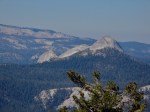
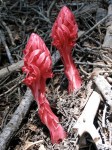
There are so many stories to tell from this trip to Yosemite, but I will stick to the ones associated with these few photos (taken with my old Powershot G3).  The red flowers are called snow plants.  Because they only grow in California and Nevada at very specific altitudes in conifer forests between May and July, I suppose it’s not a surprise I’d never seen one before.  But it was such a surprise, bursting out of the forest floor in the shadows as we made our way up to the top of El Capitan.

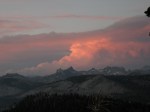
The rest of the photos were taken from Clouds Rest.  We had hiked all day to get to the top of Clouds Rest, the highest point visible from the valley.  Along the way, we saw many yellow-bellied marmots, a wide variety of squirrels and chipmunks, and one very curious mule deer buck who had walked up to us as if he wasn’t sure what we were.

We were also treated to increasingly amazing views of the Sierra Nevada mountains stretching endlessly beyond the horizon.  But, when at long last we made it to the top, we sat mute in a state of awe for a half an hour before we decided to hurry up and get camp setup and get ourselves ready for bed in time to sit and watch the sunset.

We found a spot to pitch the tent below the ridge, made our dinner following strict guidelines to avoid bear invasions, got our accommodations all arranged, and put on some extra warm clothes.  Then, we sat on the ridge and watched the light changing across the valley as the sun sank below the mountains and the mist rose in the valley.  We sat there for over an hour feeling like there was nothing more we needed to be satisfied in life than sitting on that ridge together watching the wonder of mountains.

While we had many inspiring moments on that trip, I think if that would have been the only place we hiked to, we still would have gone home satisfied.

The Morning After

After a night in the Balsam Mountain campgrounds in Great Smoky Mountain National Park, we give up on sleep as soon as there is enough light to see. Watching the lightness of the sky increase through a rain fly is not actually very exciting.  So much of the campgrounds is still asleep that I try to lay there as long as possible, not wanting to disturb the quiet.  We whisper to each other, wondering what time it is.  Pat has an uncanny ability to tell what time it is; he usually guesses within 2 minutes of the actual time.  But today, he is operating on little sleep and he guesses it’s only 5AM.  Since I have been getting up at 4AM, I know that the sun doesn’t rise until after 6AM, so I guess it’s sometime after 6AM.  We lay there contemplating whether we could possibly go back to sleep, But then our nearest neighbor’s baby starts crying again and I decide it’s time to throw in the towel.  For the second time since going to bed, I unzip the tent and head down to the restrooms.

This time, I take my toiletries with me and a camp towel.  I wash my face in the cold water and wish there were a way to take a shower.  After cleaning up, I walk back to the campsite where Pat has gotten up and started putting our gear away.  He has also checked the time and we are both surprised to learn that it’s almost 7AM!  I get out the park maps we’d collected at the visitors’ center the day before and we quietly discuss what we’ll do today.  Amazingly, we hear our neighbors on two sides still snoring in spite of the noisy children.  The neighbor to our left has a large, multi-room tent with a screened “porch” area that we can see through.  We see their dog sitting alert, watching the squirrels that keep chattering from the trees.  We didn’t know they had a dog with them until just now–it hasn’t made a single sound.  The dog sits silently amusing himself by creature watching, moving only his ears and head, patiently waiting for his people to wake up.  What a great dog to camp with!

We decide we will drive towards Cherokee and find a place to eat breakfast and then drive up to Clingman’s Dome to see the view and hike along the Appalachian trail as far as we have time for.  Pat amends our plan to add that he wants to find a hotel for the night–he’s not up for another sleepless night next to noisy neighbors.  We decide we will head North through the park after our hike and find a place to stay in Gatlinburg.  Our plan settled, I go about making a cup of coffee on our camp burner while Pat heads down to the restroom to get ready.  Unfortunately, I discover that when we were packing, we grabbed the mug that did not have the coffee filter stored with it.  Since morning coffee is something that I can’t live without, when Pat returns, he helps me look for the other cup with the filter.  Having no luck, Pat shifts into MacGyver mode.  He suggests making a filter from a Wet One, a sock, and a mesh sack, but I prefer not to strain my coffee through something icky and opt to just put the grounds straight in the cup.  After stirring and waiting for the grounds to settle, I sip carefully so as not to disturb the grounds on the bottom.  This actually works better than I expect–especially since you can’t drink coffee too quickly from a Titanium mug, it transfers too much heat and will burn your lip.

Now fully awake, I join Pat in tearing down the campsite.  We take the rain fly off the tent and turn it over, spreading it on the picnic table to give the condensation from the night a chance to dry.  We un-stake the tent and flip it over, exposing the damp bottom to the air so it, too will dry.  We pack away all the other gear and wait, our tent and rain fly still damp in the humid air.  There are heavy clouds and no rays of sunshine to help dry our gear.  Eventually, we dig napkins out of the glove box and dry off the rain fly as best we can, tired of waiting.  I make a mental note to make sure to get the gear out again when we’re at home so it can dry properly–I don’t want to have to deal with a moldy tent.

Having packed up, we stop at the restroom one last time on the way out of the campgrounds for a post-coffee brush of our teeth.  The same two rangers pass us as they start their morning rounds and we exchange enthusiastic smiles and waves as if we see each other all the time.  After finishing up, we head back down the road for the final time this weekend, hoping to see our friend the elk on the way out, but he has disappeared into the woods.  We do see an entire flock of wild turkeys with nearly a dozen young ones following their parents on a grassy slope.

Near Cherokee, we find a restaurant serving breakfast.  They have a buffet, but when we look at it, we decide to order from the menu.  Since we have a cell signal again, I’ve taken my iPad in with me to get my daily blog post done.  The waitress comes over, sees my iPad, and says, “Oh!  I want one of those!  If I had one of those, I would read all the time!”  I think she would do a lot more than read, but just smile and agree–I contain my enthusiasm for my iPad and stop myself from launching into a spiel about all the wonderful things you can do with it.  Pat gives me a look that indicates he is grateful for this–he often tells me I should work for Apple.  Breakfast comes and we eat hungrily, shoveling down eggs and bacon, toast and hashbrowns without attempting to savor it.  It’s not the best breakfast I’ve ever had, but it’s hot and we’re hungry.

We decide to go to a grocery store while in Cherokee and get some provisions for a day of hiking.  We find a large Food Lion not too far from the park entrance and wander through the store collecting apples, bananas, trail mix bars, beef jerky, and water.  We had prepared a gallon jug of filtered water to bring with us, but discovered it didn’t make it into the car when we went to refill our day-pack water bladders.  That task accomplished, we head back to the road to make our way to Clingman’s Dome.  I look forward to this–the last time we were in the park it was December and the road to Clingman’s was closed for the winter.  Although it’s overcast and visibility was poor on the way to Cherokee, I hope for clearer skies and spectacular views.

Sleeping (or not) in a Tent

Having filled our stomachs in Maggie Valley, gotten ready for bed on our way back to camp, and now arrived at our campsite as the remaining twilight fades into darkness, we decide there’s nothing left to do but sleep.  I think this is a key difference between backpackers and “campers.”  People who think “camping” means loading up their car with all kinds of goodies, setting up chairs around the fire ring, and sitting around all day think differently from people who backpack.  Backpacking means being able to haul everything you need on your back all day, rarely, if ever, gathering wood for a campfire (depending on where you are, the rules, and the fire danger level), and retiring with the sun.  Cooking is done on a super-light burner in one titanium pot because anything more than that means you’ll have more to carry.  We camp because we like to sleep outdoors, not because we like parking ourselves at a campsite and hanging out all day drinking beer around a camp fire.  While, in the state parks, beer is not allowed, which makes for a family-friendy experience, there still seems to be a set of people that hang out at their campsite all day.

We are staying next to one such group of people.  As we get our sleeping bags positioned and our food safely tucked into the trunk, they start winding up instead of down.  Somehow, they have cell reception here.  And they seem to really like the push-to-talk feature on their phone that causes them to shout at their phone from several feet away and broadcasts the responses.  I’ve been told that push-to-talk phones come with the option to talk privately, but for some reason, it seems that push-to-talk users want to broadcast both ends of their conversation as far as possible.  I find it disturbing enough to have neighbors on cell phones when I’m trying to get away from mine, but to have to listen to their conversation blaring across the quiet night challenges my ability to be patient.  Fortunately for all of us, the conversation is a short one and our neighbor puts away his phone for the night.  I figure I have to cut him some slack given that it isn’t even 9PM yet.

As we settle into our sleeping bags (or, more accurately, on them as it’s too warm to crawl inside), I nestle into my air mattress and think what an amazing invention.  I used to sleep on one of those super-thin Thermarest, self-inflating jobs, but never felt comfortable.  More recently, I invested in a Big Agnes air mattress that weighs about the same as the Thermarest and packs up almost as small, but makes me feel like I’m in the most comfortable bed when I lay down.  The only down side is if it gets a hole, but I carry a patch kit and enjoy the comfortable resting place.

Once I am situated, my eyes start to close immediately.  Just as my lashes hit my cheeks, a wail starts up in the tent behind us that does not bode well for a peaceful night.  The family behind us has 3 small children.  Two of them are small infants that don’t seem too enamored with camping.  When one starts crying, a second starts crying, then there is the fussing of the toddler.  Mom and Dad seem calm and quiet as they shush them, at least.  But Pat and I glance at each other and wonder at the wisdom of selecting a front-country campsite.

I doze off as soon as the babies go quiet.  But I’m startled from my sleep a few minutes later by another wail.  I awake with the vague feeling that I was hearing a rumble.  Pat tells me I was snoring like never before.  I laugh sheepishly and sleepily.  Apparently the neck pillow I’m sleeping on is not good for snoring.  Perhaps my snoring is what set off the crying babies again?  I rearrange the pillow and roll onto my side, hoping that will keep me quiet.  Once the babies stop crying again, I fall into the sleep of the dead.

I wake up in the middle of the night, as invariably happens when we’re camping.  I need to use the facilities and realize that it’s a long walk to get there (another disadvantage to front-country camping).  I start looking for the zipper to the tent, but there is no light, not even from the moon.  I dig around until I find a flashlight and shine the beam on the door.  I find the zipper and unzip it with a sound as loud as a gunshot in the stillness of the night.  I stick my feet out and slide them into my sandals, sitting under the vestibule formed by the rain fly.  I lean out the door and open the rain fly so I can step out of the tent, turning back as quickly as possible to re-zip the door to prevent insects from making themselves at home in my bed while I’m out.  I get myself oriented and shine the flashlight on the ground, making a small circle of light just in front of my feet so I can safely navigate the steps out of the campsite and down to the road.  I expect to be able to navigate the road without the flashlight, but it’s such a dark night and my eyes are now used to the light, I can’t see my hands in front of my face.  I turn the flashlight back on, but keep it pointed at my feet so as not to disturb sleeping campers by inadvertently shining light into their faces.

I’m concerned that I will walk on by when I get to the restrooms since it’s so dark out, but there is a concrete sidewalk outside the building that manages to reflect back what little light escapes from my flashlight beam.  It is just bright enough to allow me to see it so that I safely find my way.  On the way back, it seems even darker–probably because I managed to shine the flashlight directly into my eyes when I set it on a ledge above the sink so I could wash my hands.  I trip going up the stairs to the road, but make it up the road the 10th of a mile or so without any more tripping incidents.  When I get to the tent, Pat is wide awake, sitting up at the door.

“Do you need to go out?” I ask, thinking he’s waiting for the flashlight.

“No!  Did you call me?” he replies, sounding slightly flustered.

“No,” I say, confused.  Just then a small child let’s loose a wail that sounds just like, “Paaaaaaaaaaat!”  Pat laughs and realizes that he was awakened from a sound sleep by the cry of the child, but in his sleepy state, thought I was hurt and calling his name.  We chuckle and lay back down, listening to the child cry for a few more minutes and then hearing the call of a Barred Owl when the child settles back down.  Pat tells me that he has been awake most of the night and that the owl (and the kids) have been calling off and on.  He also tells me that I snored my way through the children screaming.  He said that it sounded like the babies were being eaten by raccoons and the older one was completely freaking out.  He couldn’t remember ever hearing children scream like that and was fairly certain they were all dead except that he heard the parents talking to the kids and calming them down and no adults screaming.

I am impressed that as a poor sleeper I managed to sleep through such havoc.  I appreciate my air mattress even more.  I settle back down and try to get back to sleep.  But, it must be close to 4AM–my body seems to think it’s time to be up.  I lay there anyway and before I know it, I am opening my eyes and darkness has been replaced with a dull gray.

Dinner in Maggie Valley

After taking our hike in the Balsam Mountains, we are starving.  Since we did not plan any meals prior to leaving (one of the advantages of not backpacking–we have the flexibility to drive somewhere to eat), we head into the closest town to find a restaurant.  Neither of our AT&T phones nor my Verizon 3G iPad has service up on the mountain, so we are limited to searching for restaurants in our Tom Tom GPS app.  This is one of the reasons I bought the Tom Tom app.  It downloads all of its data to your phone, so you can still navigate when you have no cell signal.  However, the data isn’t quite as complete or up to date as what’s available when there is a signal and searches from the web are available.  In any case, we find a list of restaurants in Maggie Valley, which is only 4 miles away.  We pick barbecue.  After all, we’re in North Carolina, barbecue should be good.  When we get a route, we discover it’s actually over 8 miles away–apparently if we were crows it would be 4 miles, but the road does enough twisting and turning to double the distance.

The “Bar-B-Que Shak” sounds like it’s just what’s in order given that we’re not exactly fresh from our hike, a “shak” sounds like a place we’re likely to fit in.  We pass several closed restaurants as we enter Maggie Valley.  These are decrepit looking buildings with sagging roofs and trash scattered on the property.  It looks as if the tourist industry has taken a big hit in recent years.  As the road descends into the valley, we pass a tourist trap with a giant tower behind the main store and big signs that say “The Most Photographed View in the Smokies.”  The tower is constructed of wood and doesn’t look particularly well engineered.  We look at the scene behind it and wonder why that would be the most photographed view.  Then we wonder how anyone could measure that.  We pass on by, not disappointed that it appears closed.

We find the Bar-B-Que Shak and are dismayed that there is only one car in front of it in spite of the sign that says “Best Bar-B-Que in Town.”  Although, it’s 7:30PM, so we hope that maybe they eat early here and the dinner rush is already over.  We always take comfort in crowds at restaurants, though.  An abandoned lot speaks volumes.  The “shak” is not fancy.  It has a log cabin sort of feel although it’s not made of logs.  Two large rooms connect and one is roped off, containing the crowd to the smaller of two rooms.  No one is sitting in the dining room and the proprietor is talking on the phone when we walk in.  She hangs up quickly and greets us in the loudest drawl I’ve ever heard.  Her voice is high in pitch and hits a note that would make a dog whine when she says hello.  I wonder if she is hard of hearing.  She recommends the pulled pork, so we both order it, me in a sandwich and Pat as a dinner without the bun.

We take a seat and wait for our food.  The dining room wallpaper catches our eye.  It’s not wallpaper at all but rather a collage of puzzles.  Every square inch of the wall has puzzles pieced together, covering the wall from floor to ceiling.  I can’t imagine how long it took to put all the puzzles together and then adhere them to the walls.  I find myself thinking about dust and dirt working its way into those puzzle pieces–they don’t seem to be coated with anything and some of the pieces have started to peel off of their cardboard backings.  It does lend a certain down-home ambience, though.  In one corner, a collection of stuffed and toy pigs sits proudly displayed.  I suppose I am a bit squeamish about being reminded of the animal I am eating, but I have a hard time looking at any of the cute, pink pigs in the eyes.

When the food is ready, the owner calls to us in her painful voice, making every vowel two syllables, “He-ey, y’all, you wan-na co-ome ge-et your fo-od?”  She is pleasant enough and well-intentioned, after all, how much control does a person have over their voice?  The food is served through a window off the kitchen.  Pat jumps up to collect our tray and brings it to the table.  The pork tastes good for about 3 bites, but then the salt starts to get to me.  I add extra barbecue sauce and it adds moisture (the pork seems dry), but makes the salt situation worse.  I try mixing the pork with the cole slaw instead and that helps.  The cole slaw is sweet and saucy, providing moisture and offsetting the saltiness of the meat.  We are too hungry not to eat heartily regardless.

The owner returns to the phone and calls back whomever she was talking to, talking on the phone in the same volume she used to call across the restaurant to us.  Pat, with his back to her, thinks she is talking to him when she asks “Do-o y’all wa-anna co-ome ge-et a pi-ece a thi-is pi-ie?” of her caller.  He turns around to respond, but she is so short that she is completely hidden behind the cash register, so he’s only more confused as to whether she’s talking to us or not.  I laugh and end his confusion, having seen her take out the phone before sitting on the stool behind the register.

After wolfing down our large platefuls of food, we get out tip money and try to figure out the logistics.  The owner calls to us again, seeing our confusion, “The-e tra-ash i-is o-over the-ere.  Y’a-all ca-an ju-ust le-ave yo-our tra-ays on to-op.”  Now we don’t know what to do with the tip given that she apparently doesn’t come out from behind the counter and there was no tip charge by the register.  We decide we’re not supposed to tip when we serve ourselves and bus our own table, so we pocket the money feeling slightly guilty and head out the door.  She thanks us and encourages us to “co-ome se-ee” her again the next time we come up to the park.  We smile and thank her and think we might actually do that–after all, what’s a little extra salt in comparison to someone actually wanting to see us again?

We drive back up to our campsite in the growing dark.  The elk is still out although he has moved up the road.  It’s too dark to get any more shots of him, but we drive by slowly.  He is now right next to the road and we pass only 20 feet from him.  He raises his head and looks non-plussed as if he recognizes our car as we crawl by.  Arriving at the campgrounds, we decide to stop at the bathroom on our way in and get ready for bed.  I am still gathering my toiletries when Pat returns to the car and informs me that there are no lights in the bathroom.  We dig up a flashlight and Pat chivalrously tells me to take it.  I remind him that we have another flashlight somewhere, but he says he’ll be OK in the dark.  I wash my face and brush my teeth in the strange light from the flashlight sitting on a window ledge.  I stand there dripping with the realization that I forgot to grab a camp towel and there are no towels in the bathroom.  I try to wipe the water off my face with my hands, which I dry on my pants.  When I return to the car, I dig up a towel and dry myself more thoroughly.  I am ready to turn in for the night even though it’s only about 8:30PM.

A Room with No View

Pat and I arrive at the South entrance to Great Smoky Mountain National Park around 3PM on Saturday.  We pull into the visitors’ center and I ask for available front-country campsites.  The ranger at the visitor’s center checks her list and rattles off all the campgrounds that are full.  It’s the first time we’ve had to ask a Southerner to slow down–we can’t keep up.  She shows us the list and advises us on which camp grounds with vacancies are closest.  We opt for Balsam Mountains even though there were only 12 sites left there as of 11AM.  It’s relatively close and it’s less popular, so we figured the odds that it will have filled are slim.

We drive through the Cherokee reservation to get to that part of the park, taking the Blue Ridge Skyway for a stretch.  It’s such a beautiful part of the country.  While Colorado and the Rockies have long been personal favorites, the Smokies have their own charm, covered in trees and draped in “smoky” clouds.  We enjoy the drive up to Balsam Mountain campgrounds although it takes longer than we expected.  It’s something I forget each time we go to a remote place–8 miles doesn’t take 8 minutes like on a highway.  As we crawl our way up the winding mountain road, we see wild turkeys along the road.  Each time, I get a step further in getting my camera together, but they disappear into the underbrush before I can get a shot off.

Then, Pat comes around a corner to see a motorcyclist pulled off in the grass on the left.  Across the grass field, a large bull elk stands with his head down, eating grass.  Pat stops the car and I get my camera out.  Having been well versed on personal safety and elks in the Canadian Rockies (where we were told that the vast majority of animal/people encounters resulting in injury are between elk and humans), I stay in the car.  However, I’m shooting with my big lens and sitting in a running vehicle.  I curse my aging eyes that I can’t tell if the pictures are clear or not from the LCD on the camera.  As soon as I put my camera down and we start to roll forward, the elk lifts his head and looks at us straight on with a mouth full of grass.  What a great shot that would have been.  We wind our way slowly by the elk, who watches us go as if he appreciates the entertainment of us stopping to gawk.

We make it to the camp grounds and go on a quest to find an empty site.  The first site in is empty, but it has a handicapped sign.  We debate the rules of occupying a handicapped site.  Is it like a parking place, which you can never park in without a sticker?  Or is it like a handicapped stall in the restroom, which you would only use if all other stalls are full?  We decide to drive on and see if anything else is open just so we don’t have to deal with the dilemma.  Fortunately, there is another site that looks to have good shade.  The sites are smaller than in most state parks and a little more on top of each other than I would like, although still more private than some of the commercial campgrounds I’ve seen.  There is a gravel pit framed with wood for pitching the tent.  The gravel is fine enough not to be bumpy but large enough to hold stakes.  We pitch our 2-man tent (which Pat says is perfect for 1 person) quickly, spread the rain-fly over it, stake it all down, blow up our Big Agnes air mattresses, and I crawl inside to get things positioned properly.  It’s good that there is no view from the campsite because the rain-fly prevents us from seeing anything other than an orange glow from inside the tent anyway.  Deciding not to put our sleeping bags in the tent yet, we head back to the entrance to fill out our site information and pay our $14 for the night.  We also make a pit stop at the restroom, which has running water, although only cold.

When we return to the site with our permit, two rangers are making rounds.  They stop to warn us about bears and about not keeping food in our tent.  One is familiar with Chattanooga and he and Pat end up chatting while I talk to the other about potential places to go for an evening hike.  He recommends Flat Creek Trail, which has one end near the campground and the other end a few miles down the road.  He says there have been many bear reports in that area and I look forward to the opportunity to see a bear (although preferably not too close).  We’ve encountered black bears several times on various hikes and have never had a problem.  However, I wouldn’t want to run into one in close proximity or come between a mother and her cubs.

We gather up the gear we’ll need for the hike.  We plan to go no more than 5 miles round trip with the amount of light left, so only one day pack will be needed.  I will, of course, haul my camera gear along with us just in case I get the chance to shoot a black bear.  Packing everything we don’t need back into the trunk of the car for security, we load back into the car and head back the way we came, deciding to start at the far end of the trail where we will be further from the humans at the campground.

As we pull out of the camp grounds, Pat spots 3 wild turkeys on the side of the road.  I’m excited by the number of wild turkeys in the park–they were once such a rare occurrence.  They, of course, dart behind tall grasses and disappear down the slope before I can get a shot.  If only they would pose for me instead of running away!  But, I suppose their quick retreat into hiding partly explains the resurgence of the population, so I’m glad that they know not to trust humans.  After we go around a few more curves, we encounter our elk friend again.  This time, a white SUV is stopped in the middle of the road and a woman is standing outside the vehicle with the door closed shooting our friend who has bedded down in the grass.  We stop and wait.  The SUV pulls off to the side to allow us to pass and the elk decides to stand.  Now, if I were that woman standing there completely exposed with no quick escape, I would start walking backwards and get into the car.  However, she takes two more steps forward, trying to get a close-up shot with a small point-and-shoot camera.  Pat passes the SUV slowly, although I really want to stay and watch just to see what happens.  As we go by, the elk looks at us with an expression that makes me think he’s asking us, “What the heck is up with this woman?”

We head on down the road and just a few curves later, find our trailhead.  We gear up and prepare to head down the trail.  Pat wears the day pack with our water and I sling my big lens on its monopod over my shoulder and we start off.