Jumping the Moat

Continued from Lost and Found.

Christmas morning we woke up early and laid there in the dark, realizing we could no longer hear the Gulf slapping the banks of our tiny island.  Even when we held our breath, we couldn’t hear the waves.

When at last dawn lightened the sky, we decided to get up and get an early start in our canoe.  We had about 8 miles of paddling in store for us and we were already sore from paddling yesterday.

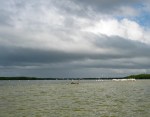
When we stepped out of the tent, we discovered our tiny island had become a giant island at low tide.  Actually, it was still a tiny island, but now it was surrounded by a giant moat.  The Gulf was suddenly so far away, it was almost unbelievable last night we were worried our canoe would get washed away by high tide.

We ate breakfast slowly.  We walked around the island and watched the sunrise.  We packed up our campsite.  We loaded up the canoe.  All the while, the water was slowly rising, coming closer, but it still looked hopelessly far away.

Having nothing left to do, we sat and waited.  But then, the wind died and we were sitting ducks for biting insects.  We were suddenly motivated to find a way across the moat, dragon or not.

We slid our canoe along the murky shore while we walked as far as we could on dry land.  We found that the opposite end of the island was closer to deep water than our end, so we edged our way through thick mangroves until we finally stepped into the muck and pushed our canoe and gear through the shallows until there was enough water that we could get in and paddle away.  We were itchy with drying muck as we paddled off into the sun.

We hadn’t been out too long when we saw a strange line of evenly spaced white dots stretched across the horizon.  As the dots got larger, we realized it was a large group of American White Pelicans flying in precise formation, sweeping the surface in search of prey.  They flew to a shoal where a huge conglomeration of pelicans gathered.  That might have been the best Christmas present ever.

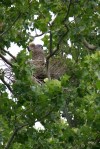
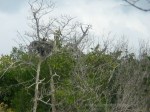
When we stopped for lunch somewhere between Rabbit Key and Tiger Key, we discovered a family of Osprey.  The young were nearly the size of their parents and angrily demanded to be fed while their parents seemed to argue that it was time for them to leave their nest.

We arrived at Tiger Key without any navigational hiccups.  But the wind soon died and we discovered “no-see-ums.”  I tried a trick someone told us–smearing baby oil on my exposed skin.  I ended up looking like human fly paper and they still bit me–my skin looked like a basketball.

Thankfully, we managed to keep the bugs out of the tent and fell asleep with smiles on our faces, dreaming of Osprey and Pelicans.

Native Song

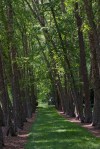
Having survived the Japanese garden at Gibb’s Gardens, I moved on with my co-shooter, John, to another part of the park.  This time, we entered an area that looked like natural woods.

As much as I enjoy gardens, natural woods are still my favorite.  By “natural,” I mean woods with plants that belong there.  This is not the same as, say, a woods covered in kudzu or so overgrown with privet or honeysuckle, you can’t even see through it.

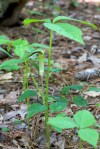
Here, the woods had only native plants and we were both tickled when John discovered a Jack-in-the-Pulpit.  Soon, we were finding more of them.

Near by, we also found some spent Trillium, Solomon’s Seal, Virginia Creeper, and the one native I don’t like to see, Poison Ivy.  I should rephrase that.  I like to see it (it is a beneficial native), but I don’t like to be anywhere near it.  I’m starting to itch just thinking about it.

As we hunted for wild flowers, a wood thrush started serenading us.  The wood thrush’s song is my favorite.  Thrushes can sing more than one note at the same time–they harmonize with themselves.  The wood thrush in particular has a haunting, flute-like song that always makes me want to stop and listen.  You can play a clip of its song here (scroll down a bit).

Although I have heard a wood thrush many times–in fact, one used to summer near our house and was my alarm clock many mornings–I have only actually seen one once.  I have never even gotten close to getting a picture of one.  This relative of the robin is reclusive by comparison.  Wood thrushes hang out in the lower story and underbrush of the woods, magically disappearing behind the tiniest of leaves.  Their brown camouflage helps them disappear, I guess.

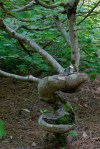
We eventually moved on from the wood thrush and made our way towards the rose gardens.  Along the way, John pointed out a tree that was growing at a nearly 90-degree angle.  He told me native americans used to train trees to grow at angles as a directional indicator towards water or other resources.  However, he felt this tree was too young to be an example of a pointer.  We never did get an explanation for it.
When we got to the base of the hill covered with roses, I was pooped.  Carrying around my 40+ pound backpack and tripod all day had wiped me out.  I suddenly realized I hadn’t had any water since 9:30AM and it was now nearly 3:30PM.  I looked up the hill and decided I really didn’t need to shoot any roses.

John, carrying less than 3 pounds of equipment including a bottle of water, was still feeling energetic enough to head on up to not only the roses, but also the day lilies at the top of the hill.  I guess that’s what a lifetime of experience shooting does for you.

Gaslight

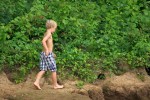
While we were on Maclellan Island, several of us got ahead of the rest of the group.  When we arrived at the meeting place to wait for our ride home, one of the women suddenly asked, “One of you doesn’t have a tow-headed boy on the island, do you?”

None of us did.  She explained that she had just seen a boy in a pair of plaid bermuda shorts on the path.

We all looked.  No boy.

A few seconds later, she said, “There he is!” We all turned to look.  No boy.

This repeated at least 3 times.  The boy was playing hide-and-seek.  The poor woman was sure we all thought she was crazy.

Eventually, we all saw him, but he immediately ran away.  We decided he was a wild boy.  Of course, I’m not sure how common it is for wild children to wear plaid bermuda shorts.

On the theme of unusual sightings, I continue to try to create photographic evidence of my white-tailed starling.  I have, over the course of the last few days, come to think of this bird as my own personal starling.

I have made a habit of taking my camera with a long lens every time I take Tisen to the park.  But having seen it 3 times when I couldn’t get a picture, I have yet to see it when I’ve had my camera at the ready.

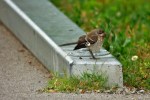
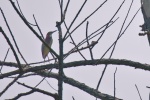
I managed to get a few shots of other birds, including a cedar waxwing.  The cedar waxwing, like the wild boy, always plays hide-and-seek with me.  I feel fortunate to have gotten one in my frame at all even though it’s not a great image.

I also spot a very strange looking turtle.  I’ve seen one like it at the aquarium.  I guess I will have to go back to find out what it is.  It has a long neck and a pointed nose and a very long tail.  I couldn’t hold still enough without a tripod to get a good shot of it–it really is like some of the pictures of big foot you see!

This morning I slept in.  When I got up, poor Tisen had decided to let me sleep even though he couldn’t hold it anymore because of his medication.  We had quite a puddle.

I rushed outside with him feeling guilty that I was so late taking him out.  It was raining and Tisen really didn’t want to spend a lot of time in the rain, so he started heading on the short route we usually only take at night.  When we got to the parking lot, there, pecking at some trash from Krystal burger, was a group of starlings.  Sure enough, the white-tailed youth I’ve been hunting was among them!  And, as one might predict, I was there without even a cell phone.

Oh well.  At least I know it’s still hanging out in the neighborhood.

Secret Island

In the Tennessee River, between the Bluff View Art District and the North Shore, there is an island.  Most people call it Maclellan Island.  The owners call it Audubon Island.  Long ago, it was Chattanooga Island. Before that, it was Ross’s Landing Island.  Whatever you call it, it’s a tough place to get to.

It’s a place I’ve wanted to see since we first came to Chattanooga.  It’s inaccessibility made it that much more desirable of a destination.  I tried a group who does kayaking tours, a business that rents paddle boards, and a water taxi service to no avail.

But finally, the Chattanooga Audubon Society is offering a tour.  Today is the big day with the Chattanooga Duck Tours providing transport.

Captain Alex takes us through downtown Chattanooga, educating us on the history of the buildings.  We had no idea that so many of them had been around since the 1800’s.  Then, we take a running dive into the river in our 1940’s DUKW vehicle, built by Rosie Riveters during WWII.  She still holds water.

We make it to McClellan Island safe and sound–and knowing a lot more about the riverfront development effort, too.

The island has 1.5 miles of trails that have been freshly groomed, but there is already poison ivy reappearing all over the trail.  Now, poison ivy is a native plant that’s good for birds and I have nothing against poison ivy.  I just don’t want to come in contact with it.  We step gingerly to avoid coming in contact, although it’s pretty much impossible.

A great-crested fly catcher sings a greeting for us, although we only catch an occasional glimpse of him flying from one tree top to the next.  We also hear a wood thrush, an Eastern towhee, and many other common birds.

Sadly, it’s hard to see anything through the dense privet, honey suckle, and vinca taking over the woods.  It makes me sad to see how devastated this tiny island is by plants that have invaded here.  Poison ivy is by far the most prolific native growing on the island, but even it is out-competed by the invasives.

The first wild-growing oak-leaf hydrangea in this county was discovered here on this tiny island just days before.  It represents a glimmer of hope that the ecosystem of this tiny green space can still be saved.  The clusters of white flowers shine through the shadows and remind us how beautiful nature, on its own, can be.

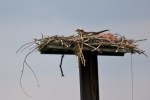
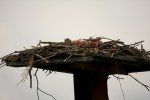
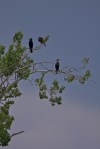
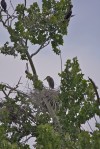
Back on the duck, we get the best view possible through fully leafed-out trees of a heron rookery.  There is also an Osprey on its nest on a platform at the end of the island.  As we come around the far side of the island, a group of double-crested cormorants perch in the trees.

I only wish we could spend more time sitting (far from poison ivy) and listening for all the birds that call this tiny sanctuary home.

Finding Big Foot

It all started several days ago when Tisen and I were on a typical walk.  Noisy European Starling toddlers tormented their parents, which has become a common scene of late.

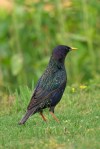
On this particular day, Tisen charged a starling family grazing on a slope.  They flew away together in a little flock, just as one expects.  The adults were clearly starlings.  The juveniles were all the same shape and size.  But there was a flash of unexpected white.

I did a double and then a triple take trying to make sense of what I was seeing–it was a white tail. I have seen thousands of starlings and I have never seen one with a white tail.  I have read descriptions of starlings dozens of times and never has anyone mentioned a starling with a white tail.

But, there it was.  A bird who acts like a starling, looks like a starling, hangs out with starlings ought to be a starling.  It was the right size and shape, but what’s with the white tail?

I could not think of a single possible bird it could have been.  I began to think I had either imagined it or the bird had somehow dipped its tail in a bucket of white paint.

Then, two days later, I saw it again.  This time, it flew across the path just about 10 feet ahead of me.  I watched it whiz by, still harassing its parents, and felt certain it had to be a starling with a white tail.

I asked a knowledgable friend of mine.  She asked an ornithologist and informed me that, yes indeed, starlings do, on rare occasions, have white tails.  Unfortunately, we were having cell phone challenges and I didn’t catch the explanation.  Amazingly, I’ve not had any luck finding an explanation online.

Today, for the third time, I saw the white-tailed juvenile hanging out with its parents in the park.  This time, I got a long look at it as Tisen was too groggy to give chase.  I even managed to get out my iPhone, unlock it, and bring up the camera app before it flew away.  Unfortunately, I didn’t actually get to take a picture first!

This evening, I am on the hunt.  It’s like a quest for Big Foot, I think.  The elusive white-tailed starling lurks in the park across the street and I aim to catch it in pixels. . .

No luck tonight.  I found normal starlings galore.  And I saw song sparrows, mocking birds, brow-headed cowbirds, cliff swallows, carolina wrens, and even a downy woodpecker.  But, no white-tailed starling.

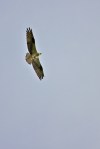
I did, however, seen another interesting thing.  A hawk was circling overhead.  When I looked at the photos enlarged, I realized it was probably a red-tailed hawk, but it has a fish in its claws.  I never saw that before, either.

Maybe a red-tailed hawk with a fish is like finding Nessy?  Big Foot, however, will have to wait for another day.

Wild Ride

Having gotten a decent shot of a red-shouldered hawk at Audubon Acres yesterday, I have the itch to practice wildlife photography today.  I also have the itch to ride my bike.

I slather on several layers of 50 SPF and head off.  It’s about 2PM in the afternoon–not exactly prime time for either wildlife or light.

I cruise casually along the Tennessee Riverpark–the 94 degree heat dissipates as I coast down hills and suffocates me when I go uphill.  At least riding generates a breeze.

I continue on to the Amnicola Marsh.  I find a shady spot to set up and I wait.  This is where I start to question just how much desire I have to be a wildlife photographer.  It’s ridiculously hot for early May.  I feel the heat pounding at me the way I feel the beat of a bass drum at a high-powered rock concert.

Then, the bugs find me.  I am the incarnation of Pig Pen–I have my own cloud.

Sweaty, bitten, itchy, and aching from my heavy pack, I have a hard time being patient.  I have been in the field 5 minutes.

Then, low-and-behold, two green herons fly in and land in a dead tree.  The lighting is horrible, and I’ve arrived without my polarizer, but I do my best to get a decent shot.

I am too far away.  I decide I should try to get closer.  I carefully creep through the scratchy weeds, leaving my bike behind, but hoisting my pack back onto my sore shoulders.  I pick my way around thorns, through spiderwebs, and avoid poison ivy until I am all of 10 feet closer to the tree in question.

I consider moving further in, but the underbrush looks a little thick, I won’t be able to keep an eye on my bike from there, and, well, it looks like my feet might get wet.  I decide to shoot from where I am.

I see a flash of white in my peripheral vision and I swing the lens around to find a snowy egret landing among the lily pads.  Then, it disappears so completely that I believe I’ve imagined it.  The lily pads blow in the breeze and flash white glare back at me, fooling me into thinking there was never a snowy egret at all.

A belted kingfisher makes an appearance.  Although the light is pretty hopeless, I fire off a few shots anyway.  Then, the green heron starts to make his way from a low perch to a high one, catching my attention once more.

Eventually, I head on home. Tisen, having spent 2 whole hours at home alone, had foraged through my not-yet-unpacked suitcase and found the squeaky balls I brought back from Columbus.  I’m happy he entertained himself.  I’m even happier when I see my photos on the big screen and realize there really was a snowy egret!

Not a bad way to spend a Sunday afternoon.

Broken Heart Birdsongs

When Tisen and I go to the park, the Cliff Swallows buzz over our heads.  I took my binocs over with me one morning to figure out what they were.  They gave me quite a run for my money making me chase them with my lenses, getting just enough of a glimpse of their details to know for sure what category to place them in, what name to give them, what song to expect from them.

There is something about swallows diving through the air that makes me want to forget all about what kind of bird they are and simply join them in the freedom of flight.  The level of emotion I feel watching them is inexplicable except maybe, at an unconscious level, they connect me to my mother.

It was, after all, my mother who first introduced me to the wonder of birds.  Although the most exotic bird I remember my mother identifying was the American Goldfinch, her fascination with them was contagious.  My mother wasn’t really about identifying them or photographing them or getting up close to them.  She was all about birdness in its purest form.

She just felt joy when she saw a bird.  Any bird.  As long as it wasn’t in a cage.

Perhaps that’s what the swallows remind me of.  Because I was unsure of what name went with them, for weeks I watched them swoop and dive with the kind of delight my mother would have taken in seeing them.

I am reminded of a reoccurring dream I used to have as a child.  In it, I was running down the street I grew up on.  Running as fast as the wind.  Then, my steps would grow longer and I would soar through the air further and further between foot falls.  The feeling of flying between foot steps was so profound that when I woke up, I could feel the remnants of the dream physically in my stomach.  I so loved that feeling.

I wonder if my mother used to dream about flying?

There are times when her absence is still so painful I cannot bear to think of her.  Even though it’s been 13 years since her death, I so wish I could take her to see the swallows across the street.  I so wish I could point out the Eastern Towhee calling from the tree tops.  I so wish she could see the Eastern Bluebirds nesting in the bird house.  As if showing her birds might somehow make up for all the times I broke her heart.  As if a birdsong might heal the remnants of the hurt.

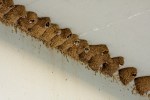
In lieu of sharing these birds with her, I share them with you.  Unfortunately, the swallows are too quick in flight for me to photograph.  But, having discovered their nests clinging to the Western side of the Market Street bridge, I can capture them there.  Frozen in a frame–I hope it’s not too much like a cage.

Booth Babe

While sitting in a booth on a Saturday may not sound like fun to a lot of people, consider the following:

  1. I work from home.  The only “person” I see during the day is my dog.
  2. My knee is troubled.  Hang gliding really isn’t an option.
  3. 10AM-4PM makes for bad lighting for photography
  4. The only people I know in the area are all busy doing things
  5. My husband has been working weekends.

So, when the opportunity to set up a booth for S.O.A.R. at an Outdoor Expo in Coolidge Park presented itself, I was more than happy to set aside a day to do it.

John and Dale and their cast of characters were busy performing at Rock City Earth Dayz and couldn’t join me, so it was just me representing the organization.

The event was not just an Outdoor Expo, but also a Green Expo and an Adoptapalooza.    The Outdoor Expo part attracts groups related to fun things to do outside ranging from kayaking to simple picnic games.  The Green Expo focused on environmentallly friendly ways to live.  The Adoptapalooza was all about getting homeless animals adopted.

As it turned out, all three events fit into one section of Coolidge Park.  This meant dogs were wandering by the tent all day.  Since birds of prey are not fond of dogs, it was a good thing they were busy performing at Rock City.  Since I didn’t have any birds of prey with me in the booth, Tisen got to spend the day with me.

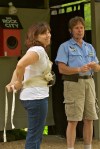
In spite of the bad lighting, I was hoping to get some interesting pictures of some of the characters in the park while I worked the booth.  Whenever I could, I would jump up and snap a few quick shots.  The booth next to me was an ongoing source of interesting subjects.  They were all dressed like their favorite Star Wars characters.  I didn’t quite get the connection between outdoors, going green, or pet adoption, so when Pat came to give me a break, I walked over and asked them what they do.  They explained that there are three separate clubs, one for the dark side, one for the good guys, and one, well, I lost track.  They are into professional costuming.  Quite honestly, I walked away still puzzled about what they do, but they clearly take it very seriously.

I also discovered there was a horse in the park.  At first, I thought they were referring to a very large great dane that had walked by earlier, but it turned out there really was a horse running around in the park, giving children rides.  How cool is that?

In the end, I got to talk to a lot of nice people about what S.O.A.R. does, I got a few photos that are, well, fun if nothing else, and I even collected enough donations to more than cover the cost of the booth.  Oh, and Tisen got to hang out with Mommy all day.

Cayce’s Turn

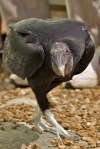
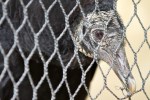
Perhaps three posts on one birds of prey program is a bit excessive?  But, I feel that Cayce requires her own post.  After all, how many Black Vultures do you know that get a standing ovation?  For that matter, how many Black Vultures do you know at all?

Vultures happen to be one of my favorite birds.  I always enjoy watching them soar on the wind, hardly ever flapping their wings.  But I really fell in love with vultures when we had a house in the country with a large pond.  One spring day, we had a inversion.  I honestly can’t say I fully understand this, but apparently the water on the top of the pond becomes cooler than the water on the bottom and, as the water switches places, the oxygen escapes and the fish suffocate.  When I say the fish suffocate, I mean hundreds of fish suffocate.  I mean more fish than we would have ever guessed lived in that pond suffocated.  I mean the entire surface of a 1 acre pond was covered in dead fish.

Enter the vultures.

Any bird that can come onto the scene of such a stinky mess and leave less than 3 days later with the place looking like nothing happened (besides a few stray skeletons)  is welcome at my house any time.  I can’t imagine how much we would have had to pay a person to clean up that mess.

My appreciation for nature’s sanitation engineers (as Dale of S.O.A.R. would say) meant I had an open mind the first time I met Cayce.  But Cayce doesn’t really require you to have an open mind–she will win you over regardless.

First of all, Cayce likes to run around on the ground.  This is in and of itself is funny.  Black Vulture run by hopping and skipping across the ground.  It’s funny.  Trust me.  Or, watch the video:

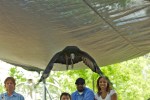
Second, Cayce flies over the audience with a particular glee.  She seems to know she’s a star and that getting as close as physically possible to the audience makes her more of a star.  In fact, she hit me in the head with her tail as she flared to land on Dale’s glove during the second show.  The audience loved it.

Third, Cayce chases John, pecking at his legs, demonstrating he is below her in the pecking order.  The entire audience cracks up as John runs from Cayce.  While he is being slightly theatrical, Cayce can draw blood, so moving quickly to avoid her beak is not just for show.

An interesting tidbit I learned about vultures from John and Dale is that Black Vultures have a strong beak for piercing and tearing through thick flesh while Turkey Vultures have a great sense of smell.  Together, both species eat well.

But today, no one is really thinking too much about what Cayce eats, even though Dale is throwing her chunks of dead mice.  My only complaint about Cayce is that she’s hard to photograph.

Audience Participation

While working on getting great pictures of birds of prey (as in, trying very hard, not necessarily achieving), I had the realization that the people are as fascinating as the birds.  Especially the children.

I’ve spent the better part of my life ignoring most children.  Not that I have anything against children; I just tend to gravitate towards people who are old enough that they would be insulted if you called them a child.  I blame this, in part, on my height.  I have a tendency not to notice much that’s shorter than about mid-thigh height unless it barks, meows, or flies.  I don’t know why this is, but I do know I have walked right into small children on more than one occasion because I just didn’t see them–they snuck into range under my radar.

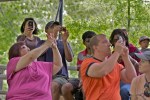
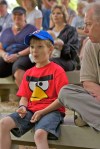
But on Sunday, when I sat in the amphitheater at Rock City watching the birds interact with the audience, it was the children who were the standouts.  Perhaps they haven’t yet developed the stiff facial muscles of adults whose faces repeat the same patterns over and over again.  Perhaps they don’t change their facial expressions to reflect what they think someone else expects of them, so their expressions seem more genuine.

I’m not sure exactly what quality of children’s expressions makes them so much more . . . well, expressive, but I cannot help but swing the camera around to catch a child practicing hooting when John teaches the audience how to call a Barred Owl.  I cannot but wish for a second camera body so I could have a wide-angle lens ready to go to catch the reactions of the children as the birds soar over their heads.

After the first show, John stands on the stage with Atsa, the bald ealge, while Dale takes Buddy, the screech owl, down the sidewalk.  I stay with John and take pictures of the people stepping up to have their picture taken with Atsa.

I sneak in a shot before they pose for their camera.  There is a moment for most people when they look up at Atsa, this magnificent bird, and their face expresses their genuine amazement, joy, or nervousness.  That’s the moment I want to capture.  Once they face their camera, they paint on the smile they’ve been using since their kindergarten class picture and I am instantly bored.

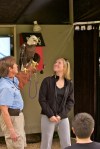
After the second show, I follow John up the walkway with Buddy and try to stand back far enough to shoot without anyone noticing.  I find myself wishing I could push the people aside blocking my view of the wonderful children petting Buddy.  Their faces made my whole day.  In a matter of moments, I witnessed fear, nervousness, surprise, joy, curiosity, and a hundred more emotions I can’t name.  I don’t know how many of those I captured in these images, but I sure have fun looking at the photos and realizing that these people were fascinated, engaged, and enjoying learning about birds of prey.