Visitors at the Visitor’s Center

Last Saturday, I watched the visitor’s center at Audubon Acres from 9AM-1PM.  It’s one of those volunteer jobs I don’t mind doing, but the visitor’s center isn’t often a busy place.

I guess it’s helpful for a volunteer to be there to deal with visitors who stop by so the various other folks who might be there can work on projects uninterrupted.  The property manager was off running an activity, which was a tour of a wetland at the local VW factory.  I was covered the front desk until he got back.

After taking advantage of the quiet to finish up some work of my own, I got out my camera.  I took the cordless phone with me, staying close enough that I could get back inside before a visitor could pull in, park, and walk in.

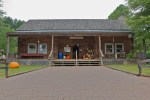
Someone had spent quite a bit of time decorating the front of the center for halloween.  They had found or grown giant pumpkins and strategically placed them in front of the center to make it look like a pumpkin patch.  I’ve never seen such large pumpkins.  I thought they were fake until I knocked on them.

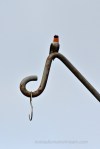
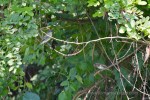
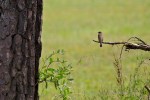
A Brown Thrasher perched in the open across the parking lot from the center.  I, of course, couldn’t resist crossing to the other side to see if I could get a shot of him.  Brown Thrashers are amazing teases.  I believe they instinctively recognize a camera even if they’ve never seen one before.  They perch where they can be seen clearly with no obstructions just until the moment when the camera achieves sharp focus.  Then, they hop behind a bunch of leaves, disappearing completely out of the frame and forcing the photographer to take her eye away from the camera to locate said bird again.

Now, this kind of hide-and-seek is expected when you’re shooting a hummingbird or a warbler.  Tiny little birds that move quickly can disappear completely behind a single leaf.  But a Brown Thrasher is a big bird.  It’s bigger than a Robin and has a much longer tail.  It should NOT be able to evade my lens so effectively.  Yet, there it is and there it isn’t.  I rarely get a shot of a thrasher even though I see them almost daily here.  I hear their loud clicking and know they are making fun of me from their favorite hiding spots.

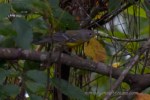
Fortunately for me, although I had no luck getting a shot of a thrasher, I did get to spend a few minutes walking around the property before I left for home.  Within minutes I’d spotted some warblers flitting around in the trees.  The first one I got several shots of was a Magnolia Warbler in fall colors.  The second was a Wilson’s Warbler–one I’ve never seen before.  I love it when I get to add a bird to my life list!  Unfortunately, 400mm is not enough for warblers, so the photos are heavily cropped.

Biking, Birding, and Bystanding

Biking and birding reminded me of several life lessons I have learned, forgotten, and learned again.  First, speed causes us to miss details.

I think back to the native prairie by the bike path back in Columbus, Ohio.  I used to ride by wondering why I didn’t see more birds.  When I went by on roller blades, I saw more birds, but was surprised I didn’t see any hummingbirds.  When I walked by, I saw hummingbirds but was surprised there weren’t any bees.  When I stood completely still, it was like a magical veil was lifted and suddenly I saw an amazingly dense array of life, buzzing and hovering and dipping among the flowers.  I am frequently reminded that sometimes, to really see the abundance of life, you have to sit still.

The second lesson was:  it probably isn’t a good idea to point out birds–even really big ones–to a bunch of people on bicycles.

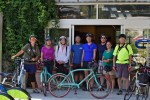
When we all pulled well off to the side of the path to stop and look, everyone was able to see the differences between a Turkey Vulture and Black Vulture, and many got to see an Osprey soaring overhead with no injuries.

As I watched these birds of prey, I had to wonder if they experienced the same kind of joy in catching a thermal and soaring on the wind as I was experiencing pedaling my bike through the early autumn breeze.  Some may think that birds just do what they do for the purpose of finding food, but I have to believe there is a joy that comes from doing what you were born to do that even birds experience, particularly on a beautiful day.  I find it impossible to watch the grace of soaring raptors without being moved.

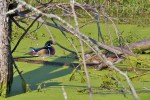
As we made our way up the Riverwalk to the Curtain Pole Road swamp area, I learned the third lesson of the day.  Sometimes, it’s not the birds that are the most interesting part of a bird walk.  One of the other participants spotted turtles and frogs.  Although the wood ducks were still my favorite (see photos from yesterday’s post), the turtles and frogs were pretty darn fascinating.  By the way, one attendee pointed out that in the last Wood Duck photo in yesterday’s post, there is a camouflaged turtle right in front of the Wood Duck.  I totally missed that!

The final lesson for the day was that we all have different levels of excitement about the same birds.  I was so excited to stand and watch the Belted Kingfishers at Amnicola Marsh.  I could have stood there all day with them swooping across the marsh, chattering away.  In the meantime, most everyone else was looking for something more interesting.

Regardless, I think we all enjoyed the outing. For me, it doesn’t get any better.  A beautiful day, a bike, a new group of interesting people to meet, some really cool birds, and my camera.  What more could anyone ask for?

Bike and Then Bird

I have been riding the Tennessee Riverwalk twice a week for a few months now.  It’s one of those places that makes me happy.  It’s just a beautiful way to wake up.  Riding along the river on the mostly quiet trail, exchanging smiles with the dozen or so pedestrians who also haunt the riverwalk just after dawn–there just isn’t a better way to start the day.

I have also been leading bird walks a couple times a month.  And, I went on a biking tour of the Chickamauga and Chattanooga National Military Park last year, which was organized by Outdoor Chattanooga.

Thus, it was only natural that, as I rode past great birding spots along the riverwalk, I would think “I should organize a bike and bird!”

Allow me to clarify for safety reasons:  I am not advocating birding while riding a bike.  That would be dangerous.  However, a bird walk is a usually a slow meander through a relatively small area with a good bird population and does not afford the opportunity to cover much distance without driving.  It seems counter-intuitive to me that we would increase the amount we drive in order to pursue an activity motivated by the desire to learn about and appreciate creatures quite dependent on an unpolluted environment.

To give credit where credit is due, a friend of mine back in Columbus, OH previously organized “eco bird walks” where all participants agreed to walk, bike, or take public transportation to the starting point and they walked from there.

So, I my idea was not exactly unique.  Regardless, I get a special pleasure out of combining activities.  I formed a plan:  Outdoor Chattanooga organizes bike tours all the time.  Why not ask them to do a bike and bird?  They have a fleet of bicycles so even people without bikes could join.  I would invite the Chattanooga chapter of TOS and the Audubon Society and we could have a lovely morning of riding and birding.  Or, to be more accurate, riding, stopping, and then birding.

And so it was.  It took a few emails and phone calls, but that was it.  Outdoor Chattanooga did the rest–and what a great group of people they are!

Finally, the Saturday selected was upon us.  I’m not sure which of the folks at Outdoor Chattanooga was in charge of arranging the weather, but they did a fabulous job.  I suppose if it would have been a little less breezy, we might have had an easier time spotting small birds among the trees, but the clear blue sky with little humidity and the cool breeze kept me smiling the entire ride.

We saw quite a few good birds, although not quite the bonanza I was hoping for.  As I told our guide from Outdoor Chattanooga, it was such a beautiful day that I would have enjoyed it even if we hadn’t seen a single bird.

Renaissance Rodents

Across the street, Renaissance Park beckons.  It calls to me with its manmade hills hiding secrets left behind by the manufacturers who occupied this park long ago.  And before that, the civil war soldiers who crossed the Tennessee here at Ross’ Landing.  And even before that, the Cherokee on their tragic walk on the Trail of Tears.

I don’t know what all was encapsulated in the mounds of Renaissance Park, but Renaissance is a good name for it.  Reborn from the pit of industrial waste it had become, it’s now a haven for birds, butterflies, the occasional deer, perhaps a fox family, and for sure coyote.

The thing is, you don’t get predators if you don’t have prey.  Fortunately, prey doesn’t care if the hills are manmade or if the wetland was created by a backhoe, or that the plants were carefully inserted into the earth by the hands of a human being.

The fact that the western hill in Renaissance is covered in native grasses and flowers means it’s a living feeder.  It feeds the American Goldfinches who love to cling to the stems of flowers that have gone to seed while they munch away.  And, underneath the foliage, it also feeds a more mysterious colony of life.

This colony becomes massive in the fall when the young have matured enough to rustle amongst the long grass on their own.  They scamper and disappear quickly enough that all I’d been able to determine is that they were rodents.  I’ve been afraid to consider the possibility that they’re rats.  Not because I’m afraid of rats but because I fear the reaction of the public to the notion of a large population of rats nesting in the park.

To me, this just makes the hillside a better feeder–it provides food for more than one link in the food chain.  But, for many, the word “rat” causes a different reaction.

When Tisen and I walked into the park a few evenings ago, these mystery creatures were showing themselves.  In fact, one sat on top of a clump of grass staring at me.  I was so caught off guard, having tried to see what they looked like for so long without success, that I barely had time to process what it looked like before it took a closer look at Tisen and decided to duck back under cover.  It looked a lot like a small brown rat.  I decided I’d better bring my camera over the next evening.

Back we went, me armed with my 70-200mm lens.  As Tisen’s tags jingled, the little critters scampered around, not holding still long enough for me to get a look, let alone a shot.  But, finally, I spotted one sitting still.  I am happy and relieved to report that it is not a rat; it’s a Meadow Vole (I think).  After all, no one ever got up in arms about exterminating a bunch of cute little voles, did they?  My favorite hawk feeder is safe.

Birding with Enthusiasm

Tuesday night, I set up the coffee maker and set the timer so it would start brewing at 5:15AM.  I put out the clothes I would wear for rowing.  Everything I needed was ready to go so that when the alarm went off at 5:30AM and I was stumbling around disoriented and wondering why in god’s name I continue to get up at 5:30AM, I wouldn’t have to think.

Wednesday morning, hot coffee in hand, I looked at my schedule for the day and there, low and behold, was a bird walk on my calendar for 7:00AM.  As in a bird walk I was leading!

Startled by my oversight in planning, I shifted gears, pulling together my bird walk backpack and gathering binoculars and my camera.  I pulled up the flashlight app on my iPhone and went searching in the darkness for a different outfit.

I admit I was feeling slightly resentful about giving up my rowing time as I imagined sitting alone in the park waiting for others who never show up.

At 6:50AM, it wasn’t even the crack of dawn yet.  I sat in darkness until I was surprised by a silhouette that turned out to be the Audubon property manager.  Next, a father with 4 enthusiastic children arrived.  Then, a regular from the condos arrived.  I stopped feeling bad about missing rowing.

I started my lesson about birding during fall migration.  I talked slowly and told more stories, hoping the sun would rise.  Every time a shadow went by, one of the children would turn, point, and shout, “What was that bird?”  I need to find out what kind of coffee they drink in the morning!

The amazing thing was how much the kids knew about birds.  They knew which birds were locals and which birds would not be found in Tennessee (even during migration).  The girl immediately recognized a Brown Thrasher she had barely seen for a split second.  Her older brother told me all about the birds he sees at his feeder at home.  Their father told me the interest in birds was the kids passion.  I thought that was pretty cool–also an advantage of home schooling.

I didn’t do so well on photography that morning.  First there wasn’t enough light.  Then I was just a bit flustered by all the questions and exclamations (LOOK!!!  THERE’S A CARDINAL!!!  LOOK!!! THERE’S A TURTLE!!!  LOOK THERE’S A BLUE HERON!!!  LOOK!!! THERE’S A SQUIRREL!!!).

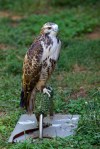
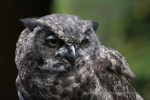
As much fun as it is to be surrounded by little people who think everything is fascinating, it does make it a little more challenging to take a moment to shoot.  I’ve filled in the photos a bit with some leftovers from the previous walk and one shot of Cody, an unreleasable Red-tailed Hawk who has appeared in this blog several times as part of the S.O.A.R. raptor program.  I saw Cody again over the weekend, but that’s another blog post.

Migrants in Disguise

This past Saturday was the first October beginning bird walk.  Fall is an interesting time to bird.  In the fall, I have a love-hate relationship with birding because the birds are migrating, so there are tons of species in town who haven’t been here since at least last spring.  On the other hand, they are wearing their drab fall colors, blending in with the fading colors of the leaves.  And they are quietly eating everything in sight with little more than a peep to even let us know they’re there.

This means paying careful attention to ever flutter and flick among the leaves.  It also means throwing out all the learned images and looking for pale yellows and browns where, in the spring, one might have looked for brilliant red.

Take, for example the Scarlet or Summer Tanager. We eventually decided it was a Summer Tanager after we saw it several times, but it was almost impossible to decide for sure until looking at the photos.

The Summer Tanager is an all-red bird in the summer.  In September, it’s yellow and green.  Not only are these birds busy getting ready for their long journey to warm climates, but they’re also expending energy completely replacing their wardrobe each fall.  I guess it’s necessary.  I know that I’ve seen many Scarlet Tanagers prior to the leaves on the trees growing in the spring.  I’ve seen only 1 after the leaves are fully out.  In spite of having neon red coloring, the Scarlet (and Summer) Tanager manages to stay well hidden in the canopy of the trees.  Once the trees drop their leaves, however, all bets are off.  So, I guess it makes sense that they would turn to a dull yellow before beginning on their annual trek to mecca.

We saw Magnolia, Nashville, Tennessee, Yellow, Yellow throated, Common Yellowthroat, and Chestnut-sided Warblers. If you have never seen these birds, take a look.  They are tiny, beautiful birds that don’t come to feeders.  Many people die having never seen one, yet they are often nearby (at least during migration season).

While the changes between the breeding and non-breeding plumages for these tiny warblers is not as dramatic as for the male Scarlet and Summer Tanagers, they still got through some dramatic changes.

I wonder how their parents prepare them for this?  Do they tell them that they shouldn’t despair over their dull colors when they’re young?  Do they sit them down and have the “birds and bees” talk?  Or do they call it something different like “the humans and the fish”?  And do they warn them that they will return to the dull yellow every fall like some sort of magical curse in a fairy tale?  And do they have controversy over whether this needs to be taught in the public schools or handled at home?

However bird parents handle preparing their young for “the change,” the birds are well-prepared for blending in.  They all look like leaves.


Hummingbird Band

Pat and I were planning to set out for two days of backpacking on Labor Day weekend.  However, a friend asked if I would like to attend a hummingbird banding on the 1st.  It was a long weekend, so of course I decided to postpone our backpacking trip by a day so I could see hummingbirds being banded.

Who wouldn’t postpone a backpacking trip to see hummingbirds being banded?  I would have postponed all kinds of plans to see how, exactly, this works.

When we arrived at the banding location on Saturday morning, the first stop was the banding table.  The bander educated us while she banded.

The house we were at was someone’s home who happened to love hummingbirds.  They put out feeders every year like so many of us do to attract them to their home.  What was unique about this location was that it was in the middle of two ridges that created a funnel effect for migrating hummers.  So, this time of year, hundreds of hummers would stop at the feeders to fill up on their way South for the winter.  By replacing the feeders with specially designed traps that wouldn’t harm the hummers, the banders were able to capture about 35 birds before we’d even arrived, about an hour after the event started.  1 bird every two minutes is pretty impressive.

I was a bit disturbed when I was asked not to show any photos of a complete trap on the internet.  Apparently there are people in the world who think Hummingbirds would make good pets and are looking for information on how to create a trap.  If you are such a person, please be assured that you cannot keep a hummingbird as a pet and that all will be much better served if you simply feed them and let them go on their merry way.

Watching the bander handle the tiny hummers with a confidence that belied how delicate these birds really are made me wish I had the dexterity to perform such a task.  I asked her if she had started as a jewelry maker–it seemed like the appropriate skill set to me.  She laughed.  Apparently she also didn’t believe she had the dexterity to handle hummingbirds when she got started.

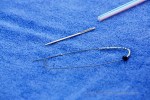
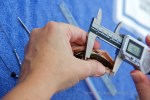
I watched her move through the measurements performed on each bird with a systematic rhythm, rarely interrupted by talking to us.  She measured each beak, each tail, each wing, used a straw to blow apart the feathers to see if there was fat, and then placed each bird on a scale.  She always banded them first.  She said that was in case they got away before she got through all the measurements.

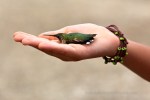
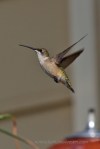
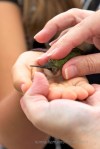
When she was done, she carefully set the bird in a waiting child’s hand and they held it until it suddenly decided it could fly and buzzed away.  Sometimes, this took several minutes.  It was fascinating to see a hummingbird hold so still.

Re-Hike

Sunday has become unofficial hiking day.  Of late, I seem to have fallen into a new routine.  Saturday, I recover from the previous 5 days of hiking, biking, rowing, and yoga.  I do this mostly by laying on the couch with the occasional interruption of taking Tisen for walks.

But Sunday, Sunday I hike.  And this past Sunday, Pat needed to work, so it was the perfect opportunity to make my second attempt at Edward Point.  This time, Tisen and I would start at 10:30 in the morning instead of 4:30 in the evening.  We were mentally prepared for a rather challenging 6 mile hike, up and down Signal Mountain, scrambling over rocks.

This was our fourth trip to the Signal Point overlook.  It’s an easy walk down a paved trail from the parking lot.  We spent 20 minutes covering the 100 yards from the parking lot to the overlook–there were lots of places to sniff.

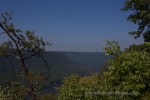
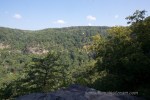
But the overlook is it for the suburban park setting.  After stopping for a couple of quick shots, we headed to the Cumberland Trail.  Even with its manmade steps, it’s not an easy trail.  Many people make it the first half mile to a “natural” overlook point over the gully that our trail would wind its way around.  But it involves clamoring down steep and big steps, jumping onto rocks, and stepping carefully.  Tisen did an amazing job navigating all the obstacles.

Every time we go on a hike that starts out with an accessible view, I notice the drop off in population as you get further from the parking lot.  We were still on the most traveled part of the trail, but already we were down to only 2 other people who we didn’t see until we made it to the overlook point.

Before we’d rounded the first blind turn, a Pileated Woodpecker called from so close to where we were standing that I was sure I would look up and see it clinging to a tree.  As I searched for the shape of this giant woodpecker, it called again, sounding slightly further away.  I searched frantically, watching for shadows against the dark forest floor.  When it called a third time, the Doppler effect kicked in–I could hear it moving away from us as it called.  I was bummed.  I haven’t seen a Pileated Woodpecker in quite a while–I would have loved to have gotten a shot of it.

We continued our hike possibly in greater safety now that the woodpecker was gone–I have a tendency to forget I’m walking on the edge of a cliff when I’m searching for a bird.

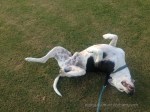
When we stopped at the first natural overlook, Tisen was already panting hard.  I got out his portable water bowl and tried to coax him into drinking water.  Tisen stuck his elbow in the collapsible water bowl and stared at me, pink tongue lolling from his black-and-white mouth.

Bird Kings

I have a lot of funny stories about birding.  Let’s start with the 2 years I spent getting out my CD-set of bird songs every time I heard a particular bird calling, trying desperately to figure out what it was, only to discover (eventually) it was a chipmunk.

Or, how about the time I managed to convince myself that a Great Blue Heron (one of the most readily identifiable birds around) was a Tri-colored Heron because its feathers were hanging at a weird angle, making a pattern of color around its neck I hadn’t seen before.

Then there’s the time I was sure I was seeing a Louisiana Waterthrush only to realize I was looking at a female Red-winged Blackbird.  While I think all birders have been fooled by a female Red-winged Blackbird, I’d bet there aren’t too many who thought they might be a Louisiana Waterthrush.

But besides my identification mishaps, I also have physical ones.  For example, at the end of this month’s Wednesday morning bird walk (which I was leading), I got excited trying to see a bird in a tree right above us and I walked right into a concrete bench and fell over it, landing on my rear.  Fortunately, my fellow birders managed to catch me enough to keep me from falling all the way over the bench and onto the ground.

There’s also the time I was so busy looking up that I walked into a branch that smacked me right in my wide-open mouth.  I guess that’s better than a friend of mine who made the mistake of looking up with an open mouth just in time to catch a not-so-tasty snack.

Oh, and then there’s the time I drove off the road trying to identify a hawk perched on post at the side of the road.  Friends, don’t let friends bird and drive.

Perhaps it’s all of these antics that often give me the feeling that the birds are as amused watching me as I am watching them.

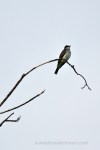
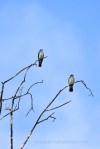
On our Saturday morning bird walk, which I was also leading, we discovered a family of Eastern Kingbirds.  It appeared the baby had fledged and Mom and Dad were trying to encourage it to start feeding itself (sound familiar, parents?).  But the baby wasn’t ready to give up on getting spoon (or beak) fed.

Perched low in a shrub near eye-level, we had quite a treat watching these wonderful flycatchers swoop in and encourage the baby to make an effort.  Baby, on the other hand, demanded to be fed loudly, squealing at Mom and Dad with a bright pink, open mouth.  No tasty treat for Baby either.

I love Eastern Kingbirds. They’re the easiest flycatcher to identify by sight.  The white rim along the tip of their tails and their size along with their pure white breast make them striking and distinct.  That’s what makes a bird a favorite for me–easily distinguishable features.

Finding Sanctuary

I discovered tonight that I’m almost out of digital photos I haven’t used in a blog post!  Who knew a year of blogging could use up 9 years of digital photos?  I’m going to have to start searching the archives again–there have to be more photos in there!

I did discover these series of shots taken two years ago during an annual trip to Portland, Oregon.  Pat and I went to the local Audubon Society Preserve there and did a hike through their woods.

It’s an amazing property for many reasons.  First, it’s been meticulously maintained as a natural, native habitat.  Most people don’t associate “meticulous maintenance” with “natural, native habitat.”  Usually, we think of a golf course.  Unfortunately, as I know from volunteering at the Audubon Society here in Chattanooga, without ongoing hard labor to remove the invasive species that pop up every time one turns one’s head, they get out of control and turn native habitat into something completely foreign.  It’s unfortunate we humans can’t agree that invasive species shouldn’t be sold or planted.  Until we do, those of us who value preserving native ecosystems have a lot of work to do to prevent those habitats from being overrun by the rest of the population’s right to decide what to plant on their own property.  But, don’t let me get on that soapbox.

The Portland Audubon Sanctuary is a 150 acre property of dense forest, including a stand of old growth trees, a pond, and a creek that’s carved some small hills within the already hilly Portland topography.

Walking through the forest area made us think we were in the rain forests of the Olympic Peninsula of Washington state.  We didn’t see too many birds while we were hiking.  Those we did see were a tough for me to ID–somehow, even the birds that also live in the East looked different enough that I couldn’t feel confident I’d correctly identified them.

When we stopped at the lovely gazebo on the pond at the sanctuary, we discovered a group who was out watching a Northern Saw-whet Owl perched in a tree and up so high that without binoculars, it couldn’t be spotted.  Fortunately, a kind man let me look through his so I could see it, too.  It was about the size of a Screech Owl (tiny) and very adorable.

The Portland Audubon Sanctuary also boasted some spectacular fungal growths.  Between the mushrooms and the weird, coral-like growths, I didn’t mind my limited success at birding (especially since I was without binocs).

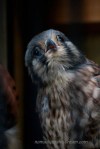
In addition to the Sanctuary, they also provide rescue services for injured birds and keep some unreleasable birds on display for educational purposes.  This mean being guaranteed to see some interesting birds even if nothing in the woods showed itself.  I particularly liked the Americal Kestrels on display.  They looked like they were making faces at me.

It’s a great place to visit and support if you’re ever in the Portland area.