Springing

The weather is playing tricks again.  Apparently, the ground hog did not see a shadow.  For President’s Day, it was as warm as a day in May with lots of sun.  Every child in the area congregated on top of the mound across the street for some good old fashioned grass sledding.

Chalk that up as one of the things I love about Chattanooga–instead of clinging to the hope that they might get to sled 1x a decade when it snows, they slide down grass covered slopes on pieces of cardboard.

The warm weather got the birds all riled up again.  I’m surprised they haven’t given up after having been teased so many times by warm weather.  But they are singing with vigor, seemingly sure that this time, it really is spring.

The robins, towhees, cardinals, wrens, and song sparrows seem to be having a sing off of some kind when Tisen and I take our morning walk.  As I try to spot a particularly loud wren, the large white rump of a flicker flashes by as one flies up into the trees.  I watch mourning doves zoom by–I am always surprised by the speed and agility they exhibit once they are in flight compared to the awkward slowness of them near the ground.

Perhaps it’s the addition of the song of the blue birds that make me think it’s really spring.  While the blue birds have been around all winter, they’ve been lurking silently waiting for the right moment to burst into song.  It seems today was the day.

Whether Tisen notices the bird songs or not is hard to say.  But he definitely has the same spring fever.  By the end of the day, when we take our last walk before the sun sets, as we walk by a long grassy slope down to the wetland, his legs bend and he plops down in the grass much like a horse.  Then he flips onto his back and kick his legs for all he’s worth.  He scootches around on his back, scratching what itches and sliding his way part way down the hill.  I start to think he’s spent too much time watching the kids sledding.

Each time I think he’s done when we get to another grassy area, he flops down again, repeating the process.  His black/brindle spots are looking more green/brindle with the grass clinging to him.  I do my best to capture him on my iPhone, but I need a longer leash to get a good angle.

After finally convincing him to leave the park, Tisen bounces along with a new spring in his step.  It’s like all he needed to know it was spring was a good roll in grass still holding the heat from a warm day of sunshine.  His antics have put a new spring in my step as well.  On the way home, I contemplate how I can take Tisen sledding on our next sunny day.

The Singing Towhee

I sit on the balcony and watch cars roll by.  It’s been a while since I’ve sat out here with my morning coffee–I am reminded of when we first arrived in Chattanooga 5 1/2 months ago.  Although, it was August then and I only sat on the balcony before sunrise–it got much too hot once the sun was up.

Earlier this morning, Tisen and I walked through the park listening to birds who clearly felt it was spring.  I believe it was just two nights ago there was a winter weather warning.  I listen to an Eastern Towhee and realize I’ve never heard one sing before–well, at least not when I knew that’s what I was hearing.  In fact, seeing an Eastern Towhee was always a rare event for me.  When I check the range map, I learn that they are present year round and this is not a harbinger of spring.  However, the urgency and vigor of his song competing with the robins’ probably is.

Our walk is uneventful, but when we return home, Tisen cannot wait to get off his leash and prance into the living room.  He does his playful prance that involves throwing limbs in directions it doesn’t seem like they should go.  I think he’s excited to see his daddy, but it turns out it’s Mr. Beaver he’s so excited to reunite with.

He and Mr. Beaver curl up on the couch.  Since my camera is still sitting on the tripod, I figure I might as well take a few shots, although I don’t bother to change the lens.  And, since I have my 17-55mm lens on the camera, I might as well go out on the balcony and see if the light is doing anything interesting to the view.  The city is shrouded in a slight mist this morning–the sun casting long shadows as it rises above the horizon.  In the sky above, a waning moon hangs mid-sky, too far from anything to get a decent shot with a my wide angle lens.

One thing is obvious–it’s going to be a beautiful sunny day.  Or at least morning.  I plop myself down on a balcony chair to write wearing my pajamas and no jacket and feel sorry for all the people below me in their cars who had to get up, get showered and into office clothes and are now on their commute to the office.

Of course, maybe they’ll have move fun at the office than I will have working from my isolated home office.  There is something about working from home that can make a person a little stir crazy.  I catch myself talking to Tisen more and more often.  He hasn’t answered yet, so I think I’m OK.  But perhaps it’s the fact that I don’t see other people all day that makes me notice things like the song of the Towhee?

Eating Virtual Space

I mentioned before that I am volunteering to help organize a fund raising event for S.O.A.R.  Well, I decided to donate a matted and framed photo for the silent auction.  It seemed like a simple enough thing to do.  After all, I have thousands of photos, a handful of ones I actually like, and the matting and framing part can be taken care of inexpensively.

But, today, I spent time culling out the handful of photos I would consider hanging on my wall.  Then, I pulled in the few that were of birds (since S.O.A.R. is all about birds) and a couple from hang gliding.  It’s a difficult thing to judge.  First, I have to step back and see photos the way normal people see photos.  It’s hard.

I find myself noticing when the rule of thirds hasn’t been applied and trying to decide if it works anyway.  Then I notice when bits of things in the foreground have popped into the frame when I’d rather they weren’t there.  Then I try to decide if the color looks off or if it’s just my imagination.  In the end, I’m down to 16 photos I will put in front of Dale, the woman running the show, to see if she thinks any of them will inspire bids.  If not, we can always make it a raffle item.

The process of filtering through the past 8 months of photos (thank goodness I stuck to the Chattanooga theme–otherwise I’d be going through 9 years of photos!) was an interesting one.  First, I realize how little time I’ve actually spent doing wildlife photography, supposedly my preferred form of the art.  Second, I realized how I don’t like to choose.  I end up with collections of extremely similar photos where the lighting is slightly different and the angle might change just a hair, but I can’t come to a conclusion as to which one I like better.

I have gotten quite strict with myself on that point.  I am trying to limit the number of photos I keep.  Given that most of my pictures are over 13 MB (and I’m shooting with an older camera–I can’t imagine what will happen the next time I upgrade), I’ve run my 120 GB hard drive on my laptop out of space more than once.  I now have a collection of disk drives lingering about in various stages of fullness.  I am constantly worried that my  2 TB backup drive will fill and overwrite some critical photo I’ll never get back.  Not sure what it would be critical for, but who knows?

What amazes me is for the number of photos I have and the amount of disk space I’m maintaining, there are so few pictures I really like.  There are even fewer I would say I’m proud of.  I wonder if this is the unintended consequence of digital photography or if film photographers have the same problem?

Rescuing a Heron

I woke up at 3AM, pinned under the covers by the weight of a sleeping dog and too content with him by my side to move him.  I eventually squirmed my way out, managing to heed the call of nature without waking either my husband or my dog.  But when I returned to bed, I was left out in the cold.  I think I got another half an hour of sleep before finally getting up at 6AM.

In those 3 hours, Tisen moved only if chasing something in his dreams and Pat snored quietly, marking the time.

I get Tisen walked, fed, and into his create in time for me to get to the gym.  We are using the create when I go to the gym.  Tisen rather likes his crate with his new bed and collection of squeaky toys–we’re getting close to trying going out to dinner again.

After the gym, I buckle down to work and try to focus.  It goes like this:

  1. Start to work on presentation
  2. Think, “I need the dates in that email from yesterday”
  3. Open inbox, see 18 unread messages have arrived in the past 5 minutes.  Start reading and responding to each one, opening files until there are 40 files open and 16 applications running.
  4. Remember I was looking for an email for my presentation, I return to the inbox to find new messages and start over again–I’m in danger of an endless loop.
  5. A reminder it’s time for my first conference call pops up and interrupts my interruption.
  6. Remember I was trying to get my presentation done before my first conference call.
  7. Look at calendar for meetings I can cancel later in the day.

In the midst of this, Pat returns from Tisen’s second walk and reports he spotted a Great Blue Heron with a broken wing.  I start juggling phones with the conference call in one ear and a call to S.O.A.R. in the other.

Pat is able to meet John (from SOAR).  When my morning conference calls end and Tisen insists he needs to go out, we are able to check on the heron rescue progress.  We arrive as Pat dives into the bushes with a large butterfly net, just missing the heron.  I get out my iPhone and snap a few pics.

John catches the heron moments later.  John asks me to remove a stick from its mouth.  I reach out and gently pull the stick free, hoping it will be a little more comfortable.  This poor bird has exposed bone where its wing has snapped and bent backwards.  John will take it to a licensed bird rehabilitator, but he doesn’t seem optimistic.

Much later, John’s wife, Dale, tells me the heron had to be euthanized.  I am sad this one could not be saved.  But, I am happy there are people like John and Dale to make sure if there is a chance a bird will survive, the bird will get it.

Now, I need to finish that presentation . . .

Going to the Birds

After spending the morning hang gliding, we change into dry clothes and head off to spend our afternoon with some of the best pilots ever born. They are a group of slightly crazy and/or disabled raptors. Raptors as in the family of birds that includes hawks, owls, eagles, and vultures–in other words, birds of prey.

I have been looking forward to this for weeks. We originally saw a poster for a Raptor Experience at the hang gliding office a month ago. The Raptor Experience is offered by a non-profit organization called SOAR (Save Our American Raptors). They care for non-releasable raptors and train them so they can be used for educational programs to teach people about birds of prey. They also have a Peregrine Falcon release project and are tracking a falcon who is currently vacationing in South America.

As a bird lover and one who is particularly fascinated by birds of prey, I am excited about this beyond belief. I’m hoping we will get to actually handle the birds, but in my excitement, I can’t remember if the person I talked to said we do or not. Even more exciting, I’ve been wanting to volunteer for a raptor rescue program for years, and now this looks like it might be an opportunity.

We arrive at the designated meeting spot a little early. My nerves kick in about meeting people a bit, but since we just talked with Dale, the wife of the husband and wife team who run the organization, I’m not too nervous. John, the other half of the team, arrives only a couple minutes after we do. He’s driving a jeep with a hang glider on the roof, so it’s not too hard to guess it’s him. Dale told me on the phone that she and John are both hang gliding pilots and I enjoyed watching a video of John taking a one-winged bald eagle hang gliding on their web site.

John offers to drive us up to their property where the birds live, explaining that the road is pretty rough. Pat, being a man, decides that he can drive the mini-van up it and save John the trip back down later. As we make our way down the dirt road with large holes, ridges, dips, and rocks, the car drags enough time to make me wish we’d just ridden with John. We make it without losing any parts of the van, although Pat comments that it’s a good thing that I’d already knocked off the front lip spoiler (whatever that is) dragging the front bumper over a parking block.

When we arrive, Dale comes out to greets us, although one of their rescued dogs beats her to the punch, and invites us into the house where she offers us freshly baked, homemade cookies and gives us a run down of what we’re going to experience and why these birds are here. We learn that, yes, we will get to handle the birds. (Yay!) We also learn that none of the birds here at SOAR are able to return to the wild either because of injuries or mental problems. Interestingly, “mental problems” are defined mostly as birds who were raised by humans and, because they imprinted on the humans, don’t know how to do what they were born to do.

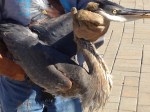
After the orientation, we head outside and are equipped with leather gloves. We are going to start with Eastern Screech Owls. Small, docile, and probably sleepy, they sit quietly on our gloves and even enjoy being petted on the back of the head. John tells us that owls understand touch as affection, but other birds we will handle do not and warns us not to attempt to pet the hawks.

I am so amazed by these tiny little owls. They weigh nothing. John points out that we can see the ruffled edges of their feathers, the secret to the silent flight of owls. And, even more amazing, John shows us their ears. They actually have little human-like ears under those feathers! The ears are offset, apparently to help locate where sounds are coming from in the dark.

I could have been happy just sitting there with these little owls all day, but Dale puts them away so John can bring us a Barred Owl–since Barred Owls will eat Screech Owls, everyone is happier when they’re not together.

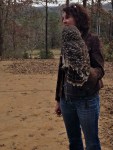
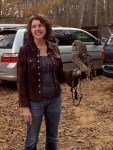
We used to live in a wooded ravine where Barred Owls also lived. They are enormous. Or, at least they look enormous. In contrast to their size, hollow bones and feathers make birds weigh far less than other types of animals of the same volume. I’ve read this before, but having never held a bird, the reality of the gap between how much this bird looks like it should weigh and how much it actually weighs surprises me when Dale puts this great big owl on my glove. This owl weighs less than 2 pounds.

Next, John returns with a Barn Owl. We don’t get to hold this owl who is about halfway between the size of the Screech and Barred Owls. At least not right way. He doesn’t like to sit on the glove–he wants to fly. And that is exactly what he gets to do.

John stands at one spot behind the house and we go to the other. Dale accompanies us with a pouch full of small mouse parts. I ask her who gets to chop mice–she makes a face when she admits it’s her. Clearly, it’s not her favorite part of the job.

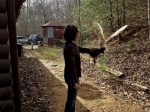
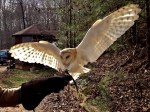
I hold out my gloved arm and Dale places a small piece of mouse on my fist. John releases the owl and he flies to me, swooping low to the ground and then flaring upward so that he lands feet forward on the glove. Having just come from hang gliding, we are fascinated watching how the owl instinctively uses ground effect (the rising air close to the ground) to get lift in time to flare, which is what Pat is now learning to do, so he can land on his feet.

It’s an amazing experience to stand there waiting for a bird of prey land on your fist. As he glides towards me, the owl’s tiny body is dwarfed by his enormous wingspan. The sunlight shines through the feathers on his wings, making him look as angelic as a bird of prey can. I wonder if he minds performing in the early afternoon when he should be sleeping. He looks pretty darn happy when he picks up a mouse chunk and swallows it down.

Next, we get to fly Cody, a Red-tail Hawk who refuses to hunt. Cody glides even closer to the ground, skimming just inches above the surface, and then swoops up in a sharp arc just before reaching me. I notice he flares with his feathers as well as his wings. Every feather spreads, his tail dramatically opening like a fan. Just as with the owl, this flare brings him nearly to a halt so that when he lands on my arm, there is no impact. It’s like he parachuted down gently.

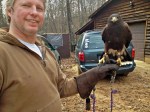
After flying Cody, we get to meet Franklin, an American Kestrel, and a Harris’s Hawk whose name escapes me. I’ve never seen a Harris’s Hawk before. He is beautiful–rich browns blend into black, which contrasts with the white in his tail.

Next, we get to meet Casey, the Black Vulture. Casey seems to think she is a dog. She circles around Dale, who tickles Casey on the back and Casey responds with what appears to be a happy Vulture sound, but comes out a lot like a hiss. Casey gallops along on the ground, preferring to walk even though she is perfectly capable of flying. Dale tells us that she sometimes walks Casey in the woods–she really does think she’s a dog!

We attempt to fly Casey, but Casey is in the mood to run instead. She flies up to our gloves to collect treats, but then hops back to the ground to run the distance between us instead of flying. Cameraless today, I switch my iPhone into video mode and try to capture her running on video–there is just something too funny about watching a vulture run.

I appreciate the work that vultures do, having once had a pond where hundreds of fish died all at once, it was an amazing thing to have a few dozen vultures show up and clean up the mess in about 3 days. However, I never thought the words “cute” and “vulture” went together. Today, I change my mind. Casey is adorable. Dale tells us that Casey is used to being the star of the show; I am not surprised.

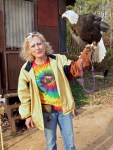
We finish off our Raptor Experience with a Bald Eagle. I can’t recall this eagle’s name, but it is a Navajo word that means, “The Littlest Eagle.” It’s a good name. This poor guy lost a wing due to a shooting. I’m not sure if the missing wing contributes to how small he looks, but he definitely is small for an eagle. I am sad to learn this eagle has not been hang gliding yet because it means that there are two one-winged eagles living out their lives in captivity.

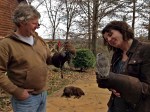
It’s an appropriate finale to the day, though. After all, it’s hard to beat a Bald Eagle for majesty. We go inside to wash our hands and talk for a while before wrapping up and heading home. Dale talks us into one of her cookies before we go–a peanut butter blossom with a soft hershey’s kiss in the middle, yum! We get in the car and I feel like I should pinch myself–it’s hard for me to believe that I just spent the afternoon playing with raptors. Instead, as Pat creeps back over the bumpy dirt road, I look at the pictures Dale took for us on my iPhone and smile.

Shooting Hawks and Clouds

I am sitting at my desk on a conference call.  I have been working on a spreadsheet for hours and, as I listen to the call and tweak numbers, I suddenly start seeing double.  I take off my glasses, rub my eyes, and then look out the window at the sweeping view of downtown.  Something between me and the city moves across my line of vision.  I look and recognize one of the hawks I’ve been seeing in the park across the street for the last few days.
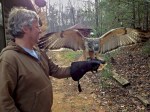
There are two mounds in the park.  According to the sign, the mounds were created as part of the process to contain hazardous waste.  Not exactly comforting, but they look nice.  The mound on the right has low-growing plants all along the sides that flop over and create lots of little dark hiding places for rodents that scurry through the plants whenever someone walks by.  Pat and I have been trying to get a good look at exactly what lives on that mound for a long time.  We know it’s grayish brown and larger than a mouse or mole.  We decided they were voles after getting a quick glance at one, but part of me secretly fears they might be rats.

Whatever it is that lives on that mound, a pair of hawks discovered the colony the other day and seems to be returning regularly for an afternoon picnic.  I’m relieved to see the hawks.  Not just because they will help control the rodent population, but because I miss seeing birds from my window.  Other than the house sparrows and starlings who seem to have an ongoing war over who will roost in the crevices above our windows, most the birds hang out in the park and are too small to see from my desk.  However, I’m confused by this hawk.  It looks to be on the small side, but it has very bright reddish coloring around it’s head, chest, and shoulders.  I would normally assume it was a Red-shouldered Hawk, but it looks awfully small.  It’s also more vividly colored both in the red areas and in the strong contrast in the spots on its back.

When I see the same pair again that evening, I spend some time looking up Red-shouldered Hawks and Cooper’s Hawks trying to determine for sure what it is.  Now, most people who have any interest in birds do not have trouble telling a Red-shouldered from a Cooper’s.  I, however, am wired to perceive connections and similarities.  This is probably due to some genetic misfortune in my brain that causes me to see commonalities that may or may not exist, but others rarely see.

This same feature of my perceptions causes me to mistake people I’ve never seen before in my life for people I know quite well.  I had to start applying a rule of probability in deciding whether to enthusiastically greet someone or not in order to avoid frightening complete strangers.  The rule of probability takes into account the likelihood that the person I think I’m seeing would actually be where I am.  I will say, though,  that I did run into a co-worker once when both of us unknowingly took vacations in Scotland and then happened to end up waiting on our completely unrelated groups outside of Edinburgh Castle at the same time.  What are the odds?

Fortunately, I did not fail to greet my co-worker in that case because I heard his voice and knew definitively it was him.  Similarly, with the hawks, if I could hear them calling, I would know for sure which species I have the pleasure of watching.  If they are calling, the traffic noise drowns it out and there is no hope that I will ever be able to use their voice for identification.

But, back to comparing Red-shouldered hawks and Cooper’s, in my defense, a young, molting Cooper’s Hawk can look like a Red-shouldered Hawk if they turn a certain way, stand in direct but muted lighting, and the viewer has a vivid imagination.  Plus, the size of these birds seems more like a Cooper’s to me than a Red-shouldered.

However, after looking at pictures of both in various settings, I have to go with Red-shouldered.  I continue to be puzzled by their size.  I manage to get a few shots, although I struggle with focusing with my long lens pointed out the window.  It’s a pretty good distance to the bird, so I’m not surprised that my shots are disappointing.  I leave the camera set up just in case I have another opportunity the next day.

In the morning, I start watching for the hawk as soon as the sun is bright enough.  When I get too busy to look, that’s when movement catches my attention out of the corner of my eye.  I look out and there is one of the hawks, hunting on the hill.  She has something in her talons that she carries to a light post to snack on.  I cringe when I see it’s a rodent with a long tail.  I really didn’t want to see any evidence that those voles really might be rats.  I say a quick thank you for the presence of the hawks and hope for some owls, too, while I’m at it.

When I go for a walk, I see the hawk in the park again, only this time I am looking up at it.  I realize it’s size is correct for a Red-shouldered hawk after all.  I’ve been looking down at it from a distance.  Now that I am standing on the ground looking up, I remember the old trick in photography that says if you want your subject to look bigger, get down and point up at it.  If you want your subject to look smaller, stand above it and shoot down at it.  Apparently it is this phenomena that has been at work on my perception.

Now that this is settled, I can move on with my life.  Next step:  learn how to shoot the suckers so that they are in focus and doing something interesting.  For now, the sky is cooperating more than the hawks, so I switch from shooting wildlife to shooting clouds.