A Room for the Night

After spending the day on the Appalachian Trail near Clingman’s Dome in Great Smoky Mountain National Park, we head into Cherokee, NC to find a hotel.  Soaking wet from a downpour that doesn’t look like it will let up for days, I pull out my iPhone and start up the Tom Tom app to see what hotels I can find.  Our GPS can’t find us between the trees and the heavy cloud cover.  I have no signal and can’t do an internet search.  Pat keeps driving, pointing out wild turkeys along the way and I continue to struggle to find some sort of direction before he gets us lost.  Fortunately, GPS picks us up and I’m able to find a hotel before Pat hits unfamiliar territory.  We find a Comfort Inn not too far away and head in that direction.

As we drive into Cherokee, we see countless motels like the Princess Motel and the Drama Inn.  We’re wet and dirty from camping and hiking, but the motels look too seedy to be tempting.  The motels in this area resemble trailers placed on foundations and we’re just not up for that kind of adventure.  In contrast, a beautiful park sits on the opposite of the river that parallels the road.  The river is more of a creek with shallow water (even in the rain) bouncing over rocks that cover the bottom.  People stand in the water, wading with the ducks and geese who seem nonplussed by the close proximity of humans.  We saw this on the way in, but I’m now surprised at the number of people still in the creek in the pouring rain.  Next to the entrance to the park, a life-sized black bear statue guards the drive.  It’s painted in native american art.  These artful bears appear all over Cherokee, each one uniquely decorated in the artist’s own style.  I am reminded of the Stratocaster guitar statues in Cleveland and the cows (is it cows?) in Cincinnati.  Apparently this form of art has become a trend.

We drive on until about a mile before we get to the hotel I’ve located, Pat spots and Comfort Inn and Suites.  He assumes it’s what we’re looking for and pulls in.  I sit in the car while he runs in.  He returns in just a couple of minutes and declares that the rates were too high and that we should drive on.  I explain that the one I found is a regular Comfort Inn and this one is a Suites version and, relieved, he follows the GPS to the Comfort Inn I originally chose.  This time, he comes back out of the office with a room key.  I’m not sure if he’s proud of himself for saving us money or disgruntled that the rate difference was only $10, but whichever it was, the difference seems to have put the room rate under his threshold for “too expensive.”

The room is surprisingly nice.  It has a living room area with a large balcony that looks over a river.  The balcony has a roof over it and we’re able to sit out there watching the rain.  The river appears swollen and flows by rapidly with the heavy rain, but it’s far enough below that there’s no reason to worry about flooding.  We take turns taking hot showers.  While I always enjoy a shower more after camping, we haven’t been in the woods enough for it to feel quite the way a hot shower feels after at least 3 days in the backwoods.  I think a person reaches maximum stinkiness after about 3 days–after that, you pretty much stop smelling much of anything.  I love showering in any case and am grateful that the hotel has good water pressure.

After getting cleaned up, we decide it’s time to go to dinner.  We cruise back up the road the way we came into town and spot a crowded family-owned place called Paul’s Diner.  Figuring a crowd was a good indicator, we pull into the lot, but there are two women in an SUV looking like they want to pull into a spot.  We wait for them to decide what they are going to do.  When they do nothing for what seems like minutes, Pat pulls into an open space and we hop out of the car.  The woman driving the SUV apparently has troubles backing because she ends up pulling forward and doing a complete loop to finally pull into another open spot.

I am reminded of a woman in the Worthington, OH Graeter’s parking lot.  Several weeks ago, before we moved, we’d gone there to meet friends for dinner.  There were 3 cars trying to leave, but all of them were blocked by one woman in a mini-van who mis-judged the length of her vehicle by about 6 feet.  She kept pulling up and back, up and back, turning her wheels the wrong way and never backing up far enough to angle her vehicle in any direction.  One of the men waiting for her to get out of the way finally got out of his car and attempted to direct her.  Even with him standing there, showing her with his arms how much room she had, she would keep stopping every couple of inches convinced she was going to hit something that was still 4 feet away.  I admit that I laughed pretty hard at her incompetence.  Maybe they should add backing out of parking spaces to the drivers test?

When we enter the restaurant, we are greeted by a sign that informs us the restaurant is not a fast-food establishment and that we should “be expected to wait” when they are busy.  Pat comments on the popularity of signs telling us how to behave, referencing the various signs in the restaurant we had breakfast in that morning.  We are apparently expected to wait for a table as well, even though the restaurant is only half full.  We stand awkwardly while the cashier chats idly with a departing couple.  When she is finally done with them, she disappears into the kitchen and we stand there some more.  Eventually, a waitress stops and asks us if we want to sit inside or out.  We choose out just because it is slightly warmer than the air conditioned interior.  But, when we go outside, none of the empty tables are clean.  We return inside and the waitress points us to a choice of two tables against the far wall.  We pick the cleaner of the two and take a seat.  The women from the SUV are already seated in the waitress’s section on the other side of the restaurant and have drinks sitting in front of them.  A group of four comes in and takes the table that was occupied by the couple who was leaving when we came in.  We watch them get drinks and place their orders, but still no one has come by to wait on us.  When the waitress brings salads out to the women who were behind us, we get aggressive and turn our bodies in our chairs and start staring at the waitress.  As it turns out, we’re not in her section.  But, she apparently got the hint because shortly after she goes back into the kitchen, our waiter appears and apologizes for the wait.

Deciding to try something I’ve never eaten before as a tactic against disappointment, I order Fry Bread with Chili and Cheese.  I have no idea what fry bread is, but I’m hungry enough that I’m confident I’ll be able to eat it.  Dinner and drinks come out a few minutes later and I discover that fry bread is a large circular piece of dough deep-fried.  The chili and cheese are dumped directly on top of it.  It’s not bad, but I’m pretty sure it’s not on the list of super foods.  Once again, the salt content is a bit more than I’m used to.  Sipping pink lemonade between bites mingles the the over-the-top salt with over-the-top sweet and doesn’t really help.  I enjoy the hot food none-the-less–one of the advantages of being cold and hungry.

After filling our bellies once more, we return to our hotel.  It’s still early and I suppose we could have checked out the sites in the town, but there is something about this town that reminds me of the state fair.  Maybe it’s the “Genuine Indian Dancers” standing on a stage in a parking lot dressed in neon colored “native” attire or the signs for “Real Indian Artifacts” for sale in trinket shops that give me this feeling.  All of it just seems like a big show put on for foolish non-native americans who don’t know any better.  There’s nothing that makes us want to participate, so we drive on.

Returning to our hotel, the bed feels pretty darn good.  And the fact that we can’t hear our neighbors seems even better.  Maybe I’m getting soft, but I feel no remorse that we’re not out in a tent tonight.

Hiking at Clingman’s Dome

When we arrive at Clingman’s Dome, the highest point in Great Smokey Mountain National Park, we discover a long line of cars in the parking lot waiting for spaces.  Pat does a quick U-turn and we drive a quarter of a mile back down the road and find a space on the side of the road.  The space is tight against a sudden drop-off and long grass hides where the slope disappears.  I step out of the car and take a step that misses the firm shoulder, but catch myself before I slide off the slope into the thick weeds.  More cautiously, I move around to the trunk to start getting out gear.  I strap on my camera with the wide-angle lens, expecting to shoot panoramic views from the lookout point, and screw my long lens into my monopod to carry over my shoulder.  I pull out my day-pack and stuff it with food from the grocery store–enough to keep us energized for a day of hiking.  I pull on my fivefingers trekking shoes, tie on my rain jacket since the clouds don’t seem to be clearing, and stuff my head into my sun hat, which it doesn’t look like I’ll need, but it keeps my hair out of my face.  Dozens of tourist walk by on their way to and from their cars.  They wear shorts and T-shirts and flip-flops–I’m sure they wonder what in the heck we’re doing.  Pat straps on a canister of pepper spray just in case we encounter an angry bear and we lock up the car and head for the look out point looking completely ridiculous.

The walk to the overlook is a half mile from the parking lot.  It’s on a paved path that climbs up several hundred feet.  We pass exhausted tourists who stop to rest along the way.  I wonder how their feet are feeling in their flip-flops.  When we get to the peak, we are surprised by a bizarre structure standing at the top.  It’s a tower with a circular viewing platform with a roof that looks somewhat like a UFO hovering over the landscape except for the long, spiral ramp that leads up to it.  It’s an interesting way to provide a view over the trees, but the ramp occupies so much space that I have to wonder if any trees were actually spared in the construction.  We climb up the ramp in spite of the heavy cloud cover.  We have lost hope that the skies would clear.  At the top, the view is still amazing with the nearest mountains looming like shadows through the clouds.  We don’t linger for long–the lack of visibility makes gazing off into the distance fruitless and we are anxious to get out of the crowd and onto the trail.

The din of hundreds of people gathered at this one point surprises me.  I’m not sure why, but maybe I expect people to be silenced by the awe of nature?  As we enter the trail and head out, we encounter several large groups of people who are clearly enjoying themselves, talking and laughing loudly.  I guess we all enjoy our experiences differently.  Recognizing that I am crabby in the morning, I put on a smile and try not to judge their exuberance.  We walk on for another tenth of a mile or so with the trail getting rockier and steeper.  Suddenly, it’s like someone hit a mute button.  All of the noise has disappeared and we hear only the sound of the wind blowing through the trees.  I sigh audibly.  This is the experience I seek when I go into the woods–the quieting of activity and the internal quieting that comes with it.  For a moment I wonder that we’re so quickly able to leave all the busyness behind–it strikes me as odd that so few people venture no further than this into the woods when they come to a national park, but I am grateful for the solitude.

The trail flattens out as we reach a valley between the first mountain and the next.  The trees open up and we find ourselves surrounded by berry-laden slopes.  Given the lateness of the season, we’re not surprised that the berries here have been picked clean, just as they had been on the Flat Creek trail.  The trail is tight and winding, so it’s probably a good thing that there the main attraction for bears is gone.  We step over bear scat about every 20 feet or so, knowing that a few weeks earlier probably would have guaranteed a bear encounter in tight quarters.  But then we see fresh scat and we perk up our ears, keeping one part of our brains focused on any sounds that might indicate we’re not alone.  We hear a snapping branch and rustling that’s too loud for a squirrel and freeze for a moment on the trail.  Then we hear voices and realize we’re encountering another group of hikers.

Moving on, we find two groups of hikers have stopped to eat lunch on large rocks at the side of the trail.  We greet them as we pass and learn that they thought we were bears–I guess we are not the only ones who noticed fresh scat on the trail.  Moving on, we enter deep woods as the trail moves lower in elevation.  The forest floor is covered in ferns and bright green moss.  The voices of our fellow hikers has died away in the wind and we are once again surrounded by solitude.  As the trail starts it way up again, we come into a slight clearing that hosts a collection of birds that dart back and forth across the trail.  I’m surprised to recognize Juncos given that they are a winter bird in Ohio.  Apparently the mountains make a good summer home for those less interested in travel.  Several other birds flit by, but I left my binoculars in the car, wanting to lighten my load.  They are all moving so fast and hiding so well when they land, that I don’t bother to try to set up for a shot.  We move on, listening to their calls and I wish I had spend more time learning bird songs as I’m only able to recognize a couple of them.

As we continue up the next mountain, climbing over rocky terrain, we encounter another group of hikers.  This time, they are clearly on a trek on the Appalachian trail, carrying full backpacks.  The three young men pass us a we stand aside, the third commenting on the size of the lens I am still carrying over my shoulder, as yet unused.  I notice that he is wearing flip flops and wonder how that is possible, but do not comment out loud.  We continue a little further and encounter two more young guys who have passed other day hikers.  They ask us where the next entry point is on the trail, wondering why there are day hikers headed that direction.  We explain that we’re dong an out-and-back from Clingman’s Dome, which satisfies their curiosity, but it seems as if they’ve never considered re-tracing their steps on a hike.  I like through-hiking when backpacking because it allows us to get to places that can’t be reached in a single day, but Pat prefers hiking without the backpack and I have to admit that my body prefers day hiking as well.  As we continue down the trail, I wonder if we’ve gotten too old to get back in shape for through hiking and long for a multi-day adventure on the trail.  I decide that it’s more of a question of how much discomfort we’re willing to put up with than how old we are–however, tolerance for discomfort seems to have an inverse relationship with aging.

We continue on until we find a breezy spot along the ridge.  Pat is sweating profusely and pauses in the breeze, enjoying the coolness.  We do a time check and decide we need to turn around in ten more minutes.  The clouds have continued moving in all day and thunder rumbles ominously in the distance.  We hike a little further and then come to a log where we decide to pause for lunch.  The salty beef jerky and peanuts make a good snack after sweating for so long.  We carefully hold our peanuts in cupped hands, cautious not to drop any out of concern for the bears.  Bears finding human food leads to bears attacking humans, which leads to bears being euthanized and we have no desire to contribute to the unfair death of a bear.

Having satiated our hunger, we head back the way we came, walking more quickly when the trail allows it and keeping our heads down, having given up on the views from the ridge.  We pause only when we encounter a breezeway in the woods or when we hear a noise that we can’t identify immediately.  We make better time on the return than we did on the way out with me stopping only once to shoot–this always happens on out-and-back hikes.  We slow down as we make our way back up to Clingman’s dome.  The trail is steep and rocky, requiring careful foot placement and a strenuous climb.  At one point, we both freeze when we hear a low, guttural roar seemingly from the brush off the side of the trail.  Then we laugh out loud when we realize the sound of a Harley has reached us from the parking lot still far off on the mountain.  Relieved, we walk on, now racing against the increasing thunder.

As we get closer to the trailhead, occasional raindrops bounce off my hat.  I contemplate stopping to put on my rain jacket, but I’m hot and so far the rain is too intermittent to worry about.  As we approach the fork in the trail and I head in the direction we came from, we encounter two tourists who have ventured into the woods from the other fork and Pat suggests we take the trail they’ve come from.  They tell us it came from the parking lot at Clingman’s Dome and it appears to be downhill while the trail we came in on is uphill back to the peak.  We glance at the sky and feel the increasing rain drops and decide to take the shorter route to the parking lot.  Going downhill over rocks is actually harder than going up, but we make fairly good time on creaky knees.  I’m happy with the stickiness of my shoes that let’s me climb over the rocks with a sure-footness I’ve never had in hiking boots.

As we get closer to the trailhead, the rain starts for real and I decide even though I’m too hot and sweaty to worry about staying dry, I need to at least cover my camera and lens.  Pat helps me tuck my rain jacket around my gear and we continue on at a faster pace.  When we think we’re at the trailhead, it takes a sudden turn uphill and I’m disappointed that we still can’t see the trailhead after we make the turn.  The trail is now smooth and covered in gravel, so the going is easier and we reach the parking lot in just a few more minutes.  It strikes me as funny that I suddenly want to get off the trail quickly when a few hours earlier, I couldn’t wait to get on the trail, but carrying heavy camera equipment is no fun when it’s raining too hard to use it.

We make our way back to our car and get in a quickly as possible in the now pouring rain.  We are soaked and get most of the car wet in the process.  As Pat pulls out into the stream of cars evacuating the mountain, I change into a dry shirt and pull on an extra layer, now chilled from the rain and the accompanying drop in temperature.  As we near the intersection with the main road through the park, we make a quick decision to go South instead of North as we had planned–traffic is backed up to the North and we are not prepared to spend hours sitting in traffic in our wet clothes.  We head back to Cherokee to find a dry hotel room tired but happy.

The Morning After

After a night in the Balsam Mountain campgrounds in Great Smoky Mountain National Park, we give up on sleep as soon as there is enough light to see. Watching the lightness of the sky increase through a rain fly is not actually very exciting.  So much of the campgrounds is still asleep that I try to lay there as long as possible, not wanting to disturb the quiet.  We whisper to each other, wondering what time it is.  Pat has an uncanny ability to tell what time it is; he usually guesses within 2 minutes of the actual time.  But today, he is operating on little sleep and he guesses it’s only 5AM.  Since I have been getting up at 4AM, I know that the sun doesn’t rise until after 6AM, so I guess it’s sometime after 6AM.  We lay there contemplating whether we could possibly go back to sleep, But then our nearest neighbor’s baby starts crying again and I decide it’s time to throw in the towel.  For the second time since going to bed, I unzip the tent and head down to the restrooms.

This time, I take my toiletries with me and a camp towel.  I wash my face in the cold water and wish there were a way to take a shower.  After cleaning up, I walk back to the campsite where Pat has gotten up and started putting our gear away.  He has also checked the time and we are both surprised to learn that it’s almost 7AM!  I get out the park maps we’d collected at the visitors’ center the day before and we quietly discuss what we’ll do today.  Amazingly, we hear our neighbors on two sides still snoring in spite of the noisy children.  The neighbor to our left has a large, multi-room tent with a screened “porch” area that we can see through.  We see their dog sitting alert, watching the squirrels that keep chattering from the trees.  We didn’t know they had a dog with them until just now–it hasn’t made a single sound.  The dog sits silently amusing himself by creature watching, moving only his ears and head, patiently waiting for his people to wake up.  What a great dog to camp with!

We decide we will drive towards Cherokee and find a place to eat breakfast and then drive up to Clingman’s Dome to see the view and hike along the Appalachian trail as far as we have time for.  Pat amends our plan to add that he wants to find a hotel for the night–he’s not up for another sleepless night next to noisy neighbors.  We decide we will head North through the park after our hike and find a place to stay in Gatlinburg.  Our plan settled, I go about making a cup of coffee on our camp burner while Pat heads down to the restroom to get ready.  Unfortunately, I discover that when we were packing, we grabbed the mug that did not have the coffee filter stored with it.  Since morning coffee is something that I can’t live without, when Pat returns, he helps me look for the other cup with the filter.  Having no luck, Pat shifts into MacGyver mode.  He suggests making a filter from a Wet One, a sock, and a mesh sack, but I prefer not to strain my coffee through something icky and opt to just put the grounds straight in the cup.  After stirring and waiting for the grounds to settle, I sip carefully so as not to disturb the grounds on the bottom.  This actually works better than I expect–especially since you can’t drink coffee too quickly from a Titanium mug, it transfers too much heat and will burn your lip.

Now fully awake, I join Pat in tearing down the campsite.  We take the rain fly off the tent and turn it over, spreading it on the picnic table to give the condensation from the night a chance to dry.  We un-stake the tent and flip it over, exposing the damp bottom to the air so it, too will dry.  We pack away all the other gear and wait, our tent and rain fly still damp in the humid air.  There are heavy clouds and no rays of sunshine to help dry our gear.  Eventually, we dig napkins out of the glove box and dry off the rain fly as best we can, tired of waiting.  I make a mental note to make sure to get the gear out again when we’re at home so it can dry properly–I don’t want to have to deal with a moldy tent.

Having packed up, we stop at the restroom one last time on the way out of the campgrounds for a post-coffee brush of our teeth.  The same two rangers pass us as they start their morning rounds and we exchange enthusiastic smiles and waves as if we see each other all the time.  After finishing up, we head back down the road for the final time this weekend, hoping to see our friend the elk on the way out, but he has disappeared into the woods.  We do see an entire flock of wild turkeys with nearly a dozen young ones following their parents on a grassy slope.

Near Cherokee, we find a restaurant serving breakfast.  They have a buffet, but when we look at it, we decide to order from the menu.  Since we have a cell signal again, I’ve taken my iPad in with me to get my daily blog post done.  The waitress comes over, sees my iPad, and says, “Oh!  I want one of those!  If I had one of those, I would read all the time!”  I think she would do a lot more than read, but just smile and agree–I contain my enthusiasm for my iPad and stop myself from launching into a spiel about all the wonderful things you can do with it.  Pat gives me a look that indicates he is grateful for this–he often tells me I should work for Apple.  Breakfast comes and we eat hungrily, shoveling down eggs and bacon, toast and hashbrowns without attempting to savor it.  It’s not the best breakfast I’ve ever had, but it’s hot and we’re hungry.

We decide to go to a grocery store while in Cherokee and get some provisions for a day of hiking.  We find a large Food Lion not too far from the park entrance and wander through the store collecting apples, bananas, trail mix bars, beef jerky, and water.  We had prepared a gallon jug of filtered water to bring with us, but discovered it didn’t make it into the car when we went to refill our day-pack water bladders.  That task accomplished, we head back to the road to make our way to Clingman’s Dome.  I look forward to this–the last time we were in the park it was December and the road to Clingman’s was closed for the winter.  Although it’s overcast and visibility was poor on the way to Cherokee, I hope for clearer skies and spectacular views.

Sleeping (or not) in a Tent

Having filled our stomachs in Maggie Valley, gotten ready for bed on our way back to camp, and now arrived at our campsite as the remaining twilight fades into darkness, we decide there’s nothing left to do but sleep.  I think this is a key difference between backpackers and “campers.”  People who think “camping” means loading up their car with all kinds of goodies, setting up chairs around the fire ring, and sitting around all day think differently from people who backpack.  Backpacking means being able to haul everything you need on your back all day, rarely, if ever, gathering wood for a campfire (depending on where you are, the rules, and the fire danger level), and retiring with the sun.  Cooking is done on a super-light burner in one titanium pot because anything more than that means you’ll have more to carry.  We camp because we like to sleep outdoors, not because we like parking ourselves at a campsite and hanging out all day drinking beer around a camp fire.  While, in the state parks, beer is not allowed, which makes for a family-friendy experience, there still seems to be a set of people that hang out at their campsite all day.

We are staying next to one such group of people.  As we get our sleeping bags positioned and our food safely tucked into the trunk, they start winding up instead of down.  Somehow, they have cell reception here.  And they seem to really like the push-to-talk feature on their phone that causes them to shout at their phone from several feet away and broadcasts the responses.  I’ve been told that push-to-talk phones come with the option to talk privately, but for some reason, it seems that push-to-talk users want to broadcast both ends of their conversation as far as possible.  I find it disturbing enough to have neighbors on cell phones when I’m trying to get away from mine, but to have to listen to their conversation blaring across the quiet night challenges my ability to be patient.  Fortunately for all of us, the conversation is a short one and our neighbor puts away his phone for the night.  I figure I have to cut him some slack given that it isn’t even 9PM yet.

As we settle into our sleeping bags (or, more accurately, on them as it’s too warm to crawl inside), I nestle into my air mattress and think what an amazing invention.  I used to sleep on one of those super-thin Thermarest, self-inflating jobs, but never felt comfortable.  More recently, I invested in a Big Agnes air mattress that weighs about the same as the Thermarest and packs up almost as small, but makes me feel like I’m in the most comfortable bed when I lay down.  The only down side is if it gets a hole, but I carry a patch kit and enjoy the comfortable resting place.

Once I am situated, my eyes start to close immediately.  Just as my lashes hit my cheeks, a wail starts up in the tent behind us that does not bode well for a peaceful night.  The family behind us has 3 small children.  Two of them are small infants that don’t seem too enamored with camping.  When one starts crying, a second starts crying, then there is the fussing of the toddler.  Mom and Dad seem calm and quiet as they shush them, at least.  But Pat and I glance at each other and wonder at the wisdom of selecting a front-country campsite.

I doze off as soon as the babies go quiet.  But I’m startled from my sleep a few minutes later by another wail.  I awake with the vague feeling that I was hearing a rumble.  Pat tells me I was snoring like never before.  I laugh sheepishly and sleepily.  Apparently the neck pillow I’m sleeping on is not good for snoring.  Perhaps my snoring is what set off the crying babies again?  I rearrange the pillow and roll onto my side, hoping that will keep me quiet.  Once the babies stop crying again, I fall into the sleep of the dead.

I wake up in the middle of the night, as invariably happens when we’re camping.  I need to use the facilities and realize that it’s a long walk to get there (another disadvantage to front-country camping).  I start looking for the zipper to the tent, but there is no light, not even from the moon.  I dig around until I find a flashlight and shine the beam on the door.  I find the zipper and unzip it with a sound as loud as a gunshot in the stillness of the night.  I stick my feet out and slide them into my sandals, sitting under the vestibule formed by the rain fly.  I lean out the door and open the rain fly so I can step out of the tent, turning back as quickly as possible to re-zip the door to prevent insects from making themselves at home in my bed while I’m out.  I get myself oriented and shine the flashlight on the ground, making a small circle of light just in front of my feet so I can safely navigate the steps out of the campsite and down to the road.  I expect to be able to navigate the road without the flashlight, but it’s such a dark night and my eyes are now used to the light, I can’t see my hands in front of my face.  I turn the flashlight back on, but keep it pointed at my feet so as not to disturb sleeping campers by inadvertently shining light into their faces.

I’m concerned that I will walk on by when I get to the restrooms since it’s so dark out, but there is a concrete sidewalk outside the building that manages to reflect back what little light escapes from my flashlight beam.  It is just bright enough to allow me to see it so that I safely find my way.  On the way back, it seems even darker–probably because I managed to shine the flashlight directly into my eyes when I set it on a ledge above the sink so I could wash my hands.  I trip going up the stairs to the road, but make it up the road the 10th of a mile or so without any more tripping incidents.  When I get to the tent, Pat is wide awake, sitting up at the door.

“Do you need to go out?” I ask, thinking he’s waiting for the flashlight.

“No!  Did you call me?” he replies, sounding slightly flustered.

“No,” I say, confused.  Just then a small child let’s loose a wail that sounds just like, “Paaaaaaaaaaat!”  Pat laughs and realizes that he was awakened from a sound sleep by the cry of the child, but in his sleepy state, thought I was hurt and calling his name.  We chuckle and lay back down, listening to the child cry for a few more minutes and then hearing the call of a Barred Owl when the child settles back down.  Pat tells me that he has been awake most of the night and that the owl (and the kids) have been calling off and on.  He also tells me that I snored my way through the children screaming.  He said that it sounded like the babies were being eaten by raccoons and the older one was completely freaking out.  He couldn’t remember ever hearing children scream like that and was fairly certain they were all dead except that he heard the parents talking to the kids and calming them down and no adults screaming.

I am impressed that as a poor sleeper I managed to sleep through such havoc.  I appreciate my air mattress even more.  I settle back down and try to get back to sleep.  But, it must be close to 4AM–my body seems to think it’s time to be up.  I lay there anyway and before I know it, I am opening my eyes and darkness has been replaced with a dull gray.

Hiking Flat Creek Trail

I’m not sure who named Flat Creek Trail, but I suspect they have a twisted sense of humor.  The first half mile of the trail is virtually straight down to a creek.  The second is almost straight up.  This repeats several times.  I’m not sure where the “flat” part came from.  Since it’s close to 5Pm by the time we leave and sunset is around 8:30PM these days, we calculate how long we have before we need to turn back around.  Given that we’re on the shady side of the mountain, it will get darker earlier.  We decide we want to be off the mountain in 2 1/2 hours and that we should allow 15 extra minutes for the return trip.  This is a habit we have developed after many years of hiking together.  We always assume it will take us longer to return since we seem to always choose trails that end uphill.  However, we always take far less time on the return than on the way out.  This is mainly because I want to stop and shoot frequently on the way out, but rarely on the way back.  In any case, since we’re always relieved to be back in plenty of time when we’re racing against nightfall, we continue to pretend the return will take longer than the way out.

We work our way down the steep mountain trail and I relish the feeling of my feet sinking into the earth.  That is what I most love about my fivefingers shoes–the feeling of being barefoot when I’m not.  However, the thing I love the least is how it feels when I kick a rock with my pinky toes–something I seem to do every third or fourth step.  I wonder how long it takes to learn to keep track of your pinky toes after they have been sheltered inside a toe box for so many decades?  As we work our way down to the bottom of the trail, the trail gets narrower, encased in berry bushes.  If it were a month earlier, I’m confident we would find an entire bear family cheerfully munching on the berries, but since this berry crop has been completely stripped, there is little chance of a beer encounter here.  That’s a good thing.  As much as I want to see a bear, these are the kinds of tight quarters where the risk of sneaking up on one accidentally is too high and too dangerous.

I continually hear rustling in the bush as we walk.  I stop frequently and ask Pat if he hears it.  He doesn’t–although he asks me if I’ve heard the gun shots that keep going off in the distance (I have).  Each time I stop, the noise stops.  This is usually a sign that I’m hearing something rubbing that I’m carrying or wearing.  Each time I start again, I try to figure out what could be making the noise I hear.  I am never able to figure it out, but then Pat starts hearing noise in the brush.  We stop and spot wild turkeys at the side of the trail.  By the time I get my camera in position, on, and the lens cap off the last one tucks her head behind a weed and they disappear.  I decide to leave my camera on, although I do put the lens cap back on.

We walk on and I continue hearing the underbrush noises that I can’t quite reconcile with any explanation that makes sense.  Then Pat stops me again.  This time, it’s a female pheasant (I think–I’m not too good with game birds) working her way back and forth on the path ahead of us.  I manage to get a couple of shots off this time, but who knows if they will be clear?  We wait for her to find her way up into the woods before we pass, keeping our eyes open for any friends or family that might be lurking near by.  However, she appears to be alone and we continue down the path.

We come to the first creek crossing and walk carefully across a single-log foot bridge.  It’s smooth under my feet but my fivefingers grip the surface securely (another thing I love about them).  We both manage to cross without getting so much as a toe wet.  We see interesting mosses and lichen growing on the trees near the creek.  Pat always spots the most interesting fungus.  Unfortunately, I didn’t bring my macro lens with me and neither lens I do have is good for these kinds of shots–my wide angle won’t focus from close enough and my telephoto requires brighter lighting for close up shots.  I pass on taking the time to try to get a shot, knowing what I’ll get won’t likely be worth the effort.

We trek on, crossing a second creek.  This time, we work our way across on the tops of rocks.  Pat opts for the path most travelled, while I head up stream a bit for a route that seems a little drier, not wanting to walk in wet feet.  My fivefingers make me feel like a rock climber the way they stick to the rocks.  I cross with dry feet and we continue on.

When we get to a flat area (maybe that’s what the trail is named after?) where the creek runs through fern-covered ground and the trees are small and young, we spot many small birds flitting around the branches that hand low over the water.  I do not even try to shoot them in the dim light.  I have a hard time shooting song birds in bright light because they are not so cooperative when it comes to sitting for my camera.  We spot a yellow-rumped warbler and a goldfinch, but several others remain a mystery, silhouetted against the sky.  We watch for a while, catching our breath and waiting to se if more of the birds will fly down to reveal what they are.  I ask Pat what time it is and if we need to turn around.  He tells me he left his phone in the car.  Neither of us has our phone or a watch, so now we have to guess at how long we’ve been hiking and whether it’s time to turn around or not.

Pat votes for turning around given that it’s getting darker faster than we expected and we have a lot of uphill climbing to do to get back.  I agree and back we go.  now we are on a mission.  I’m not exactly sure what it is that worries us so much about getting caught in the woods after dark.  We have a flashlight with us and it’s not like we’ve never hiked at night.  But, for some reason, getting back to the car before dark seems imperative.  Maybe it’s more about our growling stomachs and only one paltry bag of salted peanuts in our day pack that drives us to set this artificial deadline?  In any case, we put our heads down and hike out like there’s no tomorrow.  We pass by another group of wild turkeys, but otherwise see no more wildlife.  Whatever the sound of something in the underbrush was that I kept hearing on the way out, I don’t hear now.

When we get to the final climb, we slow down and pace ourselves.  Our goal now is to finish our hike without smelling so bad that we can’t go out to eat.  We prepare ourselves for a long, slow, uphill climb and are surprised when the total climb is less than half as long as we expected.  I comment that maybe it’s like the first time you drive somewhere–it always seems a lot longer on the way there.

Returning to the car, we get out wet wipes and clean shirts and clean up the best we can on the side of the road.  As we stand there cooling off, a ranger pulls up in a pick up truck and asks if we’ve just come off the trail.  When we affirm that we have, he asks if we saw any wild boar.  Apparently, wild boar are a problem in the area.  They were first introduced here by Europeans for hunting hundreds of years ago, but they have become an invasive species in the woods of the South ever since.  After the ranger leaves, we wonder if that’s what they were shooting.

After making ourselves semi-presentable for a casual dining spot, we once more pile into the car and head down the road.

A Room with No View

Pat and I arrive at the South entrance to Great Smoky Mountain National Park around 3PM on Saturday.  We pull into the visitors’ center and I ask for available front-country campsites.  The ranger at the visitor’s center checks her list and rattles off all the campgrounds that are full.  It’s the first time we’ve had to ask a Southerner to slow down–we can’t keep up.  She shows us the list and advises us on which camp grounds with vacancies are closest.  We opt for Balsam Mountains even though there were only 12 sites left there as of 11AM.  It’s relatively close and it’s less popular, so we figured the odds that it will have filled are slim.

We drive through the Cherokee reservation to get to that part of the park, taking the Blue Ridge Skyway for a stretch.  It’s such a beautiful part of the country.  While Colorado and the Rockies have long been personal favorites, the Smokies have their own charm, covered in trees and draped in “smoky” clouds.  We enjoy the drive up to Balsam Mountain campgrounds although it takes longer than we expected.  It’s something I forget each time we go to a remote place–8 miles doesn’t take 8 minutes like on a highway.  As we crawl our way up the winding mountain road, we see wild turkeys along the road.  Each time, I get a step further in getting my camera together, but they disappear into the underbrush before I can get a shot off.

Then, Pat comes around a corner to see a motorcyclist pulled off in the grass on the left.  Across the grass field, a large bull elk stands with his head down, eating grass.  Pat stops the car and I get my camera out.  Having been well versed on personal safety and elks in the Canadian Rockies (where we were told that the vast majority of animal/people encounters resulting in injury are between elk and humans), I stay in the car.  However, I’m shooting with my big lens and sitting in a running vehicle.  I curse my aging eyes that I can’t tell if the pictures are clear or not from the LCD on the camera.  As soon as I put my camera down and we start to roll forward, the elk lifts his head and looks at us straight on with a mouth full of grass.  What a great shot that would have been.  We wind our way slowly by the elk, who watches us go as if he appreciates the entertainment of us stopping to gawk.

We make it to the camp grounds and go on a quest to find an empty site.  The first site in is empty, but it has a handicapped sign.  We debate the rules of occupying a handicapped site.  Is it like a parking place, which you can never park in without a sticker?  Or is it like a handicapped stall in the restroom, which you would only use if all other stalls are full?  We decide to drive on and see if anything else is open just so we don’t have to deal with the dilemma.  Fortunately, there is another site that looks to have good shade.  The sites are smaller than in most state parks and a little more on top of each other than I would like, although still more private than some of the commercial campgrounds I’ve seen.  There is a gravel pit framed with wood for pitching the tent.  The gravel is fine enough not to be bumpy but large enough to hold stakes.  We pitch our 2-man tent (which Pat says is perfect for 1 person) quickly, spread the rain-fly over it, stake it all down, blow up our Big Agnes air mattresses, and I crawl inside to get things positioned properly.  It’s good that there is no view from the campsite because the rain-fly prevents us from seeing anything other than an orange glow from inside the tent anyway.  Deciding not to put our sleeping bags in the tent yet, we head back to the entrance to fill out our site information and pay our $14 for the night.  We also make a pit stop at the restroom, which has running water, although only cold.

When we return to the site with our permit, two rangers are making rounds.  They stop to warn us about bears and about not keeping food in our tent.  One is familiar with Chattanooga and he and Pat end up chatting while I talk to the other about potential places to go for an evening hike.  He recommends Flat Creek Trail, which has one end near the campground and the other end a few miles down the road.  He says there have been many bear reports in that area and I look forward to the opportunity to see a bear (although preferably not too close).  We’ve encountered black bears several times on various hikes and have never had a problem.  However, I wouldn’t want to run into one in close proximity or come between a mother and her cubs.

We gather up the gear we’ll need for the hike.  We plan to go no more than 5 miles round trip with the amount of light left, so only one day pack will be needed.  I will, of course, haul my camera gear along with us just in case I get the chance to shoot a black bear.  Packing everything we don’t need back into the trunk of the car for security, we load back into the car and head back the way we came, deciding to start at the far end of the trail where we will be further from the humans at the campground.

As we pull out of the camp grounds, Pat spots 3 wild turkeys on the side of the road.  I’m excited by the number of wild turkeys in the park–they were once such a rare occurrence.  They, of course, dart behind tall grasses and disappear down the slope before I can get a shot.  If only they would pose for me instead of running away!  But, I suppose their quick retreat into hiding partly explains the resurgence of the population, so I’m glad that they know not to trust humans.  After we go around a few more curves, we encounter our elk friend again.  This time, a white SUV is stopped in the middle of the road and a woman is standing outside the vehicle with the door closed shooting our friend who has bedded down in the grass.  We stop and wait.  The SUV pulls off to the side to allow us to pass and the elk decides to stand.  Now, if I were that woman standing there completely exposed with no quick escape, I would start walking backwards and get into the car.  However, she takes two more steps forward, trying to get a close-up shot with a small point-and-shoot camera.  Pat passes the SUV slowly, although I really want to stay and watch just to see what happens.  As we go by, the elk looks at us with an expression that makes me think he’s asking us, “What the heck is up with this woman?”

We head on down the road and just a few curves later, find our trailhead.  We gear up and prepare to head down the trail.  Pat wears the day pack with our water and I sling my big lens on its monopod over my shoulder and we start off.

Going to the Woods

Having decided to spend Labor Day weekend in Great Smoky Mountain National Park, we first have to make it there.  As we head out of Chattanooga with our entire plan being:

  1. Drive to South Entrance
  2. Find an available front-country campsite
  3. Hike,

I am somewhat nervous that our trip will implode.  But as we head off of highway 75 and into Cherokee National Forest, I have to relax.  The woods surround the roadway and we drive along a river that appears to be a popular white water rafting destination.  I give up counting rafts after about 50–the river is swarming with them.  I’m glad we’re not rafting today–it’s a bit too crowded for my tastes.  But the people in rafts all smile and look happy, which is the point.  As we twist and turn along the river’s edge, watching rafters, kayakers, and fishermen, we realize we haven’t had lunch.  Just about that time, we see a large lodge-like building on the edge of the river just ahead.  We pull in and discover a visitors center at the 1996 Olympics Kayaking course.  The river has been altered here to create an olympic shoot of rapids that probably all have special names, but I’m afraid I didn’t take the time to read all of the signs explaining the course.  We watch both kayakers and rafters take the course one-by-one.  One man in a kayak rolls over in the middle of a big rapid, but bounces right back up again, looking like he meant to do that.  I like kayaking in sea kayaks–the kind that you couldn’t roll if you stood on one edge and jumped up and down.  The notion of being tied into a boat and hanging upside down in rapids just doesn’t appeal to me, although I suppose it’s something I may end up learning how to do someday just out of shear curiosity.  (What’s that about cats?)

After watching for a while and even getting a few shots, we walk into the downstairs of the visitors’ center and find a cafe.  The man and teenaged boy working there appear to be father and son.  The son pitches their curried macaroni salad and baked potato salad enthusiastically as well as their “vintage” sodas.  We get one of each along with a ham sandwich, a grape Nihi and some specialty root beer.  I ask the teenager what year it was made.  He looks puzzled and I remind him that it’s supposed to be vintage.  He cracks up, revealing a mouth full of gums.  It’s nice to make a teenager laugh, especially when he might be self-conscious about his smile.

Selecting a table with a view of the kayak course, we discover an interesting large insect parked on our table.  I’m not sure what s/he is–but it’s large and green with the longest antenna I’ve ever seen.  I get out my macro lens and do my best to shoot it without making it move.  I didn’t have much to worry about–I don’t think an earthquake would have gotten that guy hopping.

The teenager brings our food to us and we settle down to eat.  The curried macaroni salad is more interesting than most macaroni salads, but it’s still macaroni salad.  The baked potato salad tastes just like a baked potato with sour cream and chives.  It’s really nice.  We finish our food quickly and sip on our sodas (we can’t call them “pop” anymore now that we’ve moved out of Ohio) that taste like they were definitely made recently.  I have a craving for ice cream and the cafe has a freezer full of frozen treats including Ben and Jerry’s ice cream bars.  However, we decide to use the restrooms before getting ice cream and when we return, about a dozen people appeared from no where and lined up to get food.  Deciding it’s not worth it to wait in line, we head back towards the car.

As we come up the steps to the parking lot, there are several people coming towards us.  Two of them are shirtless young men who look like they spend all of their spare time in the gym.  I really barely noticed, but I catch my sandal on a step and trip going up the stairs, which, of course, makes Pat think I’m so distracted by these shirtless wonders that I can’t walk straight.  Pat has known me for over 15 years and he’s seen me trip going up stairs about 90% of the time, so we both know that the fact that this time there happened to be a couple of shirtless men on the stairs at the same time is completely unrelated, but both of us laugh hard at the sheer silliness of it.

We return to the car and head on up the road.  When we get a stretch that is traffic free, Pat opens it up a little and enjoys the enhancements he’s made to the car over the years.  It’s a fun car to drive.  Pat is the master of making cars last forever and this BMW is no exception.  Plus, we’ve invested a little money into making it more fun, so Pat gets his money’s worth as we lean into the turns on sticky tires and a sport suspension, accelerating out of each turn with verve.  Unfortunately, the break in traffic doesn’t last long, plus, it’s getting hot enough to require air conditioning for comfortable driving and air conditioning just ruins the whole driving experience.  Pat settles back down and I get comfortable in my seat, finding my eyes closing with a full stomach and the sunshine coming through the glass.  Sometimes I think that if I could put a bed in a car, I would sleep a sound 8 hours every night.  I lean the seat back and give in to the need for an afternoon nap.

Weekend Road Trip

It’s Saturday morning and I manage to sleep until 6AM–woo hoo!  We are leaving for Great Smoky Mountain National Park today and we have no plan and haven’t started to pack.  First, we decide we will camp, but not backpack.  This tells us what we will need.  Next, we decide we will enter the park from the South side, which tells us how we will get there.  Next, we head for the storage room and start digging out our gear.  Most of our camping gear is neatly packed into our two backpacks, but my sleeping bag and the camp stove are missing.  Back in the storage room, we dig up my sleeping bag, stored full and puffy in it’s large storage bag so that it doesn’t lose loft.  I love my sleeping bag.  It’s a Western Mountaineering down, water resistant bag that weighs next to nothing but manages to keep me warm in sub-freezing temperatures.  I toss the big bag in the air a few times just to appreciate how light it is.  We find the camp stove (well, it’s really a super-light single burner that screws directly onto a small propane tank) in a plastic storage container that also has bug spray, an extra flashlight, wet wipes (a must for camping), and two super-absorbent, fast-drying camp towels.  We collect our booty and return down the hall to our apartment.

All of our gear is spread out on the floor, looking much like an explosion.  We sort through what we need for camping in the front-country from what we only need for back-country.  Having decided not to backpack, we need less stuff but don’t have to worry so much about how much space it occupies.  We thought we were going to take our mini-van so that we’d have the option to sleep in the van if the weather turned nasty, but the front brakes were making some nasty noises when we drove the day before (making Pat extremely angry since he’d just had the brakes done a month ago and the dealership had ensured him the front brakes were fine) and we decide we’d better take the BMW.  It’s a small car and we don’t want to have to leave anything valuable sitting in the seats, so we debate whether we should roll the sleeping bags into their impossibly small stuff sacks or leave them in their storage bags.  Deciding they will fit in their storage bags, we move on to packing clothing.  I grab two pairs of hiking pants, a couple of high-tech T-Shirts that will dry fast when wet.  Then I choose some bra tops that are comfortable for hiking, my five-fingers trekking shoes, a pair of socks for night time, and the world’s most comfortable underwear, Ex Officio boy-cut briefs.  Normally, I would not mention my unmentionables, but these are just so awesome for the active woman that I can’t help but share.  I slip on a pair of cropped hiking pants and tank top along with my Chaco Z sandals.  I grab my 1-quart zip lock bag of toiletries from my trip to New York and remove the items I won’t need while camping.  I stuff it all into a reversible stuff sack that has a nice fuzzy interior that can be turned inside out and stuffed with the perfect aount of clothes to make a nice pillow.  Since we’re not worried about weight this trip, I throw in my neck pillow.

Now that my gear and garments are ready to roll, I focus on water.  Unfortunately, our faucet is one of those sprayer types that you can’t attach a water filter to.  I filter 2 gallons of water through our filter pitcher and fill two large water bladders for our day packs and a gallon jug to take with us.  We drink a lot of water when we hike.  Since we can’t carry the gallon of water with us, I also prep our backpacking water filter that will allow us to safely refill our bladders from any stream should we run out.  I’m a little paranoid about hiking.  Maybe not paranoid given my proclivity for hurting myself, but I like to make sure I always have a first aid kit, emergency blankets, and plenty of water.  I figure that ensures we can survive any accident for at least 3 days.  Even when we are taking short, easy hikes, I like to know that we’re prepared for disaster.  Maybe I’ve read too many stories about hikers who died from hypothermia after a minor injury laid them up on the trail, but I want to know that I will be able to stay warm, dry, and hydrated even if we’re only a couple miles from help.

Having gathered together all the necessities save food, we load up the car.  Pat decides to take two trips.  I wait for him outside, keeping an eye on the car now that I’ve put my backpack containing my camera gear in the front seat.  He returns with the last load and we pile in and head out.  I am practically bouncing in my seat as we head out of town.  While part of me is so tired I want to lay around all weekend, I don’t want to miss the opportunity to spend a long weekend in the Smokies.  We talk about what we will do when we get there, since we still have no real plan beyond getting there.  Our first goal will be to find a campsite.  I’m somewhat worried that with it being a holiday weekend, there won’t be any available.  We also stop for gas and stock up on snack food so we can go straight from getting a campsite to going on a hike.  It’s taken us so long to get out the door that we won’t get there before 3PM.  I don’t want to miss out on a hike just because we don’t have any snacks to take with us (another little paranoid thing I have–unless I’m hiking in a metro park, I want to make sure we have some food on us).

It strikes me as funny that we spent so much time rushing around to get ready, yet we don’t know what we got ready for.  I pull out my iPad and start digging through old emails, trying to find the name of a trail a friend recommended to me.  Unfortunately, I’m not able to locate it.  I figure I’ll have to ask again and we’ll catch it next time.  I download an app that is supposed to help with planning a trip to the park, but it has little information about hiking trails.  I do searches and try to figure out where we should go when we get there, but in the end, I have to sit back and relax and assume that it will all work out.

Southern Sledding

Whenever I go to a new place, I particularly enjoy discovering things that are different there. I grew up in the Mid-West where we had enough snow to go sledding every winter. In fact, I grew up feeling sorry for people who lived in places where they didn’t get snow and didn’t get to sled. Having recently moved to Chattanooga, I assumed it was one of those places. I have yet to discover if there will be enough snow for sledding in the winter, but what I did discover is that, in Chattanooga, no one actually needs snow.

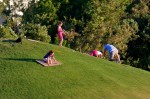
Here, grass sledding appears to be all the rage. The sled of choice is a simple piece of cardboard. Perhaps there are high-performance grass sleds available–teflon coated cardboard or maybe graphite would be slipperier–but I haven’t seen any so far. What I have seen is people having a ball sliding down grassy slopes on 95+ degree days without spending a penny. To boot, grass sleds are 100% recyclable. Now that’s what I call inventive.

I watch groups of children with their parents sliding down the grassy slope from my balcony. Summer fun at it’s finest. They begin to gather in the afternoon, making the most of the last days before school restarts. I think back to my own childhood summers. They lasted forever. Hanging out under a shady tree–or, more often, up in it. Once, a summer storm was blowing in, whipping the branches of our giant silver maple into a frenzy. I followed my brother high on the limbs, riding the tree like a crazy swing swaying frantically in the wind, our mother below yelling up at us to be careful. I remember seeing her face and recognizing her indecision–torn between letting us have fun and calling us down to safety. Then there was a bolt of lightening and her face shifted instantly into decision–she hailed us back down to earth.

I imagine the parents on the hill and their relief at having something to offer their children that is both fun and safe. After all, what is childhood without a few grass stains?

Hanging on Air

When we decided to move to Chattanooga, one of the attractions was it’s proximity to Lookout Mountain Hang Gliding Park.  Hang gliding wasn’t really on my bucket list, but it was on my husband’s.  For me, I just hate to miss out on anything.  So, adventure number one was the Introductory Experience.

We arrived at the park office at quarter ’til 8AM.  The office perched high above the valley with an ominous looking concrete . . . slide?  The words that popped into my head when I saw it were, “Ramp of Death.”  But wasn’t so much a ramp as a concreted coating on the top of the mountain that started out looking reassuringly level and then took a nasty bend at almost a 90 degree angle, directing my gaze straight down a 2000 ft drop.   My stomach started doing flips–and not for joy.  Fortunately for me, the Introductory Experience package we’d signed up for did not include that kind of leap of faith!  Instead, after signing in, we were led down the mountain to the valley below to start learning on the bunny hill.

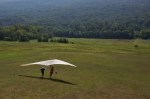
I love learning.  It’s the best part of life.  But the frustrating thing is how slowly new lessons sink in.  Especially when it includes making your body do something it’s never done before.  Picking up a hang glider and running across a field with it is one of those things.  It looks easy enough.  But finding the right spot on your shoulders to balance the weight of the glider is tricky and sometimes painful.  Then, there is wind.  There was no wind until I put a glider on my back, but as soon as I had wings, there was air moving me in directions I didn’t want to go.  The glider is designed to take flight.  You would think that would make it easier to carry.  But getting it to fly straight isn’t all that easy.  Especially when your airspeed is something less than 3 MPH.

Then there is the difference between knowing what you’re supposed to do in your mind and actually doing it.  I vaguely recall an article about how your brain has to build new neural pathways to allow you to perform an action that you have not performed before–being told what to do is not sufficient to allow you to do it until your brain finds a way to communicate the appropriate action for each muscle fiber to take and can coordinate all of those actions.  My brain seems a little stubborn.  For example, one of the things we were told when we graduated from the flat ground to the actual bunny hill was that we needed to run and keep running until we had taken three steps in the air.  Until you haven’t hit ground for three steps, you really haven’t launched.  The instructor repeated this message 9 more times as we each did our ground test hanging in a glider on a stand.  I said this to myself over and over as I prepared for my first launch.  “Keep running.  One, two, three steps in the air.  Keep running.”  But when I started down the hill and I felt myself lifting off the ground, what did I do?  I stopped running.  Then I landed hard, belly-flopped onto the ground and drug my body flat across the grassy slope at a rate of speed fast enough to make the tops of my feet feel like they were on fire.

But why did I stop running?  I know how to run.  I don’t need a new pathway to tell my legs how to move.  Yet, apparently, there is some message heavily coded in my brain that says, “Don’t run when you’re airborne.”  Where did that come from?  I’ve never run into the air before except in my dreams.  Maybe I stopped running when I was dreaming?

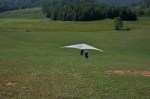
After gliding (dragging?) down the hill on my belly one more time, something in my brain clicked.  I couldn’t remember when I stopped running.  I couldn’t remember the feeling of running in the air.  It took two belly flops for me to even realize that I stopped running too soon.  The third run, that was a primary thought in my mind, “Just keep running.”  Not just before I started down the hill, but as I was picking up speed, feeling the harness pull against me, feeling myself lifting into the air, “Just keep running.”  And I felt myself running in the air, lifted off the ground, suspended by wings.  Then, I stopped running.  It was a glorious few seconds of flight.

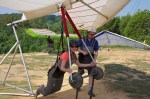
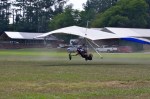
Later that afternoon, we went for a tandem ride, each of us gliding with an instructor.  Being sympathetic to beginners, Lookout Mountain uses ultralight airplanes to tow tandem rides from the ground rather than having us run off the cliff together.  Saved from jumping off the cliff!

My instructor, Clayton, checks in to see how I’m doing.  To tell the truth, I’m not sure how I’m doing.  During take off, the glider starts to climb almost immediately, but there are a lot of jerks and bumps while being towed.  Watching the plane in front of us bumping up and down in the turbulence creates visions of horrible crashes in my mind.  I keep reminding myself that a glider is forgiving and there is plenty of room for recovery.

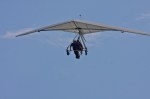
After detaching from the tow plane, we soar above the valley.  When you look out the window of an airliner, you don’t think about the experience of the wings.  Today, I am strapped to the wings–exhilaration and a small beep of terror compete for my attention as the air rushes around me.  Clayton finds a thermal and we circle our way up to nearly 3600 feet.  I’ve been in helicopters and a sailplane, but neither provides the view from a hang glider.  There is nothing between you and the ground.  I wonder how an eagle spots a fish.  I imagine spotting a fish and diving towards the earth with the assuredness of being born for flight.  I experience “eagleness” for a brief moment.

But the moments of exhilaration are clouded with fear.  I feel the tension in my body that indicates adrenaline is flowing.  I cannot relax although I try.  When I do relax for a moment, the glider bumps in an invisible shift of rising and sinking air and I am tense all over again.  I wonder how anyone can feel secure suspended from a giant kite?  I wonder why I am there.  Then, I return to that moment.  That instant of soaring above the earth experiencing lift and rushing air and the endless view.  There is no wondering and no fear when I am no where else in my head.  When I am mentally where I am physically, I am simply there.  No thoughts of crashing, no thoughts of falling, no thoughts of any kind.  I breathe in and I enjoy.