Dams and Damns

Rainy weather has kept me off my bike since our return from Germany. But today, the weather is decent and I’m home alone so I can ride wherever and however I want. I am determined to get back on my bike after so many weeks off. As soon as I can pull myself away from work, I get my bike out and go.

I tell myself just to go slow and relax since I haven’t ridden in so long, but I can’t seem to stop from pushing myself. It feels good to crank up a hill. I remind myself again that it’s been a while since I’ve ridden and that I’m planning a bigger ride in the morning and don’t want to be too tired or sore. But, I push a little harder going up a hill anyway. I’m like a little kid who doesn’t know how to pace herself.

I settle down a bit as I get into slippery boardwalks with blind curves and pedestrians. Even so, I almost collide head on with another cyclist when we both take a blind turn wide at the same time going in opposite directions. We both jump, brake, and move back to our respective sides. I feel my mouth formed in a perfect “O”, still stuck in my surprise.

I continue on my way even more cautious of the blind turns. But, I have no more close calls as I go past the various landmarks that mark progress along the trail. I pass the riverside restaurant that I want to stop at “some time.” I get to the boat house for the local rowing club that I keep meaning to visit “when I have time.” I continue past the practice football field that I can’t figure out which team uses. I make it into the gate that marks the part of the trail that is supposed to be 3-5 MPH. I glide slowly around the pedestrians in this area, trying not to draw attention to the fact that I’m going more like 10 MPH. I brake to a crawl every time I approach someone walking and call out politely (I hope), “I’m on your left,” and say “Thank you!” if they step right to make room for me. I am a regular ambassador of cyclist, pedestrian relations.

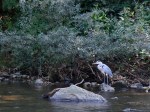
Eventually, I make it to the Chickamauga Dam. Today, the water is calmer than last time. Less churn seems to correlate with fewer blue heron. A fisherman hunkers down on the rocks in a shape identical to a giant great blue heron. I wonder if assuming the shape allows him to also assume the patience–they are the most patient birds I’ve ever watched. Then, I wonder how many of the men fishing in these toxic waters are fishing to feed their families. The sign warning fishermen about eating more than 1 fish a month from these waters still looms large on the shore. I wonder, given the choice, how many people would choose starvation over toxic fish?

I ride out to the overlook of the dam. But I am not interested in the dam so much as counting heron. The collection on the shore blends into the rocks in a way that defies the size of a great blue heron. Were it not for the low sun casting long shadows, my eye would skip right over them. As it is, I am left to guess how many I don’t see. The men and heron scattered over the rocks create an image of survival. I feel certain that there is deeper meaning in this tableau, but I am at a loss to articulate it.

I make my way back towards home, riding at a quicker pace now that the pedestrians are mostly gone and my rear end is reminding me why cyclists should wear padded biking shorts. Fortunately, the ride seems shorter on the way back and I am soon approaching the last hill up to the Bluffview Art District.

As I exit the switchback from the pedestrian/bike bridge, I encounter a bit of a traffic jam. A wedding party seems to be having a rehearsal in the sculpture garden. Two cars are headed towards me, the first confused when faced with the cul-de-sac. The bridge I have just come across dumps me into this same cul-de-sac and I must cross it to continue on my way while the car must perform a U-turn. The second vehicle is a large SUV and the woman driving has stopped so that she is blocking the entire road exiting the cul-de-sac. Plus, she is looking at the wedding party instead of the road, oblivious to my presence. I hesitate, balancing on my pedals hoping she will move on before I have to stop. I have not snapped in my left foot just in case she doesn’t move. Unfortunately, even after 44 years of intimate knowledge of my ability to hurt myself, I have failed to predict that this time I will fall to the right. I cannot get my right foot unsnapped fast enough and I fall to the ground with a thud as a loud, “God Dammit!” escapes unedited.

To add insult to injury, both drivers, still completely unaware that they have each contributed to the circumstances that led to my fall, pull up and ask through their windows if I’m OK as I struggle to free my foot so I can stand. Then, as I regain my feet, a man suddenly appears at my side out of breath and apparently ready to perform triage, “Are you OK?” he asks anxiously. This strikes me as being ridiculous to the point of offensiveness. I try to be polite, but I really just want everyone to pretend like they didn’t see a thing and let me sulk in my embarrassment. As a result, my answers are short and tight, communicating my desire to be left alone a little too plainly. When the man walks away, he’s clearly the one offended.

In the category of “could this situation get any worse,” when I try to ride away, my rear wheel won’t roll. Now, I have a lot of experience troubleshooting software over the years, so you’d think I’d check the simplest possible problem first. But, no. I get out my allen wrenches and start trying to adjust my rear disk brake, assuming that’s the culprit. After my adjustments make no immediate difference (possibly because I actually have no idea how to adjust my disk brakes), I decide to take another look. I realize the problem is much simpler: the seatpost has a rack attached to it for my saddlebags. The seatpost turned in the fall and now the rack is pressing against the rear tire.

All I need to do is open the seatpost clamp, twist the seat back to straight, and close the clamp again. Unfortunately, I can’t get a good grip on the clamp release and it’s tight. I swing the bike around for a better angle and end up with the bike across the sidewalk, the lever in my right hand, and my right foot against the frame of the bike for leverage. As I struggle with the clamp, I suddenly realize that the entire wedding party is now flowing down the sidewalk towards me. In my peripheral vision, I can see that they are gathering just short of my bike and coming to a stop. I’m too irritable at this point to be social, so I keep working without looking up, but I expect someone to offer help at any moment.

Instead, when I sneak a quick sideways glance, I realize they are confounded by the obstacle. They just want to leave, but I am blocking their path. This irritates me further. Did they not see me on the sidewalk when they headed this direction? Were they too fearful of using the street that has 2 cars an hour on it and those 2 cars drove off after they ensured my fall? Someone in the group finds a space between a road sign and the curb and the group narrows and starts flowing past me, single file. It’s my first experience as a dam.

Then, the concerned man approaches. If I had any doubt that I offended him earlier, it was removed as he walked by me briskly without so much as a sideways glance even though I’m clearly struggling with the bike. I feel remorse, but it only intensifies my desire to leave. Fortunately, the clamp releases and I’m able to make the adjustment and get on with my life.

I crank up the hill through the district harder than I thought was possible. As I pass the remaining wedding party members getting into their cars or lingering on the sidewalks, all I can think is, “Damn it! Get me out of here!” I am sending all my angst to my pedals. I can only hope that none of these people will recognize me if they ever see me again.

Unfortunately, I have to get off the bike and walk across the glass bridge only 100 yards or so later with plenty of angst still throbbing in my temples. But I take a deep breath and re-group mentally before I mount up and ride across the Walnut St bridge. It’s a Friday night and the bridge is full of tourists with small children. If I fall again, I will likely throw my bike off the bridge, and the last thing I need is to run over a small child. I relax and take it slow as I maneuver through the crowd.

I am relieved to make it home safely–that is, I am safe and so is the public. I check my bike out to make sure it will be in shape to ride tomorrow and then I put it away and focus on making a good recovery dinner. Who says you can’t have adventure close to home?
Gaining Air

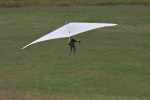
The alarm goes off at 5:45AM.  I groan.  It’s Sunday after all; shouldn’t I get to sleep in?  I roll out of bed and feel all the places that are kinked, sore, and bruised from yesterday’s hang gliding adventure.  My neck and shoulders are burning.  I remind myself that I am only going to feel worse tomorrow morning after doing this a second day, then I get moving.  Coffee, face wash, and a glass of water all wake me up.  Pat is up and in motion.

Once again, I run around gathering everything necessary for a morning on the training hills followed by tandem flights.  For someone who doesn’t own any hang gliding equipment, this is an amazing amount of stuff.  First, I pack my camera bag, then I pack a change of clothes and stuff it in my new tripod bag.  Next, I pack my laptop, Verizon MiFi, iPad, iPhone, and all required power cords along with my wallet, sunglasses, etc. into a laptop bag.  Now, you might wonder why I need an arsenal of electronics to go hang gliding.  The truth of the matter is, I don’t.  But, I need this bag for the same reason Pat is gathering up pillows while I’m packing my bags:  we are going to have 5 hours to kill between the morning hill flights and the 5PM tandem flight.  I might as well make it a productive 5 hours.  Next, I grab my bag with my five fingers shoes and our water bottles.  When at last we’re ready to roll, I hang such an assortment of goods off my appendages that it’s not clear I can fit through the door.  Pat relieves me of a couple of bags and go on our way.

Having learned from yesterday’s mistake, we stop at a gas station in Trenton, GA before we get to the country roads that lead back to the training hills.  They let us use their employee restroom and we buy a couple of granola bars.  When we get to the training hills, I, of course, have to go again.  Back to the nasty outhouse I go.  I wish I would have brought a nose plug, but I survive.

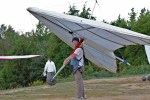
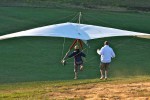
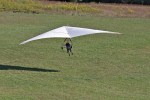
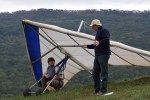
This time, I am not only on time to help put together the gliders, but I am required to put together my own.  Today, Pat and I will each have our own glider.  Assembling a glider is a little scary.  As you read the instructions and put each piece in, you think to yourself, “I’m going to fly in this thing and if I don’t do this right, I’m going to die.”  It’s a lot of pressure.  But, I manage to get the thing together and ask for some help when I’m not sure if I’ve got it right or not.  The thing that surprises me is that the ribs that make the wings rigid are rods that simply slide into pockets and rest loosely against the front bar that creates the leading edge of the wing.  Seems like they should be attached somehow.  The other thing that surprises me is the places where it’s OK for the glider to be severely bent.  For example, the bracket that attaches the wheels to the down tubes is completely askew, but I’m told that there’s no problem with that bracket.  However, bends in the wing ribs are bad.  Bends in the front tubes on the leading edge are especially bad.  While I understand why the wing needs to be a particular shape, I’d kind of like my landing gear to be just as straight.

I get my glider together faster than Pat (I had a little more help).  I load it up onto the trailer and hop on, holding the strap that keeps it from tipping backwards in one hand and bracing the front of the glider with the other to keep it down in the trailer.  We bump along over the grass and to the back hill, climbing to the top in no time.  I am the 3rd person to make it up the hill.  Dan, the instructor, arrives only minutes after I do and the first students start launching.  The air is calmer today and we hope for a good day with lots of flights.

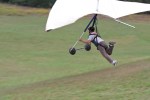
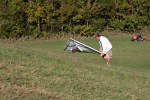
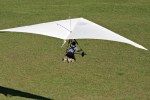
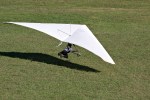
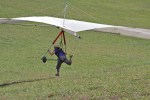
My first flight is an improvement over the day before.  I am encouraged that I am able to get air right away, although I still fail to correct my direction and spin out when I land in the middle of an unplanned turn.  An interesting thing is happening as I gain confidence–I am starting to have one more conscious thought that I remember each flight.  I remember the feeling of running in the air.  I remember letting my hands loosen and slide down the bar.  I remember trying to turn the glider.  This is all a lot of improvement–earlier flights, I could not tell what I had or hadn’t done or if I’d had any actual thoughts at all.  Now, I am able to discuss my flight with the instructor and realize that I was not keeping my eyes on target.

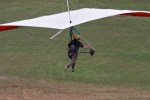
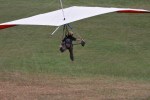
My next flight, I realize when I am not looking at the target and correct a little earlier.  Each time, something new is achieved and remembered.  It’s interesting to observe myself learn.  While I wish I were one of those natural athletes who can take on any physical task and instantly conquer it, my slow learning process at least gives me the opportunity to understand how I learn.  I notice that there is a point in each flight where I go from experiencing the exhilaration of soaring to the fear of landing (I have an assortment of scrapes and bruises from yesterday).  When I shift from the feeling of flying to the fear of falling, I start to forget what to do.  But, each time, I get a little further before that panic sets in.  Even after a particularly painful landing the flight before.  In that flight, I am caught by a cross-wind and turned dramatically to the left.  I shift my weight but I don’t change direction.  I assume I’m shifting the wrong direction and shift the other way, which makes matters worse and then I fall to the ground, literally bouncing off the grass and getting completely airborne a second time before landing for good.  The entire flight from when I left the ground to the second time I landed lasted about 8 seconds (based on the times of photos Pat shot).  Both knees hit when I landed the first time; they are bruised and swell slightly.

But the next flight, I still get better.  Now I know that I was correcting in the right direction, I just didn’t have enough speed to be able to control the glider in the wind.  I work on moving the bar in and out.  When I push the bar away from me, I get more lift.  When I pull the bar in, I get more speed, but in a downward direction.  I realize I am moving the bar too much–I need to stay light in my hands while I adjust.  I realize this just as I come in for another landing after a 7 second flight.  I get in one last flight–8 today all together–before the wind starts to kick up.  Pat gets in his last flight right before me.  He pulls his hamstring as he launches himself from the hill.  He is done.  I’m already spent and am happy for the excuse to call it a day.  I get my last flight in.  It’s smooth and controlled, although the wind has died and I don’t get as much lift as I have on previous flights.  That’s OK.  I wanted to have a controlled landing and I did.  I am not breaking any learning records on the hill, but I’m OK with that.

With Pat hobbling badly, we decide to postpone our tandem flight again.  We make the drive back up to the pro shop at the top of the mountain.  Once again, a crowd of tourist has gathered around the launch ramp only to be disappointed that no gliders are launching today–the wind is from the wrong direction again.  However, a tandem flight is towed up from the landing strip below, so the tourists (us included) get to enjoy watching that flight soar by.  I go inside to get a book that we need to pass a test to graduate to the next training hill.  While I’m paying, I hear a girl screaming and many people laughing.  Pat tells me when I return outside that the glider buzzed the pro shop and scared the girl to death.  We were surprised–I wonder if this is a boyfriend taking his girlfriend for a tandem flight since none of the pilots we flew with in our previous tandem flight did anything to intentionally scare us.  In any case, we’re glad to see them land safely on the airstrip below.

Pat limps back to the car and I drive us home.  Once again, we are exhausted.  I find myself wondering if there is a workout we can do for hang gliding preparedness!

Hang Gliding Take 2

Still toying with the idea of getting our novice hang gliding certification (although also still not convinced I ever want to launch off the mountain), we signed up for a second round of hang gliding lessons.  We upgraded our introductory package to a weekend package, which gives us 15 more hill flights and 1 more tandem flight each.  Today is the kickoff of our weekend.  The alarm wakes us up early and we scramble to gather all the gear we’re taking with us.  We actually do not need anything other than a change of clothes and water, but I, of course, must take my camera.  And, the fact that we will be done on the hills by early afternoon but our tandem isn’t until 5PM means that we need things to do.  That means I’m taking two laptops, iPad, iPhone, and MiFi.  We also take air mattresses and pillows in case we want to take an afternoon nap.  We have more stuff than if we were traveling with an infant.

But, we get the car loaded and we make it out the door in plenty of time to fill up the gas tank and still get there early.  The entrance to the training hills is about 40 minutes from our place.  But once we get to that entrance point, there is a long dirt road full of pot holes, rocks, and ruts that we must make our way down.  It adds an extra 10 minutes, although it’s a little faster in the mini van that it was last time when we made the mistake of coming in Pat’s lowered BMW.

By the time we make it over all the bumps, I really need to use the restroom again.  Believing there are no facilities at the training hills, I start to head into the woods, but I see a man heading down a mown path and stop, thinking I don’t want to walk up on him if he’s headed into the woods for the same reason.  When he returns, I follow the same path he took to discover that there is an outhouse at the end of it.  Now, I have used many outhouses and, while none generally smell good, some are tolerable and some are really only appropriate for acts of desperation.  This outhouse appears to be occupied by mice.  I assume they have some rare disorder that causes a complete loss of smell.  The mice are not home right now, but their nesting and seed shells occupy the majority of one corner of the outhouse.  That is the most pleasant part.  I stand in front of the open door looking in and contemplate the pluses and minuses of just going in the woods anyway.  In the end, I opt to hold my breath and practice my balance inside the outhouse because I figure at least it’s private and I’m running out of time to find a good spot both because I have a very full bladder and because I’m supposed to be on the field by now.  Mental note:  make a pit stop at the nearest town tomorrow.

When I arrive at the field by the storage unit, I discover that I am supposed to be learning how to assemble my own glider and that Pat and the guy we will be sharing our glider with today, Craig, are already more than halfway through the process.  I get there in time to watch the final steps and perform the pre-flight check.  Pat tells me on the way to the hill that now that he’s seen how a glider goes together, he’s a little worried.  He was expecting it to have more parts that are fastened or something.  I decide not to think about it too much.

My first flight is not a flight at all.  It’s a run-and-crash.  I try to review what I did and didn’t do, but I have no conscious memory of what actions I took or didn’t take.  I assume that I stopped running too soon.  Pat, on the other hand, gets airborne like we were just hang gliding yesterday.  He seems to have retained what he learned last time.

My next turn, Gordy, the instructor, reminds me to loosen my grip and let the glider fly and to keep my eyes on my target.  I get a good start and launch well, but perhaps I loosened my grip a little too much because I am suddenly much higher than I expected.  I am also pointed towards the woods instead of my target and headed towards the 4-wheeler used to tow the hang gliders back to the top.  I confess:  I scream.  I know I did something to turn the glider back to straight, but my brain is not processing information at a conscious level, so I cannot say for sure what it was.  However, whether I did the wrong thing or just did too little, too late, I found myself diving towards earth, landing hard, and spinning out at the stop so that I ended up facing the hill.  The good news is that I landed before I hit the 4 wheeler.

Despite the crash landing, the feeling of flying stays with me.  The moment of lift off when my feet were running in air and the sudden realization that I am flying make me want to do this again.  I realize that I’ve been pushing myself into this.  This is the first time that it really felt fun.  Every run previously was more about “I can do this, too” than it was about wanting to be in the air.  I scraped my ankle on the first landing and it’s oozing blood.  My shoulders and upper arms are already bruised from carrying the glider.  My knees are bruised from landing too hard and too fast against the ground.  But now, I really want to get good at flying off this hill.

Unfortunately, there is a big crowd on the hill.  The wind is gusting and changing direction.  We need a calm, gentle headwind to safely launch and land.   There are 10 gliders up on the hill all vying for a turn at the precise moment the wind is right–we can launch only one at a time.  Plus, the morning ground school has now joined us on the hill to try to get their first flights in, adding 8 additional students and 3 more gliders.  But there are only short windows to launch in and everyone must launch into a headwind, so things slow way down as we take turns waiting for the wind to cooperate.

We stand-by as Gordy holds another trainee poised for take off, waiting for the wind to calm down.  When it does, it changes direction.  The student moves from one side of the hill to the other to try to catch a headwind.  Then the wind changes again.  This switching of direction slows the whole process down even more.  It’s not easy to move from one side of the hill to the other with a 90+ pound wing on your back in gusting winds.  Even more troublesome, the gliders start lifting off the ground on their own when the windspeed gets too high.  We start having trouble keeping gliders on the caddy coming up the hill.  First one flips in the wind, then another.

Between gusts of wind, Gordy manages to launch a few more students.  However, as I get on deck, I watch an experienced student in front of me get caught in a crosswind that causes one wingtip to catch the ground as she runs down the hill.  The glider goes airborne, spins, and then drops her on the ground hard.  She is OK.  She didn’t get high enough into the air to get seriously hurt, although I supposed she could have twisted an ankle or something easily enough given that she wasn’t launched yet.

Gordy announces that we’re going to call it a day and that we’ll try to fly down if the wind will let us, but we should take our gliders back after we land.  He looks at the windsock and looks at me and says, “I’m nervous about this wind.  Are you nervous?”  I say no.  I’m really not–I have confidence in my ability to heal.  He decides to walk me further down the hill so that I’m launching from a lower altitude.  The wind dies and I launch safely, but I get little lift because there is suddenly no wind at all.  It’s not quite the day on the hills we were hoping for, but we live close and walking away with only some bumps and bruises is far better than risking serious injury,

Pat and I discuss the odds that we’ll be able to take our tandem flight.  We decide to drive up to the pro shop at the mountain launch and reschedule since we don’t want to hang out all day only to have to reschedule anyway.  When we get up there, there is a crowd of disappointed tourists who were hoping to watch hang gliders launching from the mountain.  The wind is blowing the opposite direction needed for a safe launch, a tailwind, which we learn is called “over the back.”    The person in the pro shop thinks it’s a good idea for us to reschedule our tandem flights for tomorrow–apparently they have already moved people from Friday to Saturday and the schedule is over booked.

We head on home, tired and slightly disappointed, but still excited about the experience of flying and looking forward to returning tomorrow.

Wandering Freiburg

On the morning of our last full day in Freiburg, I awake feeling much like I’ve been run over by a train a few times. My head aches, my throat is on fire, my body hurts every where. When I stand up, my calves remind me how much up and down walking I’ve been doing by spasming painfully. I look in the mirror to discover a large spot between my upper lip and nose. I get out my reading glasses and determine it’s a giant zit that could only be more noticeable if it were on the end of my nose. There is a certain irony about having to put on reading glasses to determine a foreign body on your face is a zit, but I cannot say I find it amusing.

I splash water on my face and drink some from a glass in the room, breaking my no tap water rule. I am glad that we have spent so many days in this small town–I don’t feel rushed to see all of it in a day and feel the freedom to relax into our trip gradually as my body adjusts to the time change and, hopefully, defeats whatever virus it is that I’ve picked up on the plane. I check the time and it’s nearly 9AM. Pat is up and we make our way towards breakfast with me moving slower than usual.

I take my iPad to breakfast with us today since we haven’t yet figured out what to do today. Pat suggests going hiking again, but every part of my body screams “Nein!” at this suggestion. I suggest we hit a couple of museums and do a casual stroll down to the Dreisam River, now that we know where it is. We plot out a broad rectangle through town, wrap up breakfast, and head back to the room to finish preparing. I make the mistake of sitting down on the bed to read while Pat is in the shower, finding myself nodding off and slow to get moving again. It’s nearly noon by the time we get out the door. I remind myself again that we don’t have to try to do and see everything and this is our 4th day in this town–if we didn’t see anything else here, it would be OK.

We wander down a street we haven’t taken before–when we looked at the map, we were surprised to find that there were a few of those left. We point ourselves at the Anthropological Museum, hoping for dinosaurs and wooly mammoths, I suppose. When we arrive at the museum, we recognize the park in front of it and realize that we’ve been by several times before. The building isn’t big enough to house dinosaurs, but we go in anyway.

We follow the displays of ancient artifacts ranging from tiny remnants of weapons and tools to large pots. The signs are only in German and the English translation booklets are all gone. Pat has trouble translating the signs, not knowing many of the words since they are not commonly used in conversation. I wonder if it is a deep character flaw on my part that when I see these types of displays with their little signs purporting historical significance that I immediately want to lay down and take a nap. We make it through two and a half small floors of displays of similar items. Some displays are models of what life looked like at each represented chapter from history. One has a tiny woolly mammoth in it and I smile. But upon closer inspection, I see that it is a child’s plastic rhino covered in fake fur to look like a mammoth–apparently model mammoths are hard to come by.

Returning to the bright sunlight outside the museum, we walk a little further and find a much more exciting sight–the university library is being torn down. A crane takes bites of concrete from the massive structure, leaving exposed rebar along the edges. We retreat to a safe corner as we watch and a man standing there strikes up a conversation with Pat. He has returned to Freiburg for the first time in 20 years and is amazed that they are tearing down the library. He tells Pat that he watched it being built when he was a college student there in 1977. Other than the building being ugly, I can’t determine why they would be tearing it down by looking. I stand there watching the crane at work as Pat and the man continue their conversation. I catch bits and pieces and realize they’re trading stories about travel, but at last Pat turns to me and says, “He’s doing what we want to do–he has no home.” Later, I learn from Pat that the man graduated from college and started living out of a VW bus, traveling all over Europe. He also spent about a year doing the same in the US. He never settled down and continues to live on the cheap as he moves from place to place. He tells Pat that he gets an occasional job but he eats from the grocery store, buys used clothes, and spends very little money. I find myself wondering who “we” is in Pat’s statement.

We wander on down to the Dreisam “river” and realize why we couldn’t find it the other day–we probably crossed over it without noticing. We walk down to a pedestrian path along the water passing groups of teenagers who pass joints back and forth between them, the smell of pot lingering in the air. Pat tells me to be careful in case we are mugged, but I imagine we would be in more danger if we were carrying a bag of fries than carrying my camera. We walk on by un-accosted.

A beer garden sits on the edge of the river in front of an active group of ducks fluttering around on the water. We stop and think we might have a snack, but the waiter doesn’t come and finally Pat goes inside, returning with two Pilsners and no food. When I ask about a snack, he tells me the kitchen was a cluster, so he just got beer. We had breakfast only two hours ago, so I figure we should survive the deprivation, but I worry about drinking strong German beer without any food. Pat has to answer an email, which takes him a long time on his iPhone. I sit and wait for him to finish, watching a silly dog dive into the knee-deep water and try to chase the ducks, hopelessly thwarted by the resistance of the water.

A man gets up and points out a large heron of some kind sitting on the bank across the stream. It looks related to the Great Blue Heron of home, but I wish for the second time that I had purchased a German bird book before coming over. I also wish I’d brought my telephoto lens with me today instead of leaving it in the hotel, but content myself with shooting with the lens I have.

After finishing our beers, we walk on along the river, passing a pair of lovers on a park bench. They are young. He sits in the bench while she lays with her head in his lap. They see nothing but each other and he reaches out and strokes her face with the tenderness of young love. After we pass, I tell Pat I wish I could shoot that moment without interrupting it, he looks at me oddly and says, “They’re dirty and homeless and they look like they’re high.” I guess we all see things differently–or maybe I really did need to have food with my beer.

Returning to the city streets, we find ourselves some ice cream and wander along towards the modern museum of art. We find a large church on the way and stop to peer at it between the bars that keep it closed to the public but open for gawking. Pat says, “They really make it hard to get close to god at this one!”. I laugh, but since I think we’re closer being outside than in, perhaps it’s not as funny to me.

We wander around some more, deciding to stop and eat a flatbread pizza-like thing that Pat says first appeared in Germany about 15 years ago and seems to have grown in popularity since. He doesn’t like Flamkuchen himself, but thinks he should give it another try. We sit outside once more, this time in a small courtyard between what might be office buildings. The Flamkuchen is not any better than Pat remembers it, but the beer is good. We sit in the sun feeling very European–or maybe French or Italian–letting the afternoon cruise by as we relax with no place to go.

Finding the small amount of energy I’d rallied flagging, I suggest we skip the art museum and return to the hotel for a nap instead. Pat agrees and we make our way back to the hotel. We decide to watch an episode of Damages on my iPad and I fall asleep ten minutes in. Pat goes through two more episodes while I doze before he, too, falls asleep.

Waking nearly 3 hours later, I am groggy and confused, but hungry. We decide to do our usual wandering for dinner exercise. I get myself sorted and we decide to try to find the restaurant we ate at our first night in town. We both think we know where it is, although we don’t agree. We wander around for an hour with it being in neither of the places we thought it was. Eventually, we settle for a place we haven’t been before where I try a traditional German version of macaroni and cheese. It’s made with spaetzle noodles and rich cheese and cream sauce and topped with toasted onions.

While I eat, I watch two French men sitting behind Pat. Tonight, they are the “loud Americans,” talking and laughing loudly and ogling each woman that walks by with an openness that I haven’t seen in the states in 20 years. One of them wears a polo shirt and khakis that look almost American. The other wears a black leather biker vest, a long dangling earring in one ear, and his mostly missing hair in a pony tail. If it weren’t for how they held their knife and fork, I would think they were Americans playing a joke by speaking French. Then, the biker guy pauses in his eating to run his tongue down the length of his knife, removing every remnant of whatever he’d been cutting with it. I have never seen anyone do this from any country, although having only been to France a few times, I can’t claim to be an expert on French etiquette. I’m pretty sure this is not standard French dinner behavior, however.

Finishing up dinner and skipping dessert, we drag our still tired selves back to the hotel for the final time. We set the alarm for the first time since we arrived, needing to get up early to catch the train to Berlin in the morning. As I get ready for bed, I carry my iPad around with me trying to catch up in the episodes I slept through. Getting caught up, I suddenly feel wide awake. We end up watching one more episode before falling asleep. I wonder if our German neighbors can hear the iPad through the walls as I drift off to sleep.

The Climb to Schlossberg Tower

In contrast to yesterday morning, I wake up feeling like whatever bug Pat was fighting has been evicted only to find it’s way over to me. I get up groggily at 6AM, but end up returning to bed until 9AM. When at last I wake up, Pat is already out of bed. We get ourselves ready and head to breakfast, debating what today’s agenda should be. Pat suggests we go hiking again. I suggest we hike up the mountain this time and take the cable car down, as my knees will not take another day of downhill. Pat does not want to work that hard, so I suggest we walk over to Shlossberg and walk up to the tower, which is supposed to be a fantastic view of Freiburg. I’m not sure why I wasn’t tipped off to the fact that if we walk up to a scenic overlook, we will also have to walk down, but I cheerfully propose this alternative, thinking it will give our knees a day to recover.

After breakfast, we wind our way through Freiburg to the restaurant the marks the start of the ascent to the tower. The sign says 1.2 KM to the tower and I smile encouragingly at Pat that it’s such a short walk. As we start up the path, we quickly learn how cramped our poor calves are from walking downhill all day yesterday–each step feels like a massive stretch. But, it feels good and we take it slow. A little too slow, perhaps–a group of octogenarian Germans passes us like we’re standing still. We pick up the pace a bit. After winding our way through several steep switchbacks, we reach a restaurant and realize it’s the same restaurant that we thought we were at below. I am a little perplexed that it seems like we’ve gone at least 500 meters, yet we have only made it from the entry point to the restaurant.

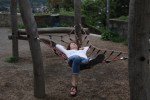
We continue up the incline, much of it as steep as basement stairs. We pass enormous trees covered in graffiti as well as ancient ruins also covered in graffiti–we are surprised by the tagging every where in this relatively small town. At last, the climb gives way to a flat place where a playground with large wood structures provides a place for young children who aren’t exhausted to burn off energy while their parents catch their breath. I notice there aren’t any children here. I recline on a chain link hammock in the middle of the structure long enough for Pat to take a rare photo of me. When I view the photo on my camera, I remember why I prefer to stay on the other side of the lens.

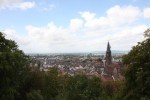
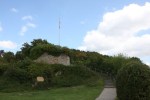
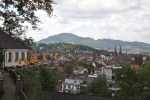
We continue on to the next stretch of the path, winding our way up even steeper climbs. Finally, we come to the ruins of a tower with a serpentine path up to the top. We look over the view and I shoot, enjoying the breeze as much as the scenery. I turn around to shoot the other side and see another mountain behind us. I lean back to take a shot and, there in my lens at the very top of the next mountain is a structure silhouetted against the sky that looks remarkably like the symbol we have seen marking the path to the tower. Yes, I have just discovered that we are not at the tower at all, but only at a stopping place on the way.

I break the news to Pat. The tower looks far off in the distance, but we are determined to make it there. All wisdom about “enjoy the journey as much as the destination” abandons me as I focus on putting one foot in front of the other to finish this climb. I wonder how they measured the 1.2 KM–perhaps it was as the crow flies or, perhaps they meant it was 1.2KM straight up? Whatever the case, we redouble our efforts and leave the octogenarians in the dust (I am not proud to say that I was pleased that they turned around at the first tower because I would have been humiliated if the climb to the top was just an afternoon stroll for them). At last, we come upon the steps leading up to a grassy field where the viewing tower sits. It’s a crazy looking structure–giant logs support a spiral staircase up the middle with viewing platforms at multiple heights.

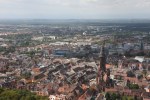
We enter the spiral stairs and I start counting each step. Then, I realize that perhaps in Germany this is not considered OCD as they have actually numbered the steps for me. 159 steps later, we arrive at the second to last viewing platform, but the steps narrow and continue, unnumbered. I climb up 16 more steps to the next platform and discover that the steps go up even further, past the viewing platform and shooting into the sky like an abandoned step ladder. I climb to the very top, but the stairs sway side to side. I take a step backwards and brace myself against the rail, every fear of heights I’ve ever had suddenly screaming in my ears, “Get down!” But I will not retreat until I have at least a couple of shots from this vantage point–it truly is an incredible view of Freiburg below and, for once, there is no fog. I manage to let go of my death grip on the rail long enough to snap a few careless photos and then I retreat to the platform where Pat waits. A man comes up the stairs below and the entire tower sways as his weight shifts with each step. Although the swaying is less amplified on the platform than it was on the stairs to no where, I am happy when Pat suggests we go down another level and sit on a built in bench for a while. When we sit, we notice a small lock snapped on the fence below the rail. It is engraved with two people’s names and a date. It seems like a nice way to tag something.

We cautiously make our way back down, but my left knee immediately starts with it’s shooting pains after only a few steps. I use the handrails to lift myself down, trying to save my knee for the descent down the hill. My knee really shouldn’t hurt this much–oddly, it’s my right knee that I previously injured, yet my left knee always starts with the pain first, my right knee catching up later. We limp our way down to the restaurant, feeling very old indeed. We decide it’s past time for lunch, so we might as well take a break and eat here. Unfortunately, the nice restaurant is no longer serving lunch, only coffee and dessert, and they send us up to the beer garden above. It’s only one flight of stairs up, so we settle at a table there and Pat goes up to the stand and orders food for us. He returns with what looks like a plate of worms. It turns out, it’s some meat like bologna that’s been sliced into thin strips and tossed with vinaigrette. Pat frowns at it–he says it’s not prepared properly and that it isn’t what he had in mind. We each try it. While it isn’t as bad as a plate of worms, it’s not significantly better. We manage to get down a couple bites each and then shift our focus to our beers. The beer is good. We sit in the sun filtered through heavy trees and drink our beer thinking life is pretty good in spite of the bologna salad. The view was worth the climb and the sore knees and, after all, we’re sitting in a lovely beer garden enjoying German pilsner with nothing else that has to be done today.

Hiking the Black Forest

I wake up at 6AM, surprisingly on schedule for having gotten so little sleep the night before. Pat, however, sleeps until I wake him at quarter to nine in spite of the fact that he fell asleep two hours before I did the night before. He jumps out of bed and throws on some clothes–we have purchased breakfast with our room and he doesn’t want to miss it.

The breakfast is a large buffet that offers foods that range from the same kind of fare at American hotels to a very German assortment of meats and cheeses. I opt for a small plate of fruit, a croissant, smoked salmon, and a small piece of cheese. I go back to make a waffle, but someone else is using both irons, so I eat corn flakes instead. After filling up, we return to the room with me thinking we’ll get ready to go to the Black Forest immediately.

Pat, however, has other plans. He lays back down “only for a minute” and falls sound asleep. I get out my iPad and read. This has happened every time we’ve gone to Europe together. Pat can’t get started before noon and I can’t stop until I collapse around 1PM. I resign myself to trying to stay awake all afternoon and let Pat sleep, slipping out to the terrace to read since it’s more pleasant than our room and I think the sunlight will help reset my biological clock.

I return to our room around noon and wake Pat up. We are not going to spend an entire day in bed. Pat says he feels like he’s fighting something and I feel bad for waking him, but he gets up anyway. We pack a single day-hike pack, filling the water bladder and stuffing it with an extra lens for my camera, his rain jacket, two pairs of reading glasses, and an assortment of maps–our loot from the tourist center yesterday.

We walk to the street car and purchase two tickets. The ticket machine is in German and I am grateful that he is the one figuring out how to buy the tickets. When we get on the street car, we stamp our tickets in a timestamp machine, i ask Pat what happens if we don’t stamp them and he tells me that there is a big fine for not having a ticket. As we come to the next stop, a blonde woman gets on wearing a T-shirt and cropped jeans and carrying a black messenger bag. She could be a college student, but she looks closer to our ages than to a 20-something. Continuing our conversation, I suggest to Pat that if he sticks to speaking English, we might get away with not stamping the ticket, but he seems quite nervous about this suggestion–apparently, Germans follow the rules. A minute later, the blonde woman approaches us, holding out an ID that shows she is “control” and asks to see our tickets. Pat gives me the “I told you so look” as she examines our properly stamped tickets.

The street car takes us to the end of the line where we transfer to a bus on the same tickets. The bus takes us to the cable car, which will take us to the top of the mountain. I suggest that we hike up instead, but it’s over a 1200 meter rise in elevation and Pat isn’t feeling up to that kind of climb. A woman with two small daughters rides up with us. She tells us they were there the day before and have returned to retrieve a forgotten teddy bear. She was forced to pay for the cable car a second time, which hasn’t made her happy, but her ire is directed at the cable car operate, not her daughter. They talk softly and laugh often. Upon discovering that I speak only English, the girls practice their English a little on me–they start learning English and French in the first grade. One girl asks me, “What is your name?” in perfectly clear English. I reply with, “My name is Dianne” and we both giggle as if we’ve told a joke. I giggle because I think we sound like every language book I’ve ever used and not at all like a real conversation. I’m not sure why she giggles, but maybe I am the first person she’s talked to who can only communicate in English (as far as she knows) and she’s delighted that her English worked.

As we rise towards the top of the mountain, we go from lovely views of the valley up into a massive cloud of fog and rain. I’m not sure which gods I’ve offended, but it seems a continual theme that whenever I get to a great view point, there is fog. When Pat and I were here last, several years ago now, we spent a day hiking to the Feldsberg (the highest point in the Black Forest) after reading that the morning fog clears in the afternoon. The fog didn’t clear and we could barely see each other if we got more than a few feet apart. We also went to the Zutgsptiz, the highest point in Germany, on a cable car and had a similar experience. You’d think I would learn.

When we arrive at the top, we’re hungry. Realizing we have only a leftover bag of peanuts for a snack, we decide to get lunch at the restaurant. We gorge on lentils with a wiener and snitzel. Of course we each have a pilsner to wash it down. Pat orders a piece of cheese cake to top it off. I have a few bites, but it’s not as good as his Mother’s cheese cake–it took me a few times to get used to the less sweet version of cheese cake German’s make, but now it’s a favorite.

After filling our stomachs, we head for the trail. We have only 2 1/2 hours left until the last cable car goes back down the mountain, and Pat wants to do an out-and-back. I tend to think we might as well just walk all the way down, but I keep this to myself since Pat does better making these kinds of decisions on the fly than in advance. We set the alarm on his iPhone for about ten minutes before half our time will be up, so we can decide then.

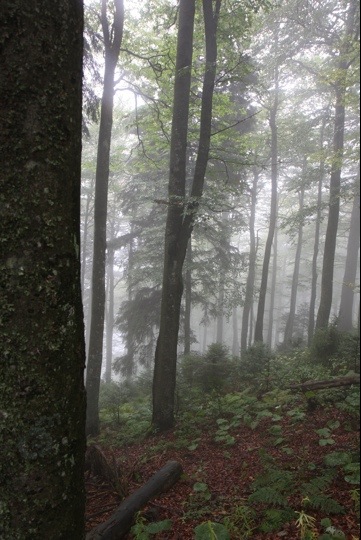
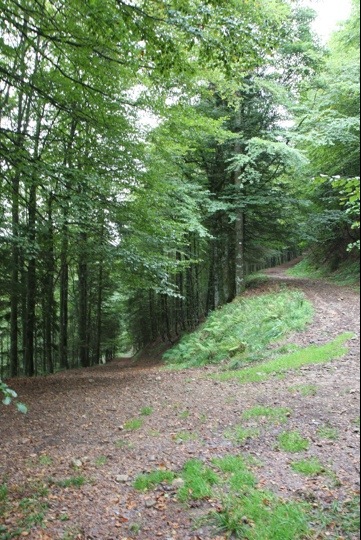
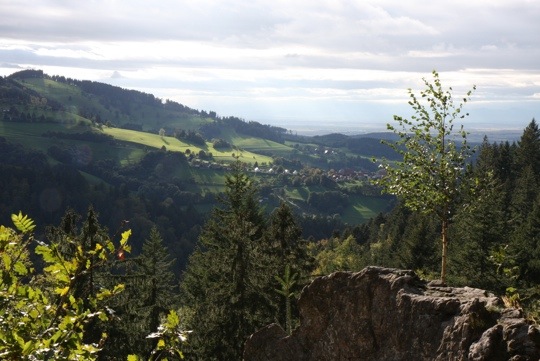
The forest is different than Pat remembers it from his many childhood trips here. There are many deciduous trees and he remembers only pines. When we get lower, there are more pines, but they are younger and less dense than he remembers. It’s beautiful none-the-less and we see few people on this Tuesday afternoon. We hike slowly down a broad path, trying to preserve our knees. The forest is quiet, and so are we. Just as Pat comments that there are no critters, a huge woodpecker appears from behind a tree. I get out my telephoto lens, but as typical, it disappears again before I can get a shot. If we were in the states, I would say it was a Pileated Woodpecker, but it looks different and I don’t know the birds here.

We walk on, the trees clear briefly and we look down into a pasture full of reddish brown creatures that I am sure are cows. Pat thinks they are deer, but the long lens on my camera proves my eyes are better than his. We wonder if there are deer here–we have seen no signs of them.

As we continue down the mountain, the path gets narrower, steeper, and rockier. My left knee reminds me that I am 44 and I’ve asked a lot of my knees over the decades. We take smaller steps, careful of the rocks, trying to step lightly on now painful knees. I don’t like hiking as much when my knees are shooting sharp pains up my legs with every step, but it still beats laying around. I think again that we would have been better off hiking up than down, but I don’t say anything.

We find ourselves at a junction that doesn’t match anything on our map and has no signs. We debate which way to go. A man on a mountain bike appears from the path above us and Pat asks him for directions. We follow his advice and walk on. A few minutes later, our alarm goes off. Pat looks up the hill we have been working our way down, the grade seems daunting, and suggests we continue down instead of going back up. I agree, since that was my plan anyway, but I’m glad he thinks it’s his idea. We walk on as the trees grow thicker and the forest darker. Pat wonders if we will make it back before dark. I realize that we didn’t take anything out of my pack and put it in his when we left mine behind–the first aid kit, the emergency blankets, the flashlight are all back in our hotel room. If we were confident that we are on the right path, we wouldn’t have these worries, but we are not.

We continue down the trail, reaching another confusing junction. The problem with tourist trail maps is that they don’t have all the trails on them. I don’t know why people think you don’t need that information–it’s hard to locate yourself on a map if you can’t recognize the drawing compared to the situation. I suppose this is life, however, you never really know exactly where you are, but you keep moving forward in the hope that it’s the right direction. Another cyclist appears as we ponder the signs at this junction. He comes up behind us, pondering as well. I say, “Do you know where you are?” to him. Pat laughs because I have spoken to the man in English without warning. But the man answers, he thinks he does. Pat consults with him and we head down one of the trails.

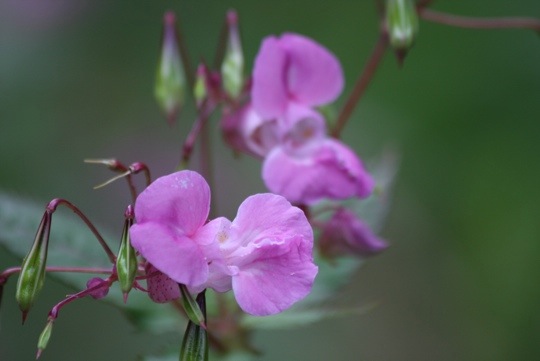
The sound of hammering reaches us from the valley below and we think we must be getting close to civilization. We reach a dirt road that runs along a stream, with banks covered in purple flowers. They are so fragrant, the air drips with their sweetness. We pause to check the time; it’s nearly 6PM. We wonder what time the last bus stops at the cable car station. The trail cuts to the left from the road and winds through a pasture surrounded by electric fences containing goats. We pass by, watching the goats, especially a baby. They are preoccupied with eating and barely notice us except one, who follows us along the fence as if he thinks we might be good for a hand out.

The trail goes back into the woods, down another steep incline, and then comes out to a paved road. It is a country highway and we cross it at a blind curve, hurrying so as to avoid surprising any drivers. Then, it returns to woods. We are going slowly again, now. In spite of feeling time pressure, our knees will not tolerate a fast pace as long as we are headed downhill. When the path looks clear, we take turns turning around and walking backwards, stretching our calves and resting our knees. Walking backwards, however, is not easy, so we give up when the trail becomes rocky again. Eventually, we can see the cable car. We wind our way through an open field and one more wooded area to the parking lot, relieved that we made it, but still not sure of the bus.

We walk to the bus stop and read the signs. There is no where to buy a ticket and the signs are somewhat confusing, besides being in German. I decide that the sign indicates a bus will come in 7 minutes. Pat has to be convinced that the numbers are times–apparently the words only make the sign more confusing. We sit and wait, the cable car station is completely shut down, looking as if it’s been boarded up for the season, although I know the wooden shutters will open again tomorrow. The bus arrives in just 2 minutes, ending our worry, but it’s going the opposite direction. The driver tells Pat we can get on now and she will turn around in a few stops. So we board and ride. I’m glad we did because the views from the mountain road of the setting sun are fantastic.

When we stop at the turn around point, the driver turns off the bus and we sit for a few minutes. I notice a ticket machine on the bus and Pat goes to purchase tickets for us. He’s unable to decipher which tickets to buy and another man, having just gotten on the bus, comes over and helps him. Germans do not understand why my husband speaks German with no accent but doesn’t know how to do things like buy bus tickets. This man is patient, however. Now that we are legal again, we sit back down and enjoy the views once more as the bus takes us back towards town. We are tired and ready for our next meal.

20110917-013031.jpg

20110917-013043.jpg

20110917-013102.jpg

20110917-013126.jpg

20110917-013136.jpg

20110917-013150.jpg

20110917-013213.jpg

20110917-013231.jpg

Getting to Germany

Having driven to the Atlanta airport, checked our luggage and picked up our boarding passes, we head for the MARTA station. We pause to do a time check and debate whether we’re better off spending the 3 hours until our plane starts boarding in the airport or going downtown for lunch. We want to allow plenty of time, figuring security will be tighter since it is the tenth anniversary of 9-11. I say, “Let’s go downtown–it will be more of an adventure than sitting in the airport.” Pat agrees.

Once we settle onto the MARTA train, we start calculating how long we will need to get back, get our carry-on bags out of our car and get in the security line. We have allowed ourselves 30 minutes of travel time in each direction and still have an hour and a half to get lunch. We get off at the Peachtree station since it’s an area I’m familiar with. I forgot that it’s a Sunday and the Atlanta downtown is not exactly hopping. We head towards the Olympic park once we find ourselves back above ground. It’s a beautiful day and the walk more welcome since we are about to take a 9+ hour flight.

We find a Googie’s hamburger place in the middle of the park. I order a coke float with my burger and we sit outside. There are plenty of people in the park. Some are playing a sport I can’t identify because they are downhill and all we can see is the top halves of people moving around a field. I assume it’s soccer. After relaxing in the shade of a giant old tree while we finished our meal, we head back towards the MARTA station. The walk is now uphill, the sun is higher, and the temperature is rapidly rising. Pat starts sweating through his shirt and then worrying about being all sweaty getting on the plane which probably makes him sweat even more. The platform is surprisingly warm considering how far underground we are. I think back to how long the escalator was and wonder if we are now so close to the center of the earth that the temperature is higher. 🙂 Pat, in the meantime, moves us to the center of the platform between two giant fans that circulate the air. He stands with his arms spread, trying to get his shirt to dry.

Back at the Atlanta airport, we are surprised that security does not seem any worse than usual. We get through the line in 15 minutes and neither of us is randomly scanned in the new “naked” scanners. When we amble up to the gate 45 minutes before our flight, they are all ready boarding all passengers. The boarding process for long flights is different than the short domestic hops–people take their time and settle in gradually. Yet, the entire airbus is full and everyone is ready to go well before our take off time.

The man sitting next to me (I took the middle seat) starts up a conversation. He tells me he’s on a business trip and I ask who he works for. It turns out he and I work for the same company! I wonder aloud how many people on this flight are our colleagues and what the odds are that we would end up sitting next to each other. He also was part of a smaller company acquired by our now mutual corporation. We swap stories of integration and he tells me that everything will settle down and seem normal in three more years. I was really hoping it would only be one more year.

As the plane reaches altitude and the movies become available, he reaches for his ear buds and I reach for my iPad. We do not talk again in the 9 hours that we sit next to each other until we are arriving in Frankfurt and he points out the location of the office he’s going to on the flight map. That’s OK. We’re unlikely to ever see each other again anyway.

The flight goes smoothly, although my knees start twitching when I get tired and it is impossible to get comfortable. I long for the days when I used to fly business class, but it’s hard to justify paying 4x the price for an already expensive ticket when the trip is only 9 hours. I nod off in fits and starts and wake again every 10 minutes. I think I managed to collectively get a couple hours of sleep, but I feel like I was up all night when the flight crew turns the lights back on and starts serving breakfast. Having lost 6 hours between dinner and breakfast, I’m not really sure I’m hungry, but I eat anyway.

When we deplane, there are no restrooms between the plane and immigration. The line is endless and moving slowly. We wait for over half an hour crossing our legs and trying not to think of water. A man is escorted away just before we are called to a desk. This often happens to Pat–he apparently has the same name as someone on the no-fly list. Having been detained 4 times now, we cross our fingers that this won’t be the fifth. Luck smiles on us and the agent stamps our passports. We find a restroom and our luggage and look for the train.

We take a bus to terminal 1 to get to the train. But, having done very little planning for this trip, we have to wait in another long, slow line to get our train passes. On most our trips, I take care of these arrangements, usually in advance. But here, Pat takes the lead since this is his birth country and German is his first language. I am reminded of a man who recently told me I need to learn how to follow; it doesn’t come naturally to me. I would like to think I am a natural leader, but I suspect I’m really just a control freak. While the ticket agent speaks fluent English, Pat’s command of German gets us 4 days of train travel in first class at a reduced rate, saving us about $550 Euros. Not bad for just letting him do the talking.

I have ridden the train in Germany before, but it’s more impressive to me this trip having taken the train from Portland to Glacier National Park back in the states since then. First, German trains are on time. Second, they run as efficiently as subways, often having only 3 minutes between arrival and departure. Finally, they are so quiet and smooth that you have to remind yourself you’re on a train. The first class car is an extra bonus–after being so cramped on the plane, it’s nice to lay back and stretch our of legs fully. I am always amazed at how tired sitting on a plane makes me feel.

In spite of being re-routed once on the way to Freidberg due to weather, we arrive only 10 minutes late. We find a cab and get to our hotel only to learn that our room won’t be ready for 2 1/2 more hours–it’s only 12:30PM. We check our bags and drag our tired selves around this ancient black forest town for an hour. Then we sit outside in a square by the farmer’s market and eat. Oh do we eat! I allowed Pat to order for me and he has chosen two dishes that we share. One is a “fine” bratwurst with fries and the other is some kind of dumpling stuffed with vegetables neatly ground and mixed with cheese. Both are good, but the brat particularly hits the spot today–maybe because it goes so well with the pilsner we drink?

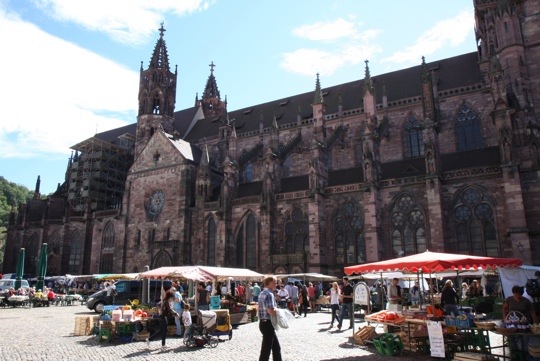
We sit in the shadow of an enormous church that was razed to the ground during World War II and has since been reconstructed, stone by stone. They are still working on it or working on it again; scaffolding shrouds the main steeple. The courtyard below is full of vendor’s tents–it’s an open farmer’s market that apparently opens every morning and shuts down every afternoon. By the time we are done with our entrees, the tents are disappearing.

We sit a while longer, ordering meringues for dessert. They are served with ice cream, whipped cream, and carmel sauce. I resign myself to gaining weight this trip and relish the dessert. We are surrounded by locals and tourists alike. One table over, a group of Americans discuss their plans while failing at keeping their young children entertained, resulting in crying and whining. I wonder if German children expect to be entertained all the time, but none are around to watch.

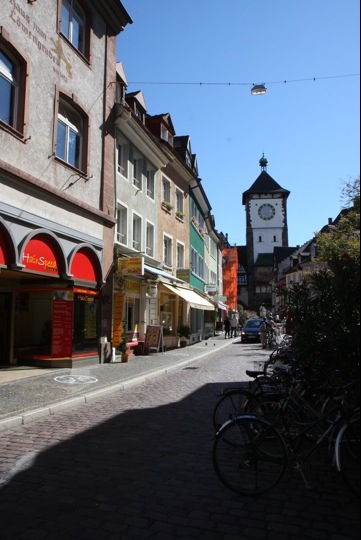
We wander around the town some more, struck by the stone streets and the old architecture laden with flowers. Nearly every building has flower boxes at every window. We attempt to walk to the river, but get ourselves mixed up. At 3PM, we stop in a coffee shop to use the restroom, get directions, and buy a bottle of water. We head back to the hotel more than ready for a nap.

20110917-012527.jpg

20110916-071055.jpg

20110916-071005.jpg

20110916-070945.jpg

20110916-070924.jpg

Traveling on the Tenth Anniversary of 9-11

It’s just after 10AM and we are packed and ready to leave for our two week vacation in Germany. We are flying out of Atlanta because the flight schedule to leave from Chattanooga will not get us home in one day. We have a plan for today: we will drive to the Atlanta airport, check two of our bags, leave our carry ons in the trunk, and take the MARTA downtown for a few hours before our flight. We divide our bags between us and head out the door looking somewhat like pack mules.

The weather has cleared and warmed up again. It’s cool this morning, but promising to get into the upper eighties. We are preoccupied with our plans and have not given much more than a passing thought to the significance of this day. But as we cruise down the highway around Chattanooga, we pass under a high overpass with a group of people on it unfurling a huge American flag and waving. I wave back as we pass under the enormous flag, and am instantly returned to ten years ago.

I was at my desk on 9-11, thankfully on a reprieve from the constant travel that I did at that time of my career. My phone rang and a colleague in NJ excitedly informed me that a plane had just crashed into one of the World Trade Center towers. At first, I waited for the punchline, assuming it was a joke. He didn’t yet know that it was an attack; it was just a crazy event for the next half hour until he called me back and told me that a second plane had crashed into the other tower.

I went down the hall to talk to my boss. He was getting updates and it was clear now that this was, in fact, the first attack on American soil since Pearl Harbor. In that moment, the sense of security I’d never known I had was shattered. Many of us gathered in the halls, talking quietly of people we knew who worked in the area. More news came in and we heard of the two other planes, one still in the air. Most of us decided to go work from home the rest of the day–it felt safer not to be in a building that once (decades ago) employed over 18,000 people.

When I got home, I turned on the TV and watched the news. I was on the phone with more friends and colleagues in the NY area, each of us recounting the stories we had learned of missing loved ones. For me, it seemed close to home even though it was a distant event. I was happy that all travel was suspended for two weeks–no one seemed to want to have a meeting in light of the tragedy. I had no desire to go get on a plane.

When I flew into Newark two weeks later, the airport seemed like a ghost town. I met with customers that day who had regular meetings in the trade center prior to 9-11. Two of them recounted their 9-11 stories. One missed being on the 11th floor of the first building when it was hit only because he’d stopped to get a cup of coffee. The other was in the street when the first tower collapsed, diving behind a dumpster with a woman he’d never met before and running for shelter in an abandoned building, barely escaping unharmed. They still didn’t know if the people they were on their way to meet had survived. I never learned the outcome.

I add these stories to my collection from people who had relatives in the city that day–one of my colleague’s daughters had a terrifying day just trying to leave the city to get to the safety of her parents’ home. Photos of one of our customer sites across the street from the destruction were forwarded around. An entire wall is missing from a data center that houses the equipment we make. Those of us who know the people that work there are stunned by these photos. These stories make what might just seem like something in the news feel next door. I am reminded of a person I once met who was sent to Grenada (or was it Panama?) in the military. He described walking through a suburban neighborhood while under attack. I imagine war in a whole new way when I hear his descriptions. I try to imagine where I would hide while soldiers go through my quiet suburban neighborhood shooting at one another.

These are the images that come to mind as we cruise along the highway. I think about what it would be like to live somewhere where personal safety is a foremost concern on a daily basis. In the ten years since 9-11, we have collectively forgotten the fear that the attack created and been more annoyed by ridiculous security rules in the airports that are hard to connect to increased security than worried about repeat attacks. I suppose that’s a good thing. After all, what would being afraid accomplish? At the same time, prior to 9-11, no one would have thought that a terrorist would crash a hijacked plane. Since that day, I’ve swapped many stories of “what we would do” with fellow travelers, each of us feeling personal responsibility for the safety of each flight in a way we never considered before.

I received a news alert from the Wall Street Journal that plans for car bombings on 9-11 were discovered and foiled. I feel oddly reassured by this news, I suppose the fact that they were found out and prevented is reassuring, but it always makes me wonder what else is going on that they haven’t found out about yet? I think the majority of the relief is purely selfish–the attacks were about car bombs and not planes and, after all, it’s a plane I’m getting on.

I feel like I should pause for a moment and honor the dead, the injured, and the chronically ill that resulted from 9-11. Yet, in some respects, do I honor them by flying on this day? Does the fact that I feel confident enough to get on a long, international flight say that we recovered well? It is impossible to know what the people most horribly affected by the attack would say, but since I am going to Germany today regardless, I choose to think they would be pleased. I say a silent thank you to the men and women who responded to the attack and an apology to those who did not survive. Then, I tuck away my fears and focus on the road ahead.

When It Rains, It Pours

After taking the Cherohala Scenic Skyway from Robbinsville, NC towards Chattanooga, we arrive in Tellico Plains just in time for lunch.  As we enter the town, we spot the Tellicafe and decide to give it a try.  Our expectations are low given that we haven’t really had good luck with restaurants on this road trip.  But part of me hopes to be surprised.  We enter the cafe and find the main dining area mostly full, but since we’ve fallen for this before as a sign of good food, I try not to get my hopes up.  The waitress seats us in a second room that has only one other couple in it.  We sit in a big cushy booth and study the menu.

A display on the table advertises their desserts with the special highlighted as “Cinnamon Napolean Cheesecake.”  It’s described as cheesecake baked in a pastry, sprinkled with cinnamon and served with ice cream.  I am tempted, but decide I should eat real food for lunch.  The waitress comes over and I indulge my now triggered sweet-tooth with sweet tea.  The waitress takes my drink order and says, “I’m glad to see I’m not the only one who wears socks with my Chacos!”  I am confused at first, forgetting that I’m wearing my Chaco hiking sandals, let alone with socks.  Then I realize what she’s referring to and I laugh.  I’m impressed that someone her age would walk around in socks and sandals.  When I was that young, I would have been too embarrassed.  Now days, I like my comfortable sandals and warm socks when the weather warrants it just fine.

The food comes and it’s the best meal we’ve had in days.  I ordered the stuffed shells special and the shells taste like they’re home made.  While I could have done without the thick layer of mozzarella melted over the pasta already stuffed with cheese, I simply lift off the extra cheese and enjoy the hot pasta below.  The sweet tea tastes just like my grandmother’s used to.  Best of all, there are no signs in this restaurant telling us how to behave.

After stuffing myself on stuffed pasta, I’m still tempted to order the dessert.  Only the thought of cheesecake stuffed inside a buttery pastry shell stops me from ordering it–it sounds too rich.  It’s really the ice cream I want.  I decide to wait for a chance to get just ice cream.

We head on down the road in the rain, which seems to be intensifying.  About an hour later, I am dozing off in my seat when suddenly something cold and wet hits me on top of the head.  I look up and discover the sunroof is leaking.  My husband loves his cars and takes tremendous pride in getting a ridiculous number of miles out of them.  This 1990 BMW is a low-mileage car in his book–it hasn’t even crossed the 200,000 mile mark.  But, the paint looked like it was every bit of 21 years until we had it repainted a few months earlier.  However, they partially disassembled the car to paint it and when they put it back together, the sunroof seemed off somehow.  Well, we just discovered how.  As it continues to rain, each time Pat slows or accelerates or turns hard, more and more water runs in on my head.  I zip up my rain jacket and pull up the hood, trying to stay dry.  Soon, water is running in streams when Pat stops hard.  It pours into my lap now, soaking through my pants and leaving me sitting in a wet puddle.  I am reminded of Pat’s winning argument as to why we shouldn’t hike in the rain today–he didn’t want to end up riding home in wet underwear.  I’m certain that if we’d gone hiking in this rain, my underwear would be drier.

Pat finds this hilarious.  Of course, his underwear is still dry.  But as the situation worsens, water starts running in from his side of the sunroof and even from the trim piece that the rearview mirror is mounted on.  I remind him that he knew the sunroof didn’t close properly and he was supposed to get it fixed before we left Columbus.  He goes from laughing to annoyed and informs me that he did have it fixed, but no one could tell it would leak.  I sit silently in my wet underwear and sulk.  These are the moments in marriage when you know you’re being ridiculous, but you just can’t help yourself.  Really, I celebrate my husband’s attachment to his cars.  After all, he’s saved us tens of thousands of dollars in the course of our relationship that has contributed to our ability to afford the things we find more meaningful.  But right now, I’m a little irritated that I let him talk me out of buying a new car.

About the time I’m soaked through, we arrive at the entrance to 75.  However, it’s backed up and the entrance ramp looks flooded.  When we look up the highway, we see brake lights and slow-moving cars.  We decide to cross over to 58 and come into Chattanooga the back way.  We follow the GPS, but it has us making multiple turns that seem like they’re taking us the wrong direction.  We’re pretty sure we’re lost when we find ourselves on a country lane with a fallen tree laying halfway across the road.  We are able to pass unimpeded and after one more turn, we see 58.  In the meantime, water continues to stream on me as Pat maneuvers through the turns.  It’s gotten to the point of such complete ridiculousness that even I cannot continue to sulk–it’s just too funny.  Each time Pat turns and a new stream of water pours on me from a new place, we burst out laughing.

Finally, we find ourselves home.  We pull up outside the entrance and unload our gear from the trunk and onto the covered walkway where it’s protected from rain.  It’s raining so hard that our stuff gets wet even in the split second that it’s in the rain.  As we haul our stuff up via the elevator and pile it up on the living room floor, all I feel is tired.  I can’t say I regret the day–it was its own kind of adventure–but I’m relieved to be able to get out of my wet underwear.

Rain Day

After camping next to noisy neighbors our first night in Great Smoky Mountain National Park, we opt for a hotel in Cherokee, NC our second night.  All night long, it rains hard.  I wake up only once in the night and am confused by the sound of rain hitting the roof–I realize that it hasn’t rained since we moved to Chattanooga 3 weeks ago.  I lay in the comfortable bed warm and dry, listening to the rain for a minute or two until my eyes close and I return to sleep.

When I wake up in the morning, I step out onto the balcony.  The river behind the hotel doesn’t look anymore swollen than it did when we went to bed the night before.  I’m puzzled by its ability to move so much water without rising perceptively, but it’s cold outside so I don’t contemplate for long before returning to the room.  Even though I showered just before going to dinner the night before, I decide to shower again just for good measure.  As the warm water wakes me up, I contemplate where we should hike today.  When I get out of the shower, Pat is up and ready to go down for the breakfast included with our room.  I get out the trail map and start pointing to different options on where we can go hiking.  Pat gives me the “I didn’t think you were insane, but now I’m not so sure” look.  Apparently he is not up for hiking in the rain.  I’m disappointed and ask what are we going to do if we don’t hike.  Pat responds with, “Indoor stuff.”  I look at him confused, unable to think of anything we would do indoors that we couldn’t do at home.  “Like what?” I ask.  “I don’t know,” he replies, “we could go to a museum or an arcade or a flight simulator.”  A flight simulator sounds interesting, so I do a quick google.  There are no flight simulators open to the public anywhere within 200 miles.  Pat suggests we discuss it over breakfast.

We walk downstairs and it has actually stopped raining just in time for us to walk over to the lobby entrance.  We go into the breakfast room and I wait in line for the waffle maker.  I think adding a waffle iron to the free breakfast buffet was the best idea in hospitality in the past 20 years.  Once I get my waffle cooking, I sit down with Pat to eat yogurt.  As I stuff a spoonful into my mouth, Pat says, “We cannot hike today.  We’ll get all wet and end up driving home in wet underwear.”  This strikes me as so funny that I nearly splutter yogurt all over Pat.  Containing myself (and my yogurt), I swallow and am forced to admit that he has a point.  There really is nothing comfortable about riding in a car in wet underwear for several hours.  The timer goes off on the waffle iron and I go retrieve my hot, fresh waffle.

When we leave to return to the room, it has started raining again.  We dive through the rain towards the walkway under an overhang and manage to get back to the room without getting soaked.  Once in the room, we debate what we can do for entertainment.  Pat votes for heading home.  I propose a compromise that will take us to the Junaluska Museum in Robbinsville, NC on a scenic route home.  Agreed that this is a reasonable plan, we pack up and get on our way.

I plug the address into the GPS and off we go.  The GPS takes us to Robbinsville without any hiccups, but when it comes to the final destination, we end up on a dead-end road lined with depressing houses in various states of disrepair.  We see a large building behind the houses on one side and think maybe that’s the museum.  After going around the block, we determine that building is an Ace Hardware.  But, we spot a brown road sign that says “Junaluska Museum” and points us down another road in the opposite direction.  We follow that sign to another sign and then to another.  But then the signs disappear and we’ve seen nothing that resembles a museum.  We decide that we are not meant to go to this museum and head on towards Cherohala Scenic Skyway.

Even though the rain won’t stop and the visibility is poor, the Cherohala truly is scenic.  We wind our way around tree-lined curves with frequent breaks in the trees that allow for views over a cliff.  The mountains look like shadows in the clouds.  As we go around one curve, Pat spots a painted box turtle (well, maybe–it’s definitely a turtle in any case) standing just on the other side of the double-yellow line.  He sees it too late to stop, but finds a place to turn around about a quarter mile down the road.  We return in the rain so I can hop out of the car and safely transport the turtle to the other side of the road.  I’m not sure if he was grateful for the lift, but it makes my day in any case.

Continuing towards home, we pass a resort.  Then, a mile further, we see an entrance to another resort with a drive that goes straight up the mountain.  Pat slams on the brakes and pulls in, saying he’s hungry and maybe we can get something to eat.  We find ourselves at the Snowbird Mountain Lodge.  We pull up our hoods and head into the lobby.  Across the parking lot, a large Bernese Mountain Dog lays on a slanting drive, oblivious to the rain.  We go up the stairs to the lodge entrance and a Newfoundland mix lays just outside the door, looking at us nervously as we approach.  We call to him in our high-pitched happy-puppy voices, but he doesn’t seem comfortable with strangers.  We enter the door around him, trying not to scare him with the swinging screen door.

When we enter the lobby, we are instantly immersed in a sense of calm.  The lodge is an old, log lodge with big over-stuffed chairs in a library-like room with a 20 foot or so ceiling and shelves of books lining the walls.  A half a dozen guests look up at us when we walk in.  All of them look like they are just too relaxed to go home.  We approach the inn keeper at the desk and inquire about lunch.  Unfortunately, they don’t serve lunch and the restaurant is closed until dinner, but he invites us to look around.  He asks us if we’ve been in “the park” and when we tell him we’ve been hiking there, he says, “Well, maybe next time you’ll come and hike in the real mountains!”

We walk through the dining room and into the bar.  The bar is full of dark hard wood and seems every bit as relaxing as the lobby even though it’s abandoned now.  The dining room has a large screened porch off of one side with tables overlooking the woods.  Back to the front of the lodge, we find a wrap-around deck with big adirondack chairs lined up facing what must be an incredible view over the mountains on a clear day.  An elderly man is standing under a sheltered portion of the deck when we step outside beside him.  He is watching the squirrels attack the bird feeders.  He tells us we just missed seeing a squirrel get stuck on a feeder, sliding back down every time he tried to climb up until he finally slipped off and fell to the ground.  His delight in the squirrel story is contagious and we find ourselves giggling.  I grab a brochure and add this place to the list of places I want to spend a weekend at.

We pull up our hoods and dash through the pouring rain back to the car–it’s time to find a place to eat lunch.