Hanging on Air

When we decided to move to Chattanooga, one of the attractions was it’s proximity to Lookout Mountain Hang Gliding Park.  Hang gliding wasn’t really on my bucket list, but it was on my husband’s.  For me, I just hate to miss out on anything.  So, adventure number one was the Introductory Experience.

We arrived at the park office at quarter ’til 8AM.  The office perched high above the valley with an ominous looking concrete . . . slide?  The words that popped into my head when I saw it were, “Ramp of Death.”  But wasn’t so much a ramp as a concreted coating on the top of the mountain that started out looking reassuringly level and then took a nasty bend at almost a 90 degree angle, directing my gaze straight down a 2000 ft drop.   My stomach started doing flips–and not for joy.  Fortunately for me, the Introductory Experience package we’d signed up for did not include that kind of leap of faith!  Instead, after signing in, we were led down the mountain to the valley below to start learning on the bunny hill.

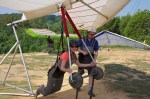
I love learning.  It’s the best part of life.  But the frustrating thing is how slowly new lessons sink in.  Especially when it includes making your body do something it’s never done before.  Picking up a hang glider and running across a field with it is one of those things.  It looks easy enough.  But finding the right spot on your shoulders to balance the weight of the glider is tricky and sometimes painful.  Then, there is wind.  There was no wind until I put a glider on my back, but as soon as I had wings, there was air moving me in directions I didn’t want to go.  The glider is designed to take flight.  You would think that would make it easier to carry.  But getting it to fly straight isn’t all that easy.  Especially when your airspeed is something less than 3 MPH.

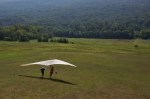
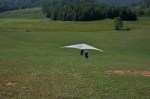
Then there is the difference between knowing what you’re supposed to do in your mind and actually doing it.  I vaguely recall an article about how your brain has to build new neural pathways to allow you to perform an action that you have not performed before–being told what to do is not sufficient to allow you to do it until your brain finds a way to communicate the appropriate action for each muscle fiber to take and can coordinate all of those actions.  My brain seems a little stubborn.  For example, one of the things we were told when we graduated from the flat ground to the actual bunny hill was that we needed to run and keep running until we had taken three steps in the air.  Until you haven’t hit ground for three steps, you really haven’t launched.  The instructor repeated this message 9 more times as we each did our ground test hanging in a glider on a stand.  I said this to myself over and over as I prepared for my first launch.  “Keep running.  One, two, three steps in the air.  Keep running.”  But when I started down the hill and I felt myself lifting off the ground, what did I do?  I stopped running.  Then I landed hard, belly-flopped onto the ground and drug my body flat across the grassy slope at a rate of speed fast enough to make the tops of my feet feel like they were on fire.

But why did I stop running?  I know how to run.  I don’t need a new pathway to tell my legs how to move.  Yet, apparently, there is some message heavily coded in my brain that says, “Don’t run when you’re airborne.”  Where did that come from?  I’ve never run into the air before except in my dreams.  Maybe I stopped running when I was dreaming?

After gliding (dragging?) down the hill on my belly one more time, something in my brain clicked.  I couldn’t remember when I stopped running.  I couldn’t remember the feeling of running in the air.  It took two belly flops for me to even realize that I stopped running too soon.  The third run, that was a primary thought in my mind, “Just keep running.”  Not just before I started down the hill, but as I was picking up speed, feeling the harness pull against me, feeling myself lifting into the air, “Just keep running.”  And I felt myself running in the air, lifted off the ground, suspended by wings.  Then, I stopped running.  It was a glorious few seconds of flight.

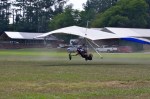
Later that afternoon, we went for a tandem ride, each of us gliding with an instructor.  Being sympathetic to beginners, Lookout Mountain uses ultralight airplanes to tow tandem rides from the ground rather than having us run off the cliff together.  Saved from jumping off the cliff!

My instructor, Clayton, checks in to see how I’m doing.  To tell the truth, I’m not sure how I’m doing.  During take off, the glider starts to climb almost immediately, but there are a lot of jerks and bumps while being towed.  Watching the plane in front of us bumping up and down in the turbulence creates visions of horrible crashes in my mind.  I keep reminding myself that a glider is forgiving and there is plenty of room for recovery.

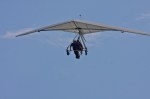
After detaching from the tow plane, we soar above the valley.  When you look out the window of an airliner, you don’t think about the experience of the wings.  Today, I am strapped to the wings–exhilaration and a small beep of terror compete for my attention as the air rushes around me.  Clayton finds a thermal and we circle our way up to nearly 3600 feet.  I’ve been in helicopters and a sailplane, but neither provides the view from a hang glider.  There is nothing between you and the ground.  I wonder how an eagle spots a fish.  I imagine spotting a fish and diving towards the earth with the assuredness of being born for flight.  I experience “eagleness” for a brief moment.

But the moments of exhilaration are clouded with fear.  I feel the tension in my body that indicates adrenaline is flowing.  I cannot relax although I try.  When I do relax for a moment, the glider bumps in an invisible shift of rising and sinking air and I am tense all over again.  I wonder how anyone can feel secure suspended from a giant kite?  I wonder why I am there.  Then, I return to that moment.  That instant of soaring above the earth experiencing lift and rushing air and the endless view.  There is no wondering and no fear when I am no where else in my head.  When I am mentally where I am physically, I am simply there.  No thoughts of crashing, no thoughts of falling, no thoughts of any kind.  I breathe in and I enjoy.

Just a few things

There is nothing like moving to make you think about things.  And I mean that in the most literal of ways.  I pick up each thing I own, examine it, think about the last time I used it,  think about whether that thing is worth the trouble of packing, lifting, carrying, and placing back in my life at the next location.  When I add into the mix a reduction of space by 1/2, I scrutinize even more carefully.  Is this thing worth my time and energy?  Where will I put it in my new place?  Is this something I will be able to find and use?  Is it something I will replace if I don’t have it?  I never cease to be amazed at the number of things that have found a place in my home that have turned out to be a drain on my energy.

Having purchased our last house from my father, we inherited all the things that he didn’t want in his life anymore.  This included things from four grandparents, my mother, and my aunt–the leavings from their lives that I felt like I should be emotionally attached to.  But none of those things were them. Detaching objects from people was a mandatory step in reducing our burden when moving from our house last year.  Now, we have reduced our space again by half, requiring yet another reduction.

Digital photography is a great tool for dealing with balancing emotional attachment and physical space.  Pictures of the things that represented something important take up only virtual space.  This method, suggested by my brother, has allowed me to unload things I don’t know what to do with ranging from trophies to family heirlooms.  Take a picture, sell or donate the item, move on.  Interestingly, I don’t find myself looking at the pictures of these objects when I want to remember the people and experiences that went with them; I just remember.

Harder for me is balancing reduction and waste.  I hate getting rid of an object that I spent money on that I don’t feel I’ve gotten my money’s worth out of yet. Likewise, I hate to get rid of something I might use.  Clothes are hard for this reason.  I seem to always end up with items I consider expensive that hang in my closet far more than on my body.  I decided that I should get my wardrobe down to 7 outfits for each season.  Then, I won’t need much space and I will save time deciding what to wear.  Unfortunately, that hasn’t been too practical.  I have a wardrobe for work, hanging out, going out, working out, biking, hiking, skiing, and yoga.  I have highly technical clothing for virtually every weather possibility.  These are practical clothes that I use to death, but it’s a slow death.  Now that I work from home, my work clothes will be needed about as often as my ski pants.  Being prepared and being a nomad don’t seem to fit well together.

I think about a book I once read called Your Money or Your Life.  It talked a lot about the concept of “enoughness.”  The stats show that there is an optimal state of wealth, and it’s not what we think of as wealth.  Once you have food, shelter, and clothing, your happiness maximizes at some minimal level of comfort beyond that point and then the stress of maintaining things causes your happiness to decline.  The trick is that there is no formula for determining what your personal level of eoughness is.  I, for one, cannot imagine life without my iPad or iPhone.  Yet, was I less happy before they existed?  It’s a slippery slope.  I introduce something new into my life and it takes hold, becomes part of what I do each day, and I cannot imagine giving it up.  Yet there is a cost to all of these things–even those that don’t require a data plan.  Clothes have to be cleaned, put away, decided upon.  Pictures have to be arranged, hung, dusted.  Collectibles have to be maintained, safe-guarded, cared-for.

I wonder if I should start a website where people can trade homes not for vacations, but for cleaning out the clutter?  If someone else came into my home and made the decision for me about what I needed to keep and what I could live without, wouldn’t it be easier for them to decide?  In the meantime, I struggle to find places for the debris of my life that I cannot part with, but don’t have a place for.  I wonder how we’ll reduce what we have to a set of things that we can take with us and how much comfort I am willing to give up in exchange for more space, time, and energy to do what I enjoy?

Getting Started

After struggling to enjoy our mostly mainstream life, the stress and boredom got to us. In 2000, I was working for a company that kicked off the implosion of the telecom industry and realized that depending on a corporate job for a living was not a sure bet. For the next 5 years, I was in a constant state of wondering if my job was going away. This motivated us to systematically eliminate debt, reduce our expenses, build our savings, and think about how we could live without my corporate job. In particular, we wanted to live on the road and really experience North America. RVs are nice, but we’re environmentalists and we couldn’t justify the gas. We imagined a life of living in an area for a few weeks either in a tent or in a cheap hotel and driving on–touring from our Honda mini-van.

However, I haven’t been without some form of income since I was 9 years old and I find I care a lot about my career. As such, living without my corporate job was just a bit too scary of a leap for me; I couldn’t imagine where my identity would come from with no career. But, since the situation I was in really wasn’t a career either, my first step was to find a different job with a growing company that was less depressing than the dying company I was at. This I accomplished at the beginning of 2006.

At the time, we still thought I would have to leave the corporate world all together to live on the road. As we continued to plan for that, we waited for the right time to sell our house. While 2006 would have been a great time to sell in the market, we had 2 English Mastiffs and renting really wasn’t an option. We were content to enjoy our dogs and worry about selling later. Sadly, we lost one in 2008 and the other in 2009. While losing our canine kids was a horrible loss, it did free us up to pursue our plans. Unfortunately, the housing market was in the toilet. However, we managed to sell our house in 2010 during a recovery period. Simultaneously, the company I worked for was being purchased by a much larger corporation. We decided to rent a house and wait things out once more.

As it turned out, the new company has a much more friendly attitude towards working remotely. As a result, we’ve revised our plan to include me keeping my career while we move around. We’re not sure what that means yet, but we decided to start by establishing residency in a state with less tax burden than the one we were in. We now find ourselves with a 6-month lease on a really cool apartment in Chattanooga, TN. So, expect more entries on life from Chattanooga for the next 6 months.

Dianne