Fall Friends

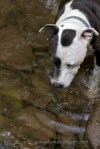
Tisen and I have been discovering friends new and old on many of our walks of late.  The other day, for example, we crossed the street to enter the park and found Tisen’s girlfriend Twiggy out for a stroll with her mom and dad.

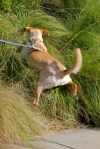
Twiggy wasn’t up for romance, however.  Today, her mind is all about the rampant rodent population living in the tall grasses growing on the hillside.  It’s fall, after all, and the busy critters have been breeding all summer.  Now, the entire population is fattening up for winter.  From Twiggy’s perspective, it probably seems like a buffet.

In spite of Twiggy’s amazing leaps and bounds, she comes up empty mouthed.  Tisen, however, looks at her with adoration like he can’t believe her athletic prowess and is imagining her bringing home venison for dinner.

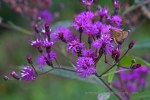
We say our goodbyes and are soon greeted by deep purple flowers that I’m going to guess are some sort of variety of fall asters, although they look far more cultivated than the wild variety that used to grow in our garden up North.

They bob and curtsy at us as our friends the Goldfinches, who are not looking so gold these days, land and depart on the dried seed pods of nearby plants.  I believe these were once our friends the purple coneflowers that have now shriveled into thin, brown mummies.  The goldfinches continue visiting them and harvesting their seed, storing it as fat for their winter coat.

I am reminded of the lateness of the season by all of this activity.  The days are shorter, the temperatures nearly tolerable, and the birds are far quieter.  I pause for a moment and listen.  A month ago, I would have heard a Titmouse, a Chickadee, a Cardinal, a Wren, a Towhee, a Robin, and an Indigo bunting in this park.  Today, all I hear are the cicadas buzzing away with their strange song.

While Twiggy may be too busy hunting to think about romance, for me, this is always the most romantic time of year.  A sense of nostalgia sets in along with the inevitable awareness of time passing that comes with it.  Another year wrapping up.  Autumn is more poignant than new year’s when it comes to reminding me of my own mortality.  In the fall, everything seems to be moving on in one way or another.  Perhaps as a nomad (at least in my imagination), I long for my own migration.

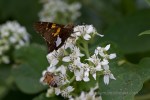
When Tisen and I encounter our next group of friends, the bees and butterflies, so dense on a brilliant white flower I don’t recognize that they’re sharing blossoms, I remember that this is migration season for the butterflies, too.  While the bees will hole up for the winter, the butterflies will take to the winds and head for warmer climates.  I look at these tiny, delicate insect-birds and wonder how they can possibly migrate a few dozen miles, let alone thousands.  One of life’s many wonders.

The iPhone is Not Enough

On Labor Day, I was hiking my way back from an overnight in the backcountry.  The next morning, I was up at 5:30AM so I could get on a plane to Orlando for a work conference at Disney World.

Because our conference hotels overflowed, I was moved to The Animal Kingdom Lodge.  Having not been inside the Disney World gates since I was 9, I didn’t know that there would be an actual animal kingdom outside my window.

Had I known, I might have figured out a way to pack my camera.

Having reduced our worldly possessions by about 80% over the course of many years and moved into a small apartment with ridiculously limited storage space, one of my greatest challenges has been not to keep acquiring more stuff that won’t fit anywhere.

I make this point because I am starting to think about getting a small, point-and-shoot camera.  Something that will do a better job than my iPhone camera.  And something I can carry backpacking without getting an ache in my neck.

Now, some might argue that I should think about trading in my iPhone 4S for a phone that has a decent built-in camera.  But, I’ve had my iPhone for less than a year and I really don’t believe there is a phone with a built-in camera that’s going to suffice.

Let’s look at the camera in the iPhone 4S. Like all built-in phone cameras, all zoom capability is digital.  By this, I mean that when you are zooming, it’s enlarging the image in software, no moving glass around to magnify the image before it is captured digitally (also known as Optical Zoom).

When you look at the images in the gallery, you can see that as you move from left to right, the buffalo get bigger and the quality of the image gets worse.  This is the same thing that happens when you enlarge a low resolution photo on your computer and the pixels get spread too far apart for the image to look good.

In comparison, when optical zoom is used, the image is magnified by the glass and then captured on the sensor at that size, so there is no loss of resolution in the image.  Maybe instead of a point-and-shoot, I just need an adapter so I can use my lenses with my iPhone?  They really exist:

http://photojojo.com/store/awesomeness/iphone-slr-mount/


But, then I’d have to carry heavy lenses plus an adapter.  Besides, that little adaptor costs $250.  I’m pretty sure I can get a really good point-and-shoot for that much money.

I started investigating MILCs (Mirrorless Interchangeable Lens Cameras), which are smaller and lighter.  I’m not ready to spend that much money on a new technology that’s step down in quality, although they do seem quite promising.

Maybe fuzzy animal pictures on work trips and an aching neck on backpacking trips will just have to do for now.

Honorable Mention

As many of you may know, last month, for the first time ever, I submitted photos in the local club’s quarterly photo contest.  My goal was to get feedback because the judges often provide comments on each image.

After much deliberation, the photos I chose were the three that I had the most visceral response to.

Molten Sky was my favorite.  It was one of those mornings when you get up and think it’s just another day and then step outside and the sky is doing crazy stuff.  I had to grab my tripod and camera and shoot.  I’ve never seen a sky that looks like molten lava before–or since.

As I might have predicted, my favorite image was the judge’s least favorite.  In fact, in the score sheet of all the nearly 100 photos submitted, it wasn’t pretty close to the bottom.  What was disappointed me was that the judges provided no comments on this image, so I still don’t know why my taste is so different from the judges’.

The second image in the gallery was my second favorite shot.  This was taken right around sunset one winter night when the rays of the sun shot across the clouds, creating sunset stripes in the Southern sky.  This was an image I took to a photography club critique and did some post-processing on based on feedback from other club members.  Had they not suggested I submit this image to the club contest, I would not have submitted any images.
I like this image, but I actually like some of my other shots I didn’t submit better.  Having no discernment between “contest-worthy images” and not-so-worthy images, I defaulted to the recommendation of the folks who gave me pointers on editing it.  It scored just a point or so below the top 10 images.  However, still no comments.

The third image was one I really had a hard time selecting.  I shot so many amazing images of the sky that evening.  I had about 30 shots from the same evening that turned out really well.  I guess that’s what happens when the sky does amazing things–it’s hard not to get a good shot.  There was a dramatic sunset in the western sky, the reflection of that sunset in the eastern sky, a double rainbow, and a rain storm that blew through in a line all in the same shoot.

I guess since I’ve never seen a sunset reflected in the clouds like this one before, I chose this shot, hoping it would be a bit more unique.  It got an honorable mention, meaning it scored in the top 10.  More importantly, the judges did provide comments for the top 10 images.

Unfortunately, the comments were a little vague for me.  They liked the color and the lighting that draws attention to the sky over the rest of the image given the theme of the contest.

Maybe photo contests aren’t the best way to get critiques.

Through the Woods

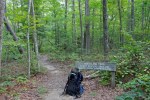
Stepping silently is impossible, especially in the woods.  But under the refuge of a heavy rain, each step disappears, blunted and blended into the sounds of the rain.  If ever I needed to escape or evade, I would hope for a downpour to hide my sound, my scent, my very presence, truly allowing me to leave no trace.

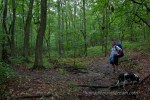
Perhaps it is the feeling of being encapsulated in a rain shower that causes an illusion of privacy.  As we put one foot solidly in front of the other, I forget my companions.  I look around in a panic realizing I haven’t heard Tisen’s familiar jingle for quite a few yards.  He is close at my husband’s heels, still trying to keep his head dry by hanging out under the over hang of Pat’s pack.  He hasn’t yet learned rain is its own kind of shelter.

Stepping through the rain becomes a meditation.  I cannot hear my own breath nor even my thoughts.  My mind has gone still and I focus on planting a trekking pole, placing a foot, planting the other trekking pole, placing the other foot.  I feel the muscles in my arms flex as I push off the poles.  I feel the twinge in my knee that threatens to turn into a sharp stab should I push it too hard.  My shoulders are already screaming.  I shift my focus back to my steps.  I don’t think about the distance left or the distance behind.  For those moments, I am my feet, my arms, my shoulders, my legs.  My boots and the ground move together as if the earth moves with me and all of me has melted; I am the rain.

Then, it stops raining.  My metaphysical moment evaporates even before the sun dares to break in through the clouds.

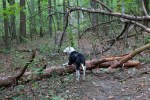
Returned to my more mundane reality, we find a spot to stop for a snack.  I slide out of my pack and dump it, rain cover down, onto a log.  It looks like an overturned turtle who has given up and stopped waving its legs.

I can’t remember ever enjoying trail mix so much as I enjoy it standing on the trail with a grumbling stomach, wondering if we will make it back without stopping for lunch.  Tisen stretches out and opts for a quick nap while we finish eating our apples before strapping our packs back on.

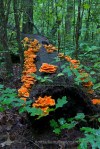
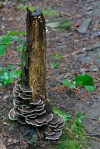
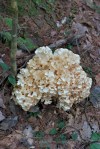
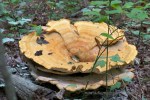
Now, the wet forest demands my photographer’s eye.  Every stretch of the trail reveals even more beautiful mushrooms.  I do my best to capture some of them with my 24-70mm lens, but I wish there were such a thing as a weightless macro lens and tripod so I could get up close and not worry about camera shake.

We hike faster as we get near the end.  My mind is no longer in the moment.  I’m longing for when I can set down my pack and know I don’t have to pick it up again for a very long time.


Overlooked

Something I always seem to forget when I haven’t been backpacking in a while is just how badly I sleep.  At first, I thought it was about equipment.  I gave up on the ultra-light sleeping pad and invested in a Big Agnes inflatable mat.  That was a nice upgrade.  A big, thick, insulated, cushy air mattress that really didn’t weigh a whole lot more.  I still didn’t sleep well.  There are several factors involved:

  1. Noises.  These range from bears to my husband snoring (he claims it’s me), but there always seem to be noises I can’t ignore.
  2. Fluids.  I drink a lot of water when we’re hiking.  Unfortunately, particularly in cold weather, this leads to having to get up many times in the middle of the night.  The whole process of managing getting out of the tent and then wandering out into the cold and/or rain has a pretty significant impact on sleep.
  3. Discomfort.  Backpacking uses muscles that don’t get used while sitting at a desk all day.  They don’t even get used in yoga class, rowing, biking, or the gym.  These muscles start screaming as I struggle to find a good position for my head.  At home, I sleep with two pillows to keep my neck and lower back comfortable.  Perhaps I need to find light-weight pillows for backpacking.
  4. Time Shift.  When one backpacks, there is little to do at the campsite after dinner if there’s no fire.  We rarely have a fire.  In many places, it’s not allowed.  In places where it is allowed, it’s often a lot of work.  Sometimes, it’s just impossible.  For example, when it’s pouring down rain.  So, once dinner is over, the dishes are washed, teeth are brushed, the supplies are appropriately stowed, and fatigue from the many miles of hiking sets in, it’s bedtime.  When bedtime is very early, this contributes to waking up throughout the night.

Rain suddenly pounding on the metal roof above our tent caused noise issues.  No pillow and sharing a tent with both a man and a dog created discomfort issues.  Going to bed at 7:30PM contributed to time shift issues.  The only thing I did well was taper off on water consumption.  None-the-less, I felt like I’d gotten no more than 15 consecutive minutes of sleep all night.

I think Tisen felt the same way–he wouldn’t get out of the tent in the morning.

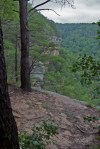
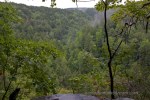
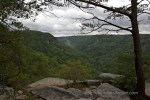
But, we made it back on the trail eventually.  On the way back, we discovered Tommy Overlook, a highlight of the trail we’d missed in the heavy rain the day before.  We were making good time on the trail–all of us walking double-time in some unspoken agreement that we wanted to get home as fast as possible.  We stopped for a good 15 minutes to enjoy the view of the 3 gulches converging.  I couldn’t help but imagine what it would look like in a few weeks when the trees are in color.

The Next 6.3 Miles

Mentally embracing the rain, we started down the trail, determined to make it the next 6.3 miles to a place called “Hobbs Cabin.”  We couldn’t help but hope the cabin (a rustic, first-come, first-serve arrangement) was available.

After about 10 minutes of hiking in the downpour, we realized hiking in the rain on a hot day was quite pleasant.  Instead of feeling stinky and sticky with sweat, we felt cool and refreshed and there were no bugs while it was raining.

Tisen, on the other hand, was not so enamored with the feeling of cool rain. He did his best to walk underneath the overhang of our packs to try to avoid being rained on directly.  He ended up just as wet as the rest of us, but there must have been something comforting about feeling like he had a roof over his head.

When we got to the first overlook of the “gulf”  (apparently that’s what a gulch is called in Tennessee), the rain had taken a break.  The sky was overcast and it was hard to tell it was noon.  The break in the rain was nice, as was the breeze blowing up from the valley below.  But, alas, we were trying to cover 6.3 miles before it got too late in the afternoon, so we couldn’t stop long to enjoy it.

As the trail veered away from the edge of the gulch, we re-entered the woods, and perhaps a time from the past.  It was easy to imagine the first settlers finding their way through woods like these when such woods covered much of the Eastern US. Of course, they would have all be old-growth forests back then.  But, these woods, mostly free of invasive plants, made me feel like we’d been transported in time. Thankfully, our gear wasn’t transported back to historical equipment–I think we would have needed a wagon.

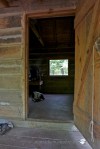
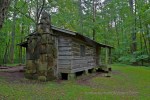
At long last, we arrived at Hobbs Cabin and were relieved to find it unoccupied.  A tiny, dark, uninviting shelter, it was equipped with 6 bunks and a table fastened to the wall.  The bunks were wood planks that would require sleeping pads and bags to make comfortable.  The small windows on the back wall let in so little light that even with our flashlights, we had trouble seeing inside the cabin.  I had a hard time imagining spending the night in there.

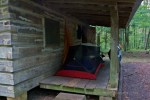
I proposed we pitch the tent on the front porch, screening out all insects, putting us where we were sure to get a breeze, and under a great big roof to keep up out of the rain.  We hung the rain fly in position just in case we started to get wet, but planned to sleep under just the screen for the night.  Tisen was more excited than a child to crawl into the tent with us, even though we decided to call it a night around 7:30PM.  It was the earliest we’ve ever gone to bed.

2 Miles

There is a fine and delicate line when it comes to backpacking between having what you need to survive and having too much weight on your back to have any fun.

Once a backpack reaches a third of your body weight, or even a quarter, when you get a few miles into the hike, you start to question the wisdom of backpacking vs day hiking.  This has been a battle played out over years for me.  The first time I went backpacking, I barely made the ascent up a 4 mile trail that climbed almost 1 mile in elevation.  I didn’t even know how much weight I was carrying at the time, but I had packed things like an 11-cup percolating coffee pot, so I’m pretty sure it was a lot of weight.

When my husband and I were in official “backpacking training,” we went on a 3-day trip to Otter Creek Wilderness in Monangahela.  This was right after I’d read a book called “The Ultra-Light Backpacker.”  I took no spare clothes except socks and underwear, no tarp, no extra anything.  If I thought I could live without it for 3 days, I left it at home.  My pack was a lot lighter, but it rained the entire time, except when it snowed, and we came pretty close to hypothermia by the time we hiked out the 3rd day with no dry clothes to change into.

Ever since then, we’ve erred on the side of too much weight.  As we headed down the trail on the Sunday of Labor Day weekend, we not only were carrying too much stuff for us, but also too much stuff for our dog:  His new special diet frozen and packed so it would stay cool long enough to be fresh for his dinner and breakfast; his bedroll strapped to the outside of Pat’s pack; extra towels packed just for drying the dog; and, of course, Tisen’s special water bowl and his own water bottle.  Spoil our dog?  What are you talking about?

It’s not surprising that after about 2 miles, we were ready for our first snack break.  We stopped right on the trail as there was no where else to go.  We opened up our packs, broke out our snacks, and started munching.

As we stood there with our stuff strewn about, we heard a sound.  It wasn’t just the sound of the wind whistling through the trees.  It was the sound of an enormous sheet of rain blowing through.  Pat went for the tarp while I went for the rain cover for my pack.  I got my pack closed and covered while Pat built us a little shelter.

We felt a little foolish when three backpackers came through soaking wet and had to duck under our shelter to continue on the trail.  We started packing up our stuff and accepting that this rain wasn’t going to just blow over.  It was time to get wet.

Hummingbird Band

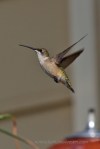
Pat and I were planning to set out for two days of backpacking on Labor Day weekend.  However, a friend asked if I would like to attend a hummingbird banding on the 1st.  It was a long weekend, so of course I decided to postpone our backpacking trip by a day so I could see hummingbirds being banded.

Who wouldn’t postpone a backpacking trip to see hummingbirds being banded?  I would have postponed all kinds of plans to see how, exactly, this works.

When we arrived at the banding location on Saturday morning, the first stop was the banding table.  The bander educated us while she banded.

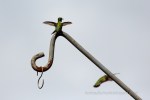
The house we were at was someone’s home who happened to love hummingbirds.  They put out feeders every year like so many of us do to attract them to their home.  What was unique about this location was that it was in the middle of two ridges that created a funnel effect for migrating hummers.  So, this time of year, hundreds of hummers would stop at the feeders to fill up on their way South for the winter.  By replacing the feeders with specially designed traps that wouldn’t harm the hummers, the banders were able to capture about 35 birds before we’d even arrived, about an hour after the event started.  1 bird every two minutes is pretty impressive.
I was a bit disturbed when I was asked not to show any photos of a complete trap on the internet.  Apparently there are people in the world who think Hummingbirds would make good pets and are looking for information on how to create a trap.  If you are such a person, please be assured that you cannot keep a hummingbird as a pet and that all will be much better served if you simply feed them and let them go on their merry way.

Watching the bander handle the tiny hummers with a confidence that belied how delicate these birds really are made me wish I had the dexterity to perform such a task.  I asked her if she had started as a jewelry maker–it seemed like the appropriate skill set to me.  She laughed.  Apparently she also didn’t believe she had the dexterity to handle hummingbirds when she got started.

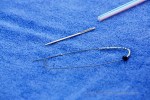
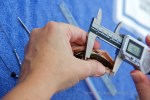
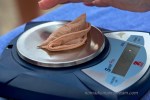
I watched her move through the measurements performed on each bird with a systematic rhythm, rarely interrupted by talking to us.  She measured each beak, each tail, each wing, used a straw to blow apart the feathers to see if there was fat, and then placed each bird on a scale.  She always banded them first.  She said that was in case they got away before she got through all the measurements.
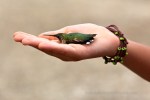
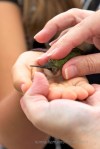
When she was done, she carefully set the bird in a waiting child’s hand and they held it until it suddenly decided it could fly and buzzed away.  Sometimes, this took several minutes.  It was fascinating to see a hummingbird hold so still.

Baby Mom

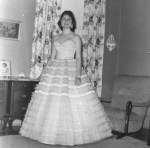
I love the photo of my mother in her formal.  It’s such a crazy dress!  But what’s most remarkable about that photo is that it could have been taken a few years before her death–she looked so much the same.  It’s hard for me to see that she’s a college student when I look at the photo.

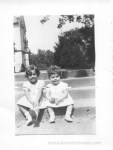
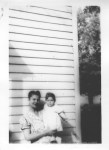
I also love the last photo of her sitting next to her niece.  Her niece is older than her.  How many people are born already an aunt?  There is a story about one of her uncles, when in his 50‘s, out on a work run with a co-worker.  When he realized they were close to my mom’s, he asked his single and much younger co-worker if he wanted to meet his niece.  The co-worker protested that he wasn’t dressed appropriately to meet a girl.  The uncle assured him his niece wouldn’t mind. When they went in and met my mother, the co-worker was highly disappointed to discover she was an infant.

My mother was a beautiful baby with big, bouncy curls in her hair.  People used to stop her mother in the street and suggest she stop what she was doing and take my mother to hollywood immediately.  Supposedly, Grandma didn’t want that kind of life for my mom, but I suspect she really just couldn’t imagine it as a real possibility.

Regardless, my mother was a favorite.  An adorable baby surrounded by adults who oohed and awed over her.  At least that’s what I imagine her childhood was like.

Her cousin, Carl, was certainly a favorite.  I guess it was mutual.  The photos of the graduate are him.  He looks very happy to have been a favorite of my mother’s.

She loved her relatives, all of them, so much that I could only imagine them treating her like a special pet.  The one regret she shared with me when I was old enough for her to start to speak of her regrets was that we lived so far away from extended family.

She described her childhood as though the center of it was a door constantly swinging open as another family member came through.  My childhood was very much the nuclear family variety.  I tried to imagine a constant parade of aunts, uncles, cousins, and second cousins marching through the kitchen and found it vaguely disturbing.  I guess it’s true that children don’t know what they’re missing.

The first two photos could have been of me when I was younger (if I were dressing for a 50’s party).  It reminds me of when I walked out of a back room into the living room of my parents house right after my mother’s wake.  One of our visiting family members got a shocked look on her face as I approached and then suddenly, realizing her mistake, said out loud that she’d thought I was my mother.  Now, I would be grateful to look like her.

My Mother’s Mother

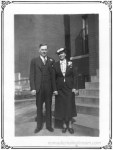
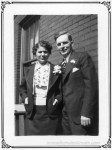
I stumbled across these old photos I scanned into the computer years ago.  They tell a story of hope.  Hope that a person can start over again in the middle of life.  The first two photos are from my grandparents wedding day.  They were in their 40’s, not far off from my age now.

In all the family lore I heard about my grandmother’s history, I never heard how my grandparents met, why they fell in love, what made my grandmother marry my grandfather.

The story that took center stage on my mother’s side of the family happened long before my mother was born.  It was the story of my grandmother’s survival.

My grandmother emigrated to the United States either from Hungary or Germany–the family lived in both places–when she was about 7, if I recall correctly.  I remember being told she had about a 3rd grade education, so I’m not sure if she went to school in the US after she got here.  Wherever she immigrated from, her family spoke German.  I know this well because many years later, when she was losing her mind, she reverted to speaking German again and couldn’t understand why no one knew what she was saying.

The story I was told was that my grandmother had 6 babies starting when she was 16 and the last when she was 24.  2 of them did not survive.  When she was about 26, with 4 young daughters, she awakened one morning to find her husband dead in the bed next to her.

In the same year, her mother died and her distraught father committed suicide.  Orphaned and widowed and left with 4 young children to support on her 3rd grade education, she turned to the Catholic church for support and turned her children over to a home for children so she could work as a live-in maid.

I don’t know the story as to how she got out of that line of work.  What I do know is that her children remained in the Catholic home until they graduated from the 8th grade, each having to choose between becoming a nun and leaving the home at the age of 13.  Only one of my aunts became a nun.

However it happened, my grandmother ended up on the church steps in these photos smiling on the second wedding day of her life.  They were still poor, but my grandfather supported my grandmother, leaving her free to take care of my mother when she surprised them by appearing so late in their lives.

What this story needs is a happy ending.  I’m not sure that it has one.  I remember my grandparents mostly as bitter, angry people.  We saw them only for about 6 days of the year most years, but their screaming arguments were what we most remembered.

Yet, my grandmother was still quick to smile and laughed often.  Maybe her happiness just looked different from what I expected?