60mm (Almost)

Does 14mm really matter?  For my non-photographer readers, in this case, I’m talking about focal length.  In short, focal length determines how close or far the subject appears through the lens.  The more millimeters, the closer things look.

I tend to like zoom lenses, which offer a range of focal lengths in one lens.  This may be because when I am done working for the day, I don’t want to make any more decisions.  When I get out my camera, I don’t want to have to decide if 50mm is going to be what I need.  However, generally speaking, lenses with the biggest range of focal lengths often have the poorest image quality.  I guess to get all that range, you have to give up something.  As such, I try to buy the best quality lenses with a reasonable range of focal lengths I can.

Over the course of several years, the range of focal lengths I could cover has grown from 17-55mm and 70-300mm to 16-55mm and 70-560mm.  Yet, I never could cover that 14mm gap from 56-69mm.

For a long time I thought I could live without those 14mm.  But then I started running into situations where I really needed a focal length between 55 and 70mm and I didn’t have it.  Granted, moving is often an option.  However, when you’re shooting from a train, a car, a boat, a balcony, a roof, or even a hilltop, moving may not be within your control.

Since I am waiting patiently for my new full-frame camera and my 17-55mm lens will not work with a full frame camera, I figured it was time to fill the gap.  After 5 years of no 56-69 coverage, I have now expanded the focal range to 16-560mm–with no gaps.

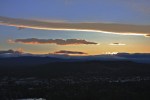
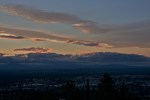
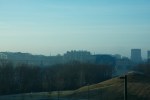
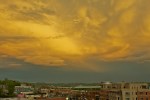
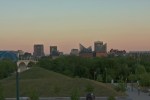
As exciting as this may be to me, comparing what I get at a previously unavailable focal length to other, available focal lengths seems like the best thing to do.  I set up on the balcony and shoot the view I have shot so many times before.  This time, I aim for 60mm–right in the middle of my new range.   Unfortunately, there are no markings between 50 and 70mm on my lens, so I have to guess where 60mm is.  When I load my photos into Aperture, I learn that I was shooting at 57 and 58mm.  Oh well.  Still within the previously missing range.

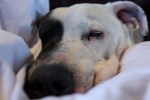
Tisen, who is suffering from a combination of allergies and a nasty rash and has been put on steroids and antibiotics, is so groggy, he barely drags himself out onto the balcony to help me shoot.  As soon as I sit down at the computer, he returns to the sofa.  Apparently he has grown tired of the view faster than I have.

The new photos are compared to old shoots from similar views at different focal lengths.  It’s funny what a difference a few mm can make!

Scenic View

One of the more sedate things I enjoy is riding in trains.  Whether it’s as transportation or a scenic route (or, better yet, both), I really enjoy knowing that no one (who isn’t getting paid to be there) gets stuck doing the driving.

When we saw a PBS documentary on scenic train rides with steam engines, I made note of the Mt. Rainier Scenic Railroad.  I had yet to make it to Mt. Rainier and taking a train ride there sounded like the perfect way to enjoy seeing Mt. Rainier with my father and his wife on our next visit to Portland.

Many weeks later when Pat and I were out on our annual visit, the four of us headed out of Portland towards Elbe, Washington early in the morning.

A little too early, in fact.

When we arrived in the “town” of Elbe, no one seemed to be up yet.  Fortunately, one of the 3 businesses at the only intersection was a quiet restaurant where we got a good, down-home breakfast.

After filling our bellies, we headed out and discovered the volunteers who run the train had arrived.  I guess if you are excited by steam engines, this would be a great event.  However, once we were on the train, we discovered two things:  first, you really can’t see the engine when you’re in the train; second, you really can’t see much of anything when you’re in the train.

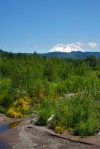
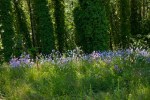
There were 2 moments totally 18 seconds during the ride where we could see beyond the immediate vegetation surrounding the tracks.  During 11 of those seconds, we saw Mt. Rainier off in the distance (2nd photo).  The rest of the time, we saw scenery like the dense trees and ferns in the 3rd photo or an occasional flower-covered slope like the 4th photo.

While I enjoy hiking in the woods, they’re tough to appreciate from a train.  Besides, this was supposed to be the “Mt. Rainier Scenic Railway.”  Call me crazy, but I expected to see Mt. Rainier for more than 11 seconds.

I suppose it’s all about expectations.  Had it been called “Get-a-Glimpse-of-Mt.-Rainier-During-an-Hour-and-a-Half-Train-Ride-Through-Dense-Woods Railway,” I probably would have been thrilled.

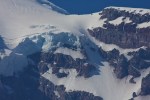
Fortunately, we were returned to the station with plenty of time to drive to Mt. Rainier National Park.  We got spectacular views just driving up to the visitor’s center and made plenty of stops so our driver (aka, Dad) could also enjoy the view.  Photos 5-13 were all taken from within the park.  It wasn’t the best time of day for good light, but the area was so beautiful, I didn’t really care.

The final image is of Tisen, taken with my iPhone using the Hipstomatic app.  I love the irony of having an app on a smart phone so you can take pictures that look like you took them with a cheap camera from the 1960’s.  It’s awesome.

The High Desert

Going back in time again to a previous trip to Oregon, I’ve pulled together a few photos from the High Desert Museum in Bend near Lava Lands National Park.

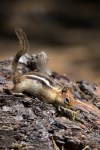
A recurring theme is the number of golden mantle ground squirrels that posed for me.  I noticed a marked improvement in the poses at the museum over the ones at the park.  I suspect the ground squirrels at the museum are professionals.

Besides the ground squirrels who scurry along the many paths, they also have native creatures on display.  Since shooting captive wildlife is far easier than sitting around waiting for it in the wild, I took full advantage of the opportunity.

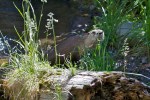
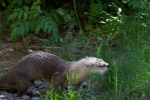
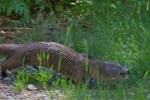
Given that it was mid-afternoon, many of the animals were content to lie in the sun and let me shoot.  However, the river otter was not so cooperative.  I can only recall having been to a facility with river otters who were actually visible and active once in my life–it was nearby at the Seattle aquarium.  There must be something about the Pacific Northwest that makes otters more active.  I guess that makes sense since the people of the Pacific Northwest tend to be more active, too.

In any case, first I tried getting shots of the river otter through a glass wall on one side of the “pond” he was swimming in.  I thought it would be really cool to have underwater shots.  With little light, I was stuck with a slow shutter speed, so none of the underwater shots are worth looking at.  Just dark, blurred shapes moving through water.

Next, I headed outside hoping for better light to shoot in.  I did get more light, but it wasn’t exactly better light considering the time of day.  It was enough that I was able to shoot at 1/160th of a second, though.  That allowed me to stop at least some motion.  My favorite pictures of the otter are the two that show him shaking off.  The first one is the start of the shake with only his head in motion.  The second one is slightly later.  The shake has propagated down to his neck.  If I would have taken a bunch of shots, you could have seen how the shake moves from the head all the way down the length of the otter’s body.  It’s pretty amusing to watch.

Another critter that posed for me was the porcupine (hedge hog) who was part of the animal show we caught the tail end of (pun!).  He didn’t pose just for me–there was a big crowd in the amphitheater, but the porcupine remained amazingly focused on the bottle his handler was feeding him.

At the end of our day, Pat and I went to Pilot Butte State Park to enjoy the sunset.  It’s basically a giant hill in the middle of an otherwise flat town.  At the top, we were treated to spectacular views of the mountains, the clouds, and the setting sun.

In Search of a New View

On Friday night, Pat decided it was time for us to try Nikki’s, a Southern Fried Chicken and Seafood drive in that we’ve been going past regularly ever since we started taking Tisen to doggy daycare.  Pat’s idea was to get take out and go have a picnic.  I decided this was the perfect opportunity to find a new location to shoot sunsets from.

After getting two fried shrimp dinners with coleslaw, fries, and hush puppies, we follow google maps up the hill to a nearby conservation area.  There isn’t a picnic area, so we wolf down 3 weeks worth of saturated fat sitting in our mini-van.

The conservation area is a shady woods that, unfortunately, has been invaded by many foreign plants that block the view through the forest.  The trail is an abandoned road that looks wide with easy walking, but we decide to forego a hike since I’m hoping to shoot the sunset.  There is no hope of getting any views of the sunset from where we are.  Not only are there no views through the thick growth, but we’re on the East-facing side of the ridge.

We decide to drive to the other side of the ridge to a different trailhead to see if we can get a view from there.  After crossing under the ridge through a tunnel and driving around to the other side, we wind our way around to the next trailhead only to find that we are still on the wrong side of the ridge.  It’s like some kind of joke.  There is no explanation as to how we still ended up facing East.

As we head back out, the trill of a wood thrush catches my ear.  I suddenly realize I haven’t heard one since we moved to Tennessee.  As I listen to its sweet flute-like voice, I suddenly ache for the ravine we left behind.  But I am soon distracted by the search for a view of the sunset.

We end up on the backside of the ridge facing the freeway.  There is a big, bald hillside on the other side of the freeway where a new complex is under construction.  It looks like the developer hired strip miners to do the excavation.  It breaks my heart.  I cannot bring myself to shoot with this eyesore in the frame and I cannot shoot around it.  Perhaps I will have to think about how to capture the ugliness of this site, but tonight I’m seeking beauty.

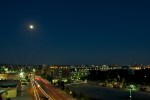
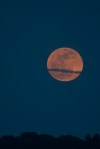
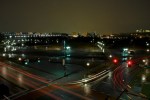
After trying every road we can get access to along the ridge, we give up on having a really good view and return to our roof at home.  We are in time for twilight.  The almost full super-moon has already risen high, shining so brightly I cannot resist shooting it.  Equipped only with my wide-angle lens, I play with long exposures.

All-in-all, it’s been a fun little adventure even though we never strayed far from home.

Wild Ride

Having gotten a decent shot of a red-shouldered hawk at Audubon Acres yesterday, I have the itch to practice wildlife photography today.  I also have the itch to ride my bike.

I slather on several layers of 50 SPF and head off.  It’s about 2PM in the afternoon–not exactly prime time for either wildlife or light.

I cruise casually along the Tennessee Riverpark–the 94 degree heat dissipates as I coast down hills and suffocates me when I go uphill.  At least riding generates a breeze.

I continue on to the Amnicola Marsh.  I find a shady spot to set up and I wait.  This is where I start to question just how much desire I have to be a wildlife photographer.  It’s ridiculously hot for early May.  I feel the heat pounding at me the way I feel the beat of a bass drum at a high-powered rock concert.

Then, the bugs find me.  I am the incarnation of Pig Pen–I have my own cloud.

Sweaty, bitten, itchy, and aching from my heavy pack, I have a hard time being patient.  I have been in the field 5 minutes.

Then, low-and-behold, two green herons fly in and land in a dead tree.  The lighting is horrible, and I’ve arrived without my polarizer, but I do my best to get a decent shot.

I am too far away.  I decide I should try to get closer.  I carefully creep through the scratchy weeds, leaving my bike behind, but hoisting my pack back onto my sore shoulders.  I pick my way around thorns, through spiderwebs, and avoid poison ivy until I am all of 10 feet closer to the tree in question.

I consider moving further in, but the underbrush looks a little thick, I won’t be able to keep an eye on my bike from there, and, well, it looks like my feet might get wet.  I decide to shoot from where I am.

I see a flash of white in my peripheral vision and I swing the lens around to find a snowy egret landing among the lily pads.  Then, it disappears so completely that I believe I’ve imagined it.  The lily pads blow in the breeze and flash white glare back at me, fooling me into thinking there was never a snowy egret at all.

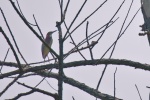
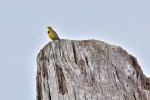
A belted kingfisher makes an appearance.  Although the light is pretty hopeless, I fire off a few shots anyway.  Then, the green heron starts to make his way from a low perch to a high one, catching my attention once more.

Eventually, I head on home. Tisen, having spent 2 whole hours at home alone, had foraged through my not-yet-unpacked suitcase and found the squeaky balls I brought back from Columbus.  I’m happy he entertained himself.  I’m even happier when I see my photos on the big screen and realize there really was a snowy egret!
Not a bad way to spend a Sunday afternoon.

Big Moon

Yes, it’s that time of the month again–the full moon!  But not just any full moon.  No, this is the super-moon!  Not only is the moon at perigee tonight, but it’s also Cinco de Mayo.

Seems like a recipe for disaster, but according to one article, there is no truth to the belief that crime and wild behavior increases with the full moon.  I’m not so sure.

Another special aspect about tonight’s moonrise is the time.  The moon will rise before the sun sets.  This means there will still be light on the trees along the ridge top.  I’m excited about the possibility of capturing the moon in this kind of lighting.

Pat and I had some logistical issues in our plan today.  I volunteered at the Audubon Society’s visitor’s center most of the day and Pat worked.  Tisen got to go to doggy daycare.

By the time Pat came home, it was 6:30PM.  We wanted to celebrate Cinco de Mayo at Taco Mamcito’s next door, so Pat jumped in the shower while I took Tisen for a walk.  Then Tisen had to be fed and we had to wait for him to eat before we could leave (he won’t eat when I’m gone).  By the time we were headed out the door, it was past 7:30PM.

While this may seem plenty early to begin a Cinco de Mayo celebration, the problem was that the moonrise was going to happen at 8:21PM and I didn’t want to miss it.  By that, I mean I wanted to be set up on the roof of our building with my camera ready to start shooting by the time the super-moon appeared on the horizon.

We went next door quickly, but when we saw the crowd, we gave up all hope of getting food and just ordered margaritas.  Fortunately, the margaritas were small because a margarita was probably the last thing I needed having still not eaten.

We drank our margaritas quickly as we huddled in a corner of the patio, trying not to crowd the people sitting next to us.  At 8:15PM, we are racing out the back door to get me up to the roof on time.

I manage to grab my gear and Tisen and get set up on the roof before the first glimpse of the moon appears over the ridge.  I am helped by the fact that it takes an extra 10 minutes for the moon to get from sea level to the top of the ridge.

I shoot and check focus and exposure and shoot some more.  I don’t know what it is about this giant, orange moon rising over the ridge that I find so exciting, but I wish the moon would pause for a few minutes so I could get all the adjustments just right and perfectly capture it as it hangs as a glowing backdrop to the ridge.  I never get tired of the moon.

First Flash

I finally got caught up on post processing photos from my whirlwind trip to Columbus.  These photos are from the baby shower I attended.  Rule one:  decide if I want to shoot or attend a party.  When I’m trying to do both, I don’t do either well.

There’s a certain geek factor about walking around a baby shower with a big lens and a flash on a stand with a funny looking box over it.  Now, imagine if I would have added my loupe hanging around my neck.  Would that really have pushed me over the line between overly enthusiastic and completely socially inept?

I’m thinking I crossed that line the moment I decided to put my flash on a stand.  And as one guest pointed out, people will put up with my flash because they want the pictures.  This only holds true if you do a really good job on the pictures.

In any case, I discovered several things my first time out with my new flash.

First, I understand why event photographers often put the flash on the camera even though the lighting options are limited.  Having the flash on a stand in a relatively small space with a lot of people was a bit awkward.  It was often difficult to find a position for the flash stand without asking someone to step out of the way.  There were many times I didn’t bother to use the flash at all because I didn’t want to disrupt the whole room by setting it up in the middle.

Another thing I learned was that since I was working without a tripod (not something I do too often these days), I needed to have a fast enough speed to not get blur from movement but also slow enough not to exceed sync speed with the flash.  I ended up with a shot where the shutter speed was too slow for my hand-holding ability when I was using flash. Seems like it defeats the purpose of using a flash.

I was pleased with the effect of using the flash to light the shot of the gifts.  Although there is a bright reflection in the piano, it’s not actually from the flash–it’s just brighter because of the flash.  There seems to be a pretty even light.  Of course, the ambient light from the windows helped with the fall off.

While an umbrella might have been even better light, we decided it was too crowded to have a big umbrella sticking out of the stand.  That was definitely a good decision!

Another thing I learned was the challenge of lighting multiple people.  Especially when the people don’t know each other that well enough to get into each other’s personal space.  Or, when there is a huge height difference between the subjects.  Shadows get exponentially harder to control.

All in all, given it was my first time using a flash, I’m trying not to be too hard on myself.

Big Dog in a Flash

Today, a mysterious brown box showed up outside our door.  I hadn’t ordered anything and yet a package arrived.  The address was hand written like maybe it came from someone we knew.  It was addressed to both my husband and me.  When Pat came home, we opened it together.  It turned out, it was a gift for Tisen!

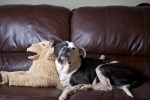
Tisen’s very thoughtful grandma sent him his own dog friend!  This is not just a little squeaky toy to add to his collection.  No, this is a life-sized stuffed dog that’s so incredibly soft, I tried it out as a pillow.  It makes a great pillow.

Since Tisen was at puppy daycare when we opened the package, we set Big Dog up on the couch with Lion.  When Tisen came home, he ran to the couch, grabbed Big Dog and threw him on the floor, snagging Lion in the process.  I guess he thought Big Dog had no business playing with Lion.

After a while, Tisen started carrying Big Dog around, which was pretty amusing because Big Dog is about the same size as Tisen.  Eventually, he settled down on the couch with Big Dog and discovered just how comfy a pillow Big Dog makes.

This gave me an opportunity to get a little portrait practice in.  Having just gotten my new flash before leaving for Columbus last week, I hadn’t tried it at home yet.  Interestingly, when I use my monolights (which can only be turned down to 1/8 power), Tisen gets up and leaves.  With my flash on an umbrella stand and turned down to 1/64 power, he seems to actually pose for me instead.  I could be onto something.

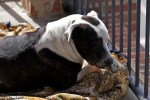
One of the challenges of properly exposing Tisen is that he is black and white.  As you can see from the last photo (taken with my iPhone), the whites tend to blow out and/or the blacks get clipped.  This is fine for an iPhone photo, but not really what I’m shooting for (a pun!).  I started with the umbrella on the white side of his face first because the black side of his face was in lots of ambient light.  Then, I tried speeding up the shutter to exclude the ambient light and moving the flash to the black side of his face.

One discovery from this experiment:  pleather makes a very bad background for shooting with a flash–the glare makes it pretty obvious that a flash is in use.  That said, you should now be able to tell which of the photos were taken with ambient light only and which of the photos used the flash on the umbrella stand.

Tisen was not too concerned about the glare.  He was just happy to have something soft and cushy to snuggle with.  He decided he liked Big Dog so much that when we went out to pick up a pizza, Tisen grabbed Big Dog for the ride.  Here’s a video of Tisen with Big Dog for your enjoyment.

Blowing the Top

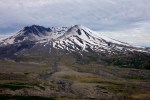
Mount St. Helen is one of those places everyone should see.  Or at least anyone who is interested in what happens when a mountain explodes.  It’s one of those fascinating places that I have no problem returning to.  I’ve been there three times, which is a lot considering I live about 2500 miles away and there are a lot of places I haven’t been that are higher on my bucket list.

Our last trip out to Portland, my brother, sister-in-law, and nephew wanted to see Mount St. Helen and we decided to do a 6 mile hike while we were there.  My dad and his wife would hang at the visitor’s center while we did our through-hike.  They would pick us up at the end of the trail.  Timing was a bit tricky.  With no working cell phones, we had to predict how long it would take us to go 6 miles.

I have read a lot of books about backpacking where people say things like “20 minutes a mile with a full pack is a good pace.”  I have yet to go on a day hike where we were able to maintain a 20 minute mile pace, let alone a hike with a full pack.  So, when my sister-in-law (who likes to do things like run marathons at an 8 minute/mile pace) guestimated we could hike 6 miles in 1 1/2 hours, I was less optimistic.  A 15 minute pace sounds painfully slow to a runner, I suppose, but maybe that’s why I don’t enjoy running?

Before we departed, I told my father we would take at least 2 hours and that he shouldn’t worry if we took 3.  I set the panic time for 7:00PM, figuring that would give us three hours–I felt confident we could manage a 30 minute pace even in the worst of conditions.

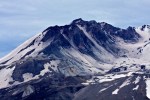
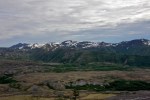
The views in the Mount St Helen area are haunting.  The landscape looks almost foreign.  Yet, each time I’ve returned here, there were more signs of life–more green, more elk, more birds.  Given that it’s been nearly 10 years since my first trip, the progress is slow, but it is progress.

As it turned out, we got confused about which trail we were on.  Our only trail map was a flyer from the visitor’s center that gave us so little information we couldn’t find the trail we wanted to be on and eventually decided to turn back.  We walked back quickly to an overlook we’d passed.

After hitting up a few tourists until someone agreed to give me a ride down to the meeting place, I made it to the rendezvous spot about 1 minute before the panic time.  My dad and his wife were quietly napping, so I don’t think we were in danger of them panicking.

On the way home, we stopped one last time to enjoy the view of Mount St. Helen–majestic even without her peak.

Squirrel!

Every year, we go to Portland, Oregon to visit my father and his wife.  Every year, we discover some new and fascinating part of Oregon that makes us think about living there.

For example, I thought hiking in Hawaii Volcanoes National Park was the kind of experience that nothing on the mainland could even suggest.  As it turns out, Oregon has Lava Lands National Park.  While you can’t creep out over still crackling hot lava that’s only a couple of weeks old, you certainly can experience walking through a vast stretch of nothing but cooled lava.  Who knew?

The entire area is amazing.  The Three Sisters mountains stand watching over the lava fields, a reminder of where the lava originated from.

But an interesting reality came home to me while we explored the area:  there is something about me that attracts mosquitoes and chipmunks.  To be honest, I discovered the mosquito thing many years ago when I realized that I averaged anywhere from 5 to 10 times as many mosquito bites as the people sitting around me at a campfire.  Anytime I need to feel attractive, I just take a walk in the evening while the mosquitos are buzzing.  But, it wasn’t until we were walking around lava lands that I realized chipmunks seem to follow me wherever I go–especially when I’m carrying a camera.

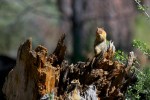
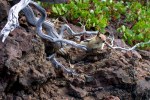
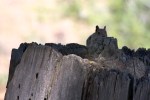
To be more accurate, these are golden-mantled ground squirrels, but they look like overgrown chipmunks to a mid-westerner.

I have nothing against chipmunks.  They are extremely cute.  I was slightly embarrassed when I tried to identify a bird I kept hearing for about two years until I finally saw a chipmunk making the mysterious chirping I could never identify.  But, I don’t hold it against the chipmunks.

I appreciate their willingness to pose for me when no other wildlife dares to appear.  I particularly enjoy the range of caution these little guys display.  Some seem to be out trying to attract attention while others appear to practice careful camouflage.

They all freeze when they see me swing my lens their way.  I wonder what they think?  I suspect what they think is something like, “I wonder if I sit real still and let that woman take pictures of me if she’ll eventually throw me something to eat?”

The lava fields make for an incredible playground for the ground squirrels.  They have an infinite number of crevices to jump into, tunnels to run through, and rocks to sun on.  If it weren’t for the predators, I imagine there would be a ground squirrel on every rock, every one of them hoping for a hand out.

As it is, they appear and disappear frequently enough to demonstrate that the static field of lava pulses with life.  The rhythm of their movements becomes the heartbeat of a place that might appear dead to the casual observer.  They remind me to stop and look closely.