


Urban Anxiety

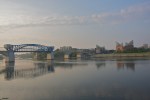
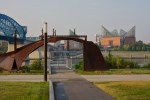
For 10 years, we lived in what I would describe as an “urban residential area.” Located North of the Columbus downtown area, the walk to restaurants, the grocery store, the library, the farmers market was an easy endeavor. At the same time, we were nestled into a wooded ravine, keeping us cocooned and creating separation from city activity. We spent a year a few miles further North where there was less separation, but also a little less busyness. Now, we live on one of the busier streets in Chattanooga in an apartment with a balcony that oversees it all. The view of the downtown skyline is fantastic–I love keeping the blinds open so I can look out over the park across the street, the bridges over the river, and the cityscape. Being in walking distance of the majority of the things we want or need to do every day is also a big plus. But it’s definitely different.

For us, it’s a small step from where we lived before, but the noise has been an adjustment. Fireworks at the baseball stadium across the river sounded like they were going off right outside our window. We learned about the summer concert series across the river because we thought a band was playing in our living room. When large trucks go by during the day, I have to mute my phone to avoid disturbing conference calls. And, perhaps most surprising to me, sirens scream by every single day. I had no idea there could be so many fires in a town with about 300,000 residents!

We recently met a young guy who told us he had moved here about a week before we did from some small town in Tennessee that I had never heard of. He told us the name of the “big city” he had to drive to as a kid in order to see a movie. The “big city” was another small town I’d never heard of. Walking with him across the street, when I went to push the button for a walk signal, he thought I was walking off the wrong direction. When I explained my intention, he laughed and said he was from such a small town that it never occurred to him he was supposed to push a button to cross the street. I imagined a small town where he could step out in the street unassisted by lights and if a car happened to be going by, they would stop to say hello. This must be a completely different world to him.

While adjusting to the noise is a bit of a challenge (and may have something to do with why I’m only sleeping 4-5 hours a night these days), I wouldn’t give up our location. Convenience is a great benefit. For one, we can see our new bank from our balcony, which has made setting up new accounts a lot easier. We try to take a walk each morning along the riverfront between my first burst emails in the morning and settling down to work steadily for the rest of the day (and, more often than I would like, the evening). The other day, as we were strolling by the bank, our new banker was arriving. He stopped to chat with us for a minute. I can’t remember ever having a banker whom I’ve met once and then seemed like a friend the next time I ran into him. I think of my small-town acquaintance and how nice it feels to be recognized as part of the neighborhood.

As far as feeling like being part of the community goes, we haven’t made a lot of progress there yet. Working from home doesn’t lend itself well to meeting new people. And working a lot limits the time available for activities that promote making new friends. It’s easier to just jump on my bike for a ride whenever I can work it in than it is to have to be somewhere at a specific time. This leads to watching people more than being with people. Part of my problem is putting work away. It was easier to stop working when my office wasn’t across the room 24×7. Now, I think of something I forgot to do and I go do it. Once I get started, I find other things I need to do and soon, hours have gone by. Work often consumes me.

I also have a new anxiety about my career. I worry that because no one sees me answering emails at 5AM, on a conference call at 11:00PM, creating presentations at 8PM, etc. that if I step out to go get lunch late in the afternoon and miss a call, an email, an instant message, people will think I’m slacking. I’m not sure who I think would see me if I were in the office at those times, but I worry all the same. It makes it harder to put work away.

On the plus side, I can take my laptop out on the balcony for as long as I can stand the heat and enjoy the view unobscured by windows at any time of the day (as long as I’m quick with the mute button since I seem to be on the phone at least 8 hours a day). It’s a tradeoff, but I’m adjusting.

But people watching is interesting. Lots of visitors wander the streets. Chattanooga attracts people from all over. Plus, it’s summer time and the ever-blowing breeze from the river attracts people to the waterfront all on its own. I am not the only one watching. Cameras lace the park areas, observing secluded corners from lamp posts. I always wonder who is watching me as I walk by and what they think I’m up to. Security seems to be a primary concern. Cops patrol on bicycles, Segways, foot, and in cars. Between the cameras and the police presence, I find myself wondering if I’m in danger. Funny thing how security can make you feel insecure. Perhaps the anxieties that motivated people to hang cameras and hire extra cops taps into my own anxieties?

I told myself before we started this venture that I had to remember that no matter where we moved, I was still taking myself with me.  Trying to avoid the disappointment of expecting a new life along with a new place, I coached myself that I couldn’t expect to be a new person.  Yet, I find that I secretly hoped I would leave my anxiety back in Columbus.  My husband once told me when we were planning our great escapade that he worried that even if I didn’t have a job, I would still be me.  He didn’t really mean this as an insult.  🙂  He just meant that I can get obsessed and anxious about anything.  I can take the most enjoyable pastime and turn it into a stressful burden in no time–I’ve even managed to do this with learning relaxation techniques.  It’s a skill I don’t take pride in, but it comes from a lifetime of believing hard work is central to character.  The lesson I continue to try to learn is how to relax into the work.  The philosophy of enjoying the journey as much as the destination comes hard for me.  I constantly remind myself to be where I am, to experience fully what I’m experiencing, and to let the next moment take care of itself.  After all, right now is all we have.  But goals loom large and distract from the joy of each step along the way.

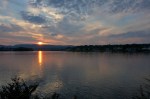
I take a deep breath.  I look out over the view.  I remind myself that I am here, sitting on my balcony, my feet pressed against warm concrete, cars rolling by below, writing purely for the pleasure of writing.  Chattanooga is a beautiful place.  And I am in it.  The early morning light highlights the yellows in the trees, giving the scene freshness.  Birds sing loudly enough to hear them over the traffic.  The breeze still holds the coolness of the night and delivers it to me in soft waves.  I think briefly about the work I didn’t finish yesterday, but bring my attention back to now.  I finish my coffee and put my laptop away far less anxious.

Riding the Riverpark

The Tennessee Riverwalk parallels the Tennessee River as it winds it’s way East through the city and then turns North. As a cyclist, I anticipated enjoying this highlight of Chattanooga on a regular basis. After our move, we didn’t have the energy to explore it until a week after we’d settled in. But, I talked my husband into a short, exploratory ride late on a Sunday afternoon. We didn’t actually get started until close to sunset, so we knew we weren’t going to get far. However, we didn’t anticipate failing to find the route!

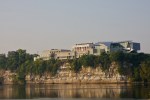
We crossed over the Walnut St Bridge and found an entry point, but it involved switch-back ramps that were not designed for bicycles. We ended up heading West instead of East, running into the end of the route after only a few minutes. Although the West route led us through the river park in front of the Chattanooga Aquarium, right on the waterfront with it’s spectacular fountains, it wasn’t much of a ride. We headed back East and searched for a route to the West. We ended up on a cliff in front of the Hunter Museum, precariously perched on the cliff high above the river. Fortunately, there were hand rails. Since the sun had set, we gave up, made our way back to the Bridge and headed home.

What do you do when you fail to find a highlight you’ve been looking forward to? Start up Google Earth. From the vantage point of a satellite, I spotted our mistake–in the Bluff View Art District (another must see spot in Chattanooga), the route East requires riding a short distance on the road to a bridge that crosses a highway and safely deposits riders on the route.

Pat (hubby) takes a trip back to Columbus the next day and I decide it’s a good time for me to check the accuracy of Google Earth that evening. After a long day at work, I have 1 hour between my last office-hours call and the start of my first late call (one of the joys of working with a global team is accommodating vast time differences). I hop on my bike and head out.

Sure enough, Google is right again. The river walk is easy to follow once I find the entry point. I can’t help but think about the San Antonio river walk in comparison. The key difference is that Chattanooga actually has a river. San Antonio created a man-made stream that is akin to the stream that flows through the Venetian casino in Vegas. It’s nice, but it’s not nature. In contrast, riding along the Tennessee River is a polite form of nature. The route is man-made concrete, wooden board-walks and bridges. The river has been dammed and the development is plentiful, but the park areas along the ride preserve natural wetlands and woods along the way as well. It’s like Disney meets the Everglades (minus the mangroves and alligators).

I push myself a bit climbing the hills. One of the climbs gets me out of breath. I push harder, feeling the burn as I stand to climb the steepest parts of the trail, daring myself not to sit until I’ve reached the top. I feel my calves flex, my heart accelerate, and my arms pull against the handle bars. The feeling of strength pushes me forward. I am sweating in the heat, but smiling as I top the final climb. It’s a short climb–easier than the climbs in and out of the river valleys in flat Columbus, even. The views of the river are what make me smile.

If I wanted to train for a race, this would not be the place for me. The slippery boardwalks and plentiful pedestrians make high-speeds dangerous. But I am not racing. I am enjoying. I finish my ride satisfied that this highlight will not disappoint.

Do Nomads Need Personal Trainers?


The Hill

I imagine trying to explain the concept of a personal trainer to a nomad. Where would I start? How would I explain that if I don’t make time for exercise, I don’t get any to someone who spends most of their day on their feet?  Then, how would I convince them that it makes perfect sense to pay someone to appoint a time and place for us to meet so s/he can tell me what to do? How crazy would it seem that I am so far removed from the physical activity of my ancestors that I have to learn how to stay fit? As crazy as it may seem to our ancestors, the reality of mainstream life is that many of us spend most of our waking hours sitting at a computer.  For me, while I manage to work walking, biking, and yoga into my routine, I have a harder time with strength training. So, I embrace my mainstream-self and sign up for a three month personal training package.

It’s a funny thing about working out. When I first worked out with a trainer, it was all about the weights. Then, circa 2002, more holistic body movements came into fashion, returning us to childhood gym classes with medicine balls, balancing balls, pulleys, and a wide assortment of other torture devices. Today, trainers seem to have shifted even more towards using your own body weight and have added bursts of cardio into each workout.

Here in Chattanooga, the trainer took me out to do hill runs between strength exercises. I’ve never actually done hill runs. Maybe because I grew up in Columbus, OH? Thankfully, it was a short hill. He prodded me to “sprint” up the hill. I was breathing too hard to explain that I was sprinting; I flashed back to playing co-rec softball and running for first base with my teammates yelling encouragements like, “Drop the piano!” And that was on a flat surface. I can run fast, actually. Even very fast for short distances. What I can’t do is accelerate from a stop. I’m a slow accelerator. This is a mystery to me. It’s like my legs are too long and my brain loses track of where they went. If I get into a rhythm for a while, something in my brain clicks and it knows where my feet are again and knows how to tell them to move faster. Of course, getting into a rhythm and running are not two things that occur in the same sentence for me very often–I would far rather get my cardio with a set of wheels taking all the abuse.

But, today, I run. The heat and gravity push against me like a wall. I keep pushing back, knowing the hill will end soon. My breath accelerates faster than my legs. I reach the top before I give out. I take a moment to breathe deeply, trying to restore my heart rate to something that simulates normal. I look at my trainer who laughs at me. I ponder briefly why I am spending money to have someone make me do things I don’t want to do. Then, I bounce awkwardly back down the hill backwards (another twist of modern training), giggling to myself as I experience a flash of the childhood silliness that goes with skipping backwards down a hill. I realize this is fun. Then I do push ups at the bottom and feel pride that I am strong enough to do them well.

Fitness is a funny thing. I’ve learned over many years of vacillating between couch-potatoeness and obsessive (if clumsy) althetic-ness that black-and-white thinking does not allow me to sustain fitness. Killing myself in the gym leads to pain and exhaustion, which leads to sitting on the couch for stretches that can reach months. Working exercise into my life sustainably has now given me a lot of years of moderate fitness. Realizing that I will never be a good athlete was a break-through moment for me. Accepting my limitations (which I am grateful are just a lack of coordination and desire) and allowing just a little regular exercise to be enough maintains my health. Ultimately, health is my goal–I accept that I will never again look like I did when I was 25 or 28 or 32 . . .

In moments (of which there were recently many) when I can do things like lift a heavy box and carry it confidently, I congratulate myself for finding this balance. There is something empowering about knowing I can do something. It opens doors to taking on tasks that would otherwise seem daunting. It allows for possibilities like hang gliding, bike tours, backpacking, and even just taking the stairs. This precarious balance between stressing myself and reducing stress creates a daily experience of can-do versus wish-I-could-do. I run that hill not because I want to but because I want to know that possibility is open to me, too.

Southern Sledding

Whenever I go to a new place, I particularly enjoy discovering things that are different there. I grew up in the Mid-West where we had enough snow to go sledding every winter. In fact, I grew up feeling sorry for people who lived in places where they didn’t get snow and didn’t get to sled. Having recently moved to Chattanooga, I assumed it was one of those places. I have yet to discover if there will be enough snow for sledding in the winter, but what I did discover is that, in Chattanooga, no one actually needs snow.

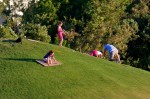
Here, grass sledding appears to be all the rage. The sled of choice is a simple piece of cardboard. Perhaps there are high-performance grass sleds available–teflon coated cardboard or maybe graphite would be slipperier–but I haven’t seen any so far. What I have seen is people having a ball sliding down grassy slopes on 95+ degree days without spending a penny. To boot, grass sleds are 100% recyclable. Now that’s what I call inventive.

I watch groups of children with their parents sliding down the grassy slope from my balcony. Summer fun at it’s finest. They begin to gather in the afternoon, making the most of the last days before school restarts. I think back to my own childhood summers. They lasted forever. Hanging out under a shady tree–or, more often, up in it. Once, a summer storm was blowing in, whipping the branches of our giant silver maple into a frenzy. I followed my brother high on the limbs, riding the tree like a crazy swing swaying frantically in the wind, our mother below yelling up at us to be careful. I remember seeing her face and recognizing her indecision–torn between letting us have fun and calling us down to safety. Then there was a bolt of lightening and her face shifted instantly into decision–she hailed us back down to earth.

I imagine the parents on the hill and their relief at having something to offer their children that is both fun and safe. After all, what is childhood without a few grass stains?

Shooting the Moon

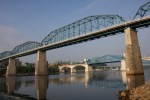
People walk in Chattanooga a lot. It’s part of the city’s identity. It’s also part of the reason we ended up here. Chattanooga offers total coolness when it comes to places to take a walk–both literally and figuratively. The Walnut St Bridge tops the charts for popularity.  Connecting downtown to the North Shore, Walnut St Bridge was converted from an old wooden bridge for cars to a pedestrian walkway. The entire bridge is dedicated to people-not-in-cars–imagine that!  Paralleling Walnut St Bridge to the West, the Market St bridge also has sidewalks on both sides and a good share of its own pedestrian traffic, although there is plenty of car traffic too. There aren’t many places that you can’t walk safely in Chattanooga. Maybe that’s why they don’t have traffic problems?

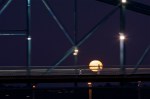
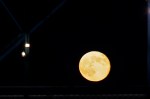
I intended to shoot the moon (I know it’s a pun, but it makes me giggle) after hang gliding last weekend, but I missed the true full moon because hang gliding was so exhausting that I slept right through the moonrise. So, I shot the almost-full moon the next night instead.  [Photography lesson learned: a monopod is not the right solution for long-exposure shots with a big, heavy 100-400mm lens. That said, some of the blurry shots are still interesting.]  We raced out to the Market St Bridge to find a place to shoot just before moonrise.

Standing on the bridge after another hot day provides the relief of the cool breeze that seems to be constantly blowing over the river. I admit that when we visited last January, we didn’t find this breeze so refreshing, though. People go by in all shapes, sizes, ethnicities, and fashion styles. My favorites are the cops on Segways. The blue lights on the Segways always make interesting light patterns as they travel across the bridge. You can hang out on the Walnut St bridge–there are benches. The Market St. bridge is not so hang-out friendly. As we wait for the moon to rise, our fellow pedestrians rush by without pausing, although usually with a friendly greeting.

No one seems to wonder what we are doing there–I suppose a camera offers it’s own explanation. I imagine this town is familiar with gawkers and photographers alike. I have seen photographers far better equipped than me wandering around the riverfront, shooting the fantastic views of Chattanooga’s downtown area–there are a lot of subjects to choose from.

Shooting requires concentration. Trying to hold a big lens still in a strong breeze becomes a sort of meditation: position yourself, take a deep breath, set up for the shot, breathe out, hold everything as still as possible, snap the shot. The moon rises quickly–as if it’s worried it’s late for it’s nightly appointment. In the fading sunlight, it glows big and orange. I see the man in the moon clearly through my lens and wonder who decided it looked like a man. But, I feel the pull of it’s magic.  What is it about the moon that makes my blood run at a different pace?  It looks so naked hanging there in reflected light, yet what does its nakedness reveal?  That the moon still seems mysterious in a time when it has been picked clean of all its secrets speaks to just how magical it is.  This night, it looms large and poses for me only briefly.

Hanging on Air

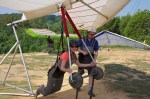
When we decided to move to Chattanooga, one of the attractions was it’s proximity to Lookout Mountain Hang Gliding Park.  Hang gliding wasn’t really on my bucket list, but it was on my husband’s.  For me, I just hate to miss out on anything.  So, adventure number one was the Introductory Experience.

We arrived at the park office at quarter ’til 8AM.  The office perched high above the valley with an ominous looking concrete . . . slide?  The words that popped into my head when I saw it were, “Ramp of Death.”  But wasn’t so much a ramp as a concreted coating on the top of the mountain that started out looking reassuringly level and then took a nasty bend at almost a 90 degree angle, directing my gaze straight down a 2000 ft drop.   My stomach started doing flips–and not for joy.  Fortunately for me, the Introductory Experience package we’d signed up for did not include that kind of leap of faith!  Instead, after signing in, we were led down the mountain to the valley below to start learning on the bunny hill.

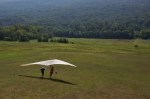
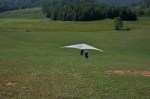
I love learning.  It’s the best part of life.  But the frustrating thing is how slowly new lessons sink in.  Especially when it includes making your body do something it’s never done before.  Picking up a hang glider and running across a field with it is one of those things.  It looks easy enough.  But finding the right spot on your shoulders to balance the weight of the glider is tricky and sometimes painful.  Then, there is wind.  There was no wind until I put a glider on my back, but as soon as I had wings, there was air moving me in directions I didn’t want to go.  The glider is designed to take flight.  You would think that would make it easier to carry.  But getting it to fly straight isn’t all that easy.  Especially when your airspeed is something less than 3 MPH.

Then there is the difference between knowing what you’re supposed to do in your mind and actually doing it.  I vaguely recall an article about how your brain has to build new neural pathways to allow you to perform an action that you have not performed before–being told what to do is not sufficient to allow you to do it until your brain finds a way to communicate the appropriate action for each muscle fiber to take and can coordinate all of those actions.  My brain seems a little stubborn.  For example, one of the things we were told when we graduated from the flat ground to the actual bunny hill was that we needed to run and keep running until we had taken three steps in the air.  Until you haven’t hit ground for three steps, you really haven’t launched.  The instructor repeated this message 9 more times as we each did our ground test hanging in a glider on a stand.  I said this to myself over and over as I prepared for my first launch.  “Keep running.  One, two, three steps in the air.  Keep running.”  But when I started down the hill and I felt myself lifting off the ground, what did I do?  I stopped running.  Then I landed hard, belly-flopped onto the ground and drug my body flat across the grassy slope at a rate of speed fast enough to make the tops of my feet feel like they were on fire.

But why did I stop running?  I know how to run.  I don’t need a new pathway to tell my legs how to move.  Yet, apparently, there is some message heavily coded in my brain that says, “Don’t run when you’re airborne.”  Where did that come from?  I’ve never run into the air before except in my dreams.  Maybe I stopped running when I was dreaming?

After gliding (dragging?) down the hill on my belly one more time, something in my brain clicked.  I couldn’t remember when I stopped running.  I couldn’t remember the feeling of running in the air.  It took two belly flops for me to even realize that I stopped running too soon.  The third run, that was a primary thought in my mind, “Just keep running.”  Not just before I started down the hill, but as I was picking up speed, feeling the harness pull against me, feeling myself lifting into the air, “Just keep running.”  And I felt myself running in the air, lifted off the ground, suspended by wings.  Then, I stopped running.  It was a glorious few seconds of flight.

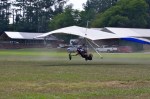
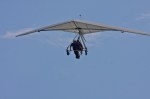
Later that afternoon, we went for a tandem ride, each of us gliding with an instructor.  Being sympathetic to beginners, Lookout Mountain uses ultralight airplanes to tow tandem rides from the ground rather than having us run off the cliff together.  Saved from jumping off the cliff!

My instructor, Clayton, checks in to see how I’m doing.  To tell the truth, I’m not sure how I’m doing.  During take off, the glider starts to climb almost immediately, but there are a lot of jerks and bumps while being towed.  Watching the plane in front of us bumping up and down in the turbulence creates visions of horrible crashes in my mind.  I keep reminding myself that a glider is forgiving and there is plenty of room for recovery.

After detaching from the tow plane, we soar above the valley.  When you look out the window of an airliner, you don’t think about the experience of the wings.  Today, I am strapped to the wings–exhilaration and a small beep of terror compete for my attention as the air rushes around me.  Clayton finds a thermal and we circle our way up to nearly 3600 feet.  I’ve been in helicopters and a sailplane, but neither provides the view from a hang glider.  There is nothing between you and the ground.  I wonder how an eagle spots a fish.  I imagine spotting a fish and diving towards the earth with the assuredness of being born for flight.  I experience “eagleness” for a brief moment.

But the moments of exhilaration are clouded with fear.  I feel the tension in my body that indicates adrenaline is flowing.  I cannot relax although I try.  When I do relax for a moment, the glider bumps in an invisible shift of rising and sinking air and I am tense all over again.  I wonder how anyone can feel secure suspended from a giant kite?  I wonder why I am there.  Then, I return to that moment.  That instant of soaring above the earth experiencing lift and rushing air and the endless view.  There is no wondering and no fear when I am no where else in my head.  When I am mentally where I am physically, I am simply there.  No thoughts of crashing, no thoughts of falling, no thoughts of any kind.  I breathe in and I enjoy.

Just a few things

There is nothing like moving to make you think about things.  And I mean that in the most literal of ways.  I pick up each thing I own, examine it, think about the last time I used it,  think about whether that thing is worth the trouble of packing, lifting, carrying, and placing back in my life at the next location.  When I add into the mix a reduction of space by 1/2, I scrutinize even more carefully.  Is this thing worth my time and energy?  Where will I put it in my new place?  Is this something I will be able to find and use?  Is it something I will replace if I don’t have it?  I never cease to be amazed at the number of things that have found a place in my home that have turned out to be a drain on my energy.

Having purchased our last house from my father, we inherited all the things that he didn’t want in his life anymore.  This included things from four grandparents, my mother, and my aunt–the leavings from their lives that I felt like I should be emotionally attached to.  But none of those things were them. Detaching objects from people was a mandatory step in reducing our burden when moving from our house last year.  Now, we have reduced our space again by half, requiring yet another reduction.

Digital photography is a great tool for dealing with balancing emotional attachment and physical space.  Pictures of the things that represented something important take up only virtual space.  This method, suggested by my brother, has allowed me to unload things I don’t know what to do with ranging from trophies to family heirlooms.  Take a picture, sell or donate the item, move on.  Interestingly, I don’t find myself looking at the pictures of these objects when I want to remember the people and experiences that went with them; I just remember.

Harder for me is balancing reduction and waste.  I hate getting rid of an object that I spent money on that I don’t feel I’ve gotten my money’s worth out of yet. Likewise, I hate to get rid of something I might use.  Clothes are hard for this reason.  I seem to always end up with items I consider expensive that hang in my closet far more than on my body.  I decided that I should get my wardrobe down to 7 outfits for each season.  Then, I won’t need much space and I will save time deciding what to wear.  Unfortunately, that hasn’t been too practical.  I have a wardrobe for work, hanging out, going out, working out, biking, hiking, skiing, and yoga.  I have highly technical clothing for virtually every weather possibility.  These are practical clothes that I use to death, but it’s a slow death.  Now that I work from home, my work clothes will be needed about as often as my ski pants.  Being prepared and being a nomad don’t seem to fit well together.

I think about a book I once read called Your Money or Your Life.  It talked a lot about the concept of “enoughness.”  The stats show that there is an optimal state of wealth, and it’s not what we think of as wealth.  Once you have food, shelter, and clothing, your happiness maximizes at some minimal level of comfort beyond that point and then the stress of maintaining things causes your happiness to decline.  The trick is that there is no formula for determining what your personal level of eoughness is.  I, for one, cannot imagine life without my iPad or iPhone.  Yet, was I less happy before they existed?  It’s a slippery slope.  I introduce something new into my life and it takes hold, becomes part of what I do each day, and I cannot imagine giving it up.  Yet there is a cost to all of these things–even those that don’t require a data plan.  Clothes have to be cleaned, put away, decided upon.  Pictures have to be arranged, hung, dusted.  Collectibles have to be maintained, safe-guarded, cared-for.

I wonder if I should start a website where people can trade homes not for vacations, but for cleaning out the clutter?  If someone else came into my home and made the decision for me about what I needed to keep and what I could live without, wouldn’t it be easier for them to decide?  In the meantime, I struggle to find places for the debris of my life that I cannot part with, but don’t have a place for.  I wonder how we’ll reduce what we have to a set of things that we can take with us and how much comfort I am willing to give up in exchange for more space, time, and energy to do what I enjoy?

Getting Started

After struggling to enjoy our mostly mainstream life, the stress and boredom got to us. In 2000, I was working for a company that kicked off the implosion of the telecom industry and realized that depending on a corporate job for a living was not a sure bet. For the next 5 years, I was in a constant state of wondering if my job was going away. This motivated us to systematically eliminate debt, reduce our expenses, build our savings, and think about how we could live without my corporate job. In particular, we wanted to live on the road and really experience North America. RVs are nice, but we’re environmentalists and we couldn’t justify the gas. We imagined a life of living in an area for a few weeks either in a tent or in a cheap hotel and driving on–touring from our Honda mini-van.

However, I haven’t been without some form of income since I was 9 years old and I find I care a lot about my career. As such, living without my corporate job was just a bit too scary of a leap for me; I couldn’t imagine where my identity would come from with no career. But, since the situation I was in really wasn’t a career either, my first step was to find a different job with a growing company that was less depressing than the dying company I was at. This I accomplished at the beginning of 2006.

At the time, we still thought I would have to leave the corporate world all together to live on the road. As we continued to plan for that, we waited for the right time to sell our house. While 2006 would have been a great time to sell in the market, we had 2 English Mastiffs and renting really wasn’t an option. We were content to enjoy our dogs and worry about selling later. Sadly, we lost one in 2008 and the other in 2009. While losing our canine kids was a horrible loss, it did free us up to pursue our plans. Unfortunately, the housing market was in the toilet. However, we managed to sell our house in 2010 during a recovery period. Simultaneously, the company I worked for was being purchased by a much larger corporation. We decided to rent a house and wait things out once more.

As it turned out, the new company has a much more friendly attitude towards working remotely. As a result, we’ve revised our plan to include me keeping my career while we move around. We’re not sure what that means yet, but we decided to start by establishing residency in a state with less tax burden than the one we were in. We now find ourselves with a 6-month lease on a really cool apartment in Chattanooga, TN. So, expect more entries on life from Chattanooga for the next 6 months.

Dianne